

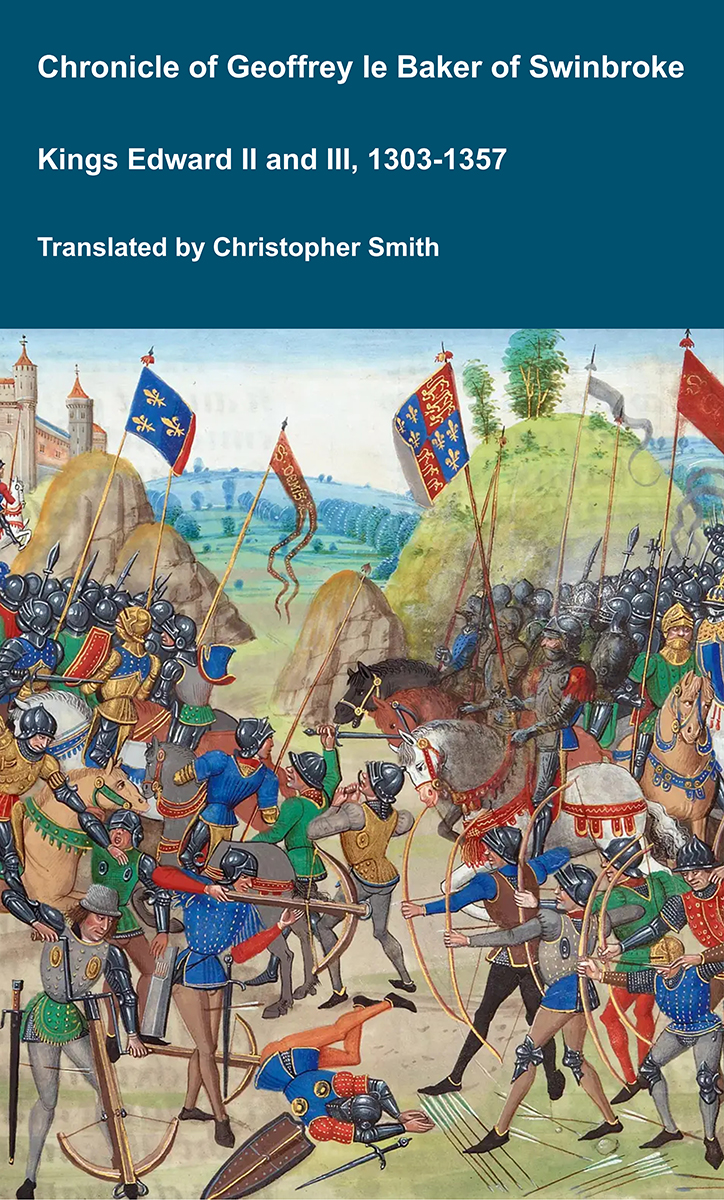
Chronicle of Geoffrey le Baker of Swinbroke
Baker was a secular clerk from Swinbroke, now Swinbrook, an Oxfordshire village two miles east of Burford. His Chronicle describes the events of the period 1303-1356: Gaveston, Bannockburn, Boroughbridge, the murder of King Edward II, the Scottish Wars, Sluys, Crécy, the Black Death, Winchelsea and Poitiers. To quote Herbert Bruce 'it possesses a vigorous and characteristic style, and its value for particular events between 1303 and 1356 has been recognised by its editor and by subsequent writers'. The book provides remarkable detail about the events it describes. Baker's text has been augmented with hundreds of notes, including extracts from other contemporary chronicles, such as the Annales Londonienses, Annales Paulini, Murimuth, Lanercost, Avesbury, Guisborough and Froissart to enrich the reader's understanding. The translation takes as its source the 'Chronicon Galfridi le Baker de Swynebroke' published in 1889, edited by Edward Maunde Thompson.
Available at Amazon in eBook and Paperback format.
Ashville Trading Estate Iron Age Settlement, Abingdon is in Berkshire.
Carbon Date. 1360BC. Late Bronze Age Carbon Dates
Report: grain; from house gully 13, which enclosed an Iron Age structure.
ID: 15036, C14 ID: HAR 1248 Date BP: 3360 +/- 130, Start Date BP: 3490, End BP: 3230
Abstract: Abingdon: Ashville Trading Estate [Map]; 1975-76
Reference Name: Jordan, D, Haddon-Reece, D, Bayliss, A 1994 'Radiocarbon dates: from samples funded by English Heritage and dated before 1981', London: English Heritage
Council for British Archaeology (2012) Archaeological Site Index to Radiocarbon Dates from Great Britain and Ireland [data-set]. York: Archaeology Data Service [distributor] https://doi.org/10.5284/1017767
Carbon Date. 970BC. Early Iron Age Carbon Dates
Report: grain; from ditch 73, enclosing an Iron Age structure.
ID: 15037, C14 ID: HAR 1249 Date BP: 2970 +/- 80, Start Date BP: 3050, End BP: 2890
Abstract: Abingdon: Ashville Trading Estate [Map]; 1975-76
Reference Name: Jordan, D, Haddon-Reece, D, Bayliss, A 1994 'Radiocarbon dates: from samples funded by English Heritage and dated before 1981', London: English Heritage
Council for British Archaeology (2012) Archaeological Site Index to Radiocarbon Dates from Great Britain and Ireland [data-set]. York: Archaeology Data Service [distributor] https://doi.org/10.5284/1017767
Carbon Date. 970BC. Early Iron Age Carbon Dates
Report: Carbonised grain and charcoal from Feature 73, ditch at Ashville Trading Estate [Map], Abingdon, Oxfordshire, England.
ID: 150, C14 ID: HAR-1249 Date BP: 2970 +/- 80, Start Date BP: 2890, End BP: 3050
OS Letter: SU, OS East: 483, OS North: 973
Archaeologist Name: M Parrington
Reference Name: Counc Brit Archaeol Res Rep, 28, 1978, 39
Council for British Archaeology (2012) Archaeological Site Index to Radiocarbon Dates from Great Britain and Ireland [data-set]. York: Archaeology Data Service [distributor] https://doi.org/10.5284/1017767
Carbon Date. 470BC. Middle Iron Age Carbon Dates
Report: grain; from pit 60 (Iron Age).
ID: 15035, C14 ID: HAR 1247 Date BP: 2470 +/- 70, Start Date BP: 2540, End BP: 2400
Abstract: Abingdon: Ashville Trading Estate [Map]; 1975-76
Reference Name: Jordan, D, Haddon-Reece, D, Bayliss, A 1994 'Radiocarbon dates: from samples funded by English Heritage and dated before 1981', London: English Heritage
Council for British Archaeology (2012) Archaeological Site Index to Radiocarbon Dates from Great Britain and Ireland [data-set]. York: Archaeology Data Service [distributor] https://doi.org/10.5284/1017767
Carbon Date. 470BC. Middle Iron Age Carbon Dates
Report: Carbonised grain and charcoal from Feature 60, pit at Ashville Trading Estate [Map], Abingdon, Oxfordshire, England.
ID: 151, C14 ID: HAR-1247 Date BP: 2470 +/- 70, Start Date BP: 2400, End BP: 2540
OS Letter: SU, OS East: 483, OS North: 973
Archaeologist Name: M Parrington
Reference Name: Counc Brit Archaeol Res Rep, 28, 1978, 39
Council for British Archaeology (2012) Archaeological Site Index to Radiocarbon Dates from Great Britain and Ireland [data-set]. York: Archaeology Data Service [distributor] https://doi.org/10.5284/1017767
Carbon Date. 170BC. Middle Iron Age Carbon Dates
Report: grain; from pit 37 which was Iron Age and the earliest stratigraphic feature on the site, cut by feature 13 (HAR-1248 and HAR-1333).
ID: 15034, C14 ID: HAR 1100 Date BP: 2170 +/- 70, Start Date BP: 2240, End BP: 2100
Abstract: Abingdon: Ashville Trading Estate [Map]; 1975-76
Reference Name: Jordan, D, Haddon-Reece, D, Bayliss, A 1994 'Radiocarbon dates: from samples funded by English Heritage and dated before 1981', London: English Heritage
Council for British Archaeology (2012) Archaeological Site Index to Radiocarbon Dates from Great Britain and Ireland [data-set]. York: Archaeology Data Service [distributor] https://doi.org/10.5284/1017767
Carbon Date. 170BC. Middle Iron Age Carbon Dates
Report: Carbonised grain from Feature 37, pit at Ashville Trading Estate [Map], Abingdon, Oxfordshire, England.
ID: 152, C14 ID: HAR-1100 Date BP: 2170 +/- 70, Start Date BP: 2100, End BP: 2240
OS Letter: SU, OS East: 483, OS North: 973
Archaeologist Name: M Parrington
Reference Name: Counc Brit Archaeol Res Rep, 28, 1978, 39
Council for British Archaeology (2012) Archaeological Site Index to Radiocarbon Dates from Great Britain and Ireland [data-set]. York: Archaeology Data Service [distributor] https://doi.org/10.5284/1017767
Carbon Date. 50BC. Middle Iron Age Carbon Dates
Report: animal bone; from ditch 32 (Iron Age).
ID: 15038, C14 ID: HAR 1332 Date BP: 2050 +/- 70, Start Date BP: 2120, End BP: 1980
Abstract: Abingdon: Ashville Trading Estate [Map]; 1975-76
Reference Name: Jordan, D, Haddon-Reece, D, Bayliss, A 1994 'Radiocarbon dates: from samples funded by English Heritage and dated before 1981', London: English Heritage
Council for British Archaeology (2012) Archaeological Site Index to Radiocarbon Dates from Great Britain and Ireland [data-set]. York: Archaeology Data Service [distributor] https://doi.org/10.5284/1017767
Carbon Date. 50BC. Middle Iron Age Carbon Dates
Report: Animal bone from Feature 32, house gully at Ashville Trading Estate [Map], Abingdon, Oxfordshire, England.
ID: 153, C14 ID: HAR-1332 Date BP: 2050 +/- 70, Start Date BP: 1980, End BP: 2120
OS Letter: SU, OS East: 483, OS North: 973
Archaeologist Name: M Parrington
Reference Name: Counc Brit Archaeol Res Rep, 28, 1978, 39
Council for British Archaeology (2012) Archaeological Site Index to Radiocarbon Dates from Great Britain and Ireland [data-set]. York: Archaeology Data Service [distributor] https://doi.org/10.5284/1017767
Carbon Date. 100. Late Iron Age Carbon Dates
Report: Animal bone from Feature 392, ditch at Ashville Trading Estate [Map], Abingdon, Oxfordshire, England.
ID: 154, C14 ID: HAR-1334 Date BP: 1900 +/- 90, Start Date BP: 1810, End BP: 1990
OS Letter: SU, OS East: 483, OS North: 973
Archaeologist Name: M Parrington
Reference Name: Counc Brit Archaeol Res Rep, 28, 1978, 39
Council for British Archaeology (2012) Archaeological Site Index to Radiocarbon Dates from Great Britain and Ireland [data-set]. York: Archaeology Data Service [distributor] https://doi.org/10.5284/1017767
Chronicle of Geoffrey le Baker of Swinbroke
Baker was a secular clerk from Swinbroke, now Swinbrook, an Oxfordshire village two miles east of Burford. His Chronicle describes the events of the period 1303-1356: Gaveston, Bannockburn, Boroughbridge, the murder of King Edward II, the Scottish Wars, Sluys, Crécy, the Black Death, Winchelsea and Poitiers. To quote Herbert Bruce 'it possesses a vigorous and characteristic style, and its value for particular events between 1303 and 1356 has been recognised by its editor and by subsequent writers'. The book provides remarkable detail about the events it describes. Baker's text has been augmented with hundreds of notes, including extracts from other contemporary chronicles, such as the Annales Londonienses, Annales Paulini, Murimuth, Lanercost, Avesbury, Guisborough and Froissart to enrich the reader's understanding. The translation takes as its source the 'Chronicon Galfridi le Baker de Swynebroke' published in 1889, edited by Edward Maunde Thompson.
Available at Amazon in eBook and Paperback format.
Carbon Date. 100. Late Iron Age Carbon Dates
Report: animal bone; from Iron Age ditch 392, which is stratigraphically later than house gully 13 (HAR-1248 and HAR-1333).
ID: 15040, C14 ID: HAR 1334 Date BP: 1900 +/- 90, Start Date BP: 1990, End BP: 1810
Abstract: Abingdon: Ashville Trading Estate [Map]; 1975-76
Reference Name: Jordan, D, Haddon-Reece, D, Bayliss, A 1994 'Radiocarbon dates: from samples funded by English Heritage and dated before 1981', London: English Heritage
Council for British Archaeology (2012) Archaeological Site Index to Radiocarbon Dates from Great Britain and Ireland [data-set]. York: Archaeology Data Service [distributor] https://doi.org/10.5284/1017767
Carbon Date. 130. Late Iron Age Carbon Dates
Report: Animal bone from Feature 13A, house gully at Ashville Trading Estate [Map], Abingdon, Oxfordshire, England.
ID: 155, C14 ID: HAR-1333 Date BP: 1870 +/- 80, Start Date BP: 1790, End BP: 1950
OS Letter: SU, OS East: 483, OS North: 973
Archaeologist Name: M Parrington
Reference Name: Counc Brit Archaeol Res Rep, 28, 1978, 39
Council for British Archaeology (2012) Archaeological Site Index to Radiocarbon Dates from Great Britain and Ireland [data-set]. York: Archaeology Data Service [distributor] https://doi.org/10.5284/1017767
Carbon Date. 130. Late Iron Age Carbon Dates
Report: animal bone; from house gully 13 (sample submitted as a check on HAR-1248); this feature cuts pit 37 (HAR-1100), but is stratigraphically earlier than ditch 392 (HAR-1334).
ID: 15039, C14 ID: HAR 1333 Date BP: 1870 +/- 80, Start Date BP: 1950, End BP: 1790
Abstract: Abingdon: Ashville Trading Estate [Map]; 1975-76
Reference Name: Jordan, D, Haddon-Reece, D, Bayliss, A 1994 'Radiocarbon dates: from samples funded by English Heritage and dated before 1981', London: English Heritage
Council for British Archaeology (2012) Archaeological Site Index to Radiocarbon Dates from Great Britain and Ireland [data-set]. York: Archaeology Data Service [distributor] https://doi.org/10.5284/1017767
On 26th October 1878 Theresa Stourton Baroness Arundel Wardour [aged 66] died at North Court House, Abingdon.
On 20th November 1174 Archbishop Edmund Rich was born at St Edmund's Lane, Abingdon.