

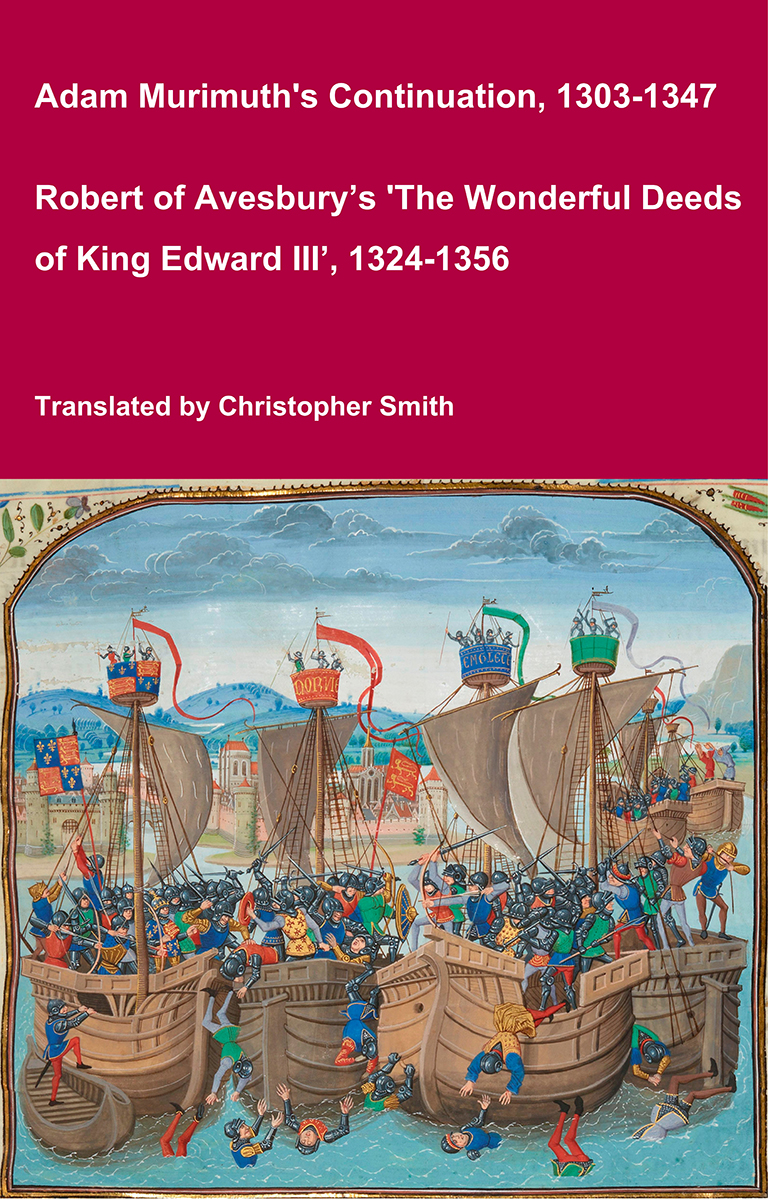
Adam Murimuth's Continuation and Robert of Avesbury’s 'The Wonderful Deeds of King Edward III'
This volume brings together two of the most important contemporary chronicles for the reign of Edward III and the opening phases of the Hundred Years’ War. Written in Latin by English clerical observers, these texts provide a vivid and authoritative window into the political, diplomatic, and military history of fourteenth-century England and its continental ambitions. Adam Murimuth Continuatio's Chronicarum continues an earlier chronicle into the mid-fourteenth century, offering concise but valuable notices on royal policy, foreign relations, and ecclesiastical affairs. Its annalistic structure makes it especially useful for establishing chronology and tracing the development of events year by year. Complementing it, Robert of Avesbury’s De gestis mirabilibus regis Edwardi tertii is a rich documentary chronicle preserving letters, treaties, and official records alongside narrative passages. It is an indispensable source for understanding Edward III’s claim to the French crown, the conduct of war, and the mechanisms of medieval diplomacy. Together, these works offer scholars, students, and enthusiasts a reliable and unembellished account of a transformative period in English and European history. Essential for anyone interested in medieval chronicles, the Hundred Years’ War, or the reign of Edward III.
Available at Amazon in eBook and Paperback format.
Croydon, Surrey is in Surrey.
Close Rolls Edward II 1307-1313. 9th February 1308 King Edward II of England [aged 23]. Dover, Kent [Map]. To Alice, late wife of Roger Bigod, Earl of Norfolk and Marshall of England. Order to meet the king at Dover, Kent [Map] on his return from France with his consort about Sunday next after the Feast of the Purification of St Mary. Witnessed by Piers Gaveston 1st Earl Cornwall [aged 24].
The like to:
Elizabeth, Countess of Hereford and Essex [aged 25].
Henry de Lancastre [aged 27].
Robert de Monte Alto.
Almaric de Sancto Amando[Ibid].
To R Archbishop of Canterbury [aged 63]. Order to attend the king's coronaion on Sunday next after the feast of St Valentine [14 Feb] at Westminster [Map], to execute what pertains to his office.
To the Sheriff of Surrey. Order to proclaim in market towns, etc., that no knight, esquire, or other shall, under pain of forfeiture, pressure to tourney or make jousts or bordices (torneare, justos seu burdseicas facere), or otherwise go armed at Croydon, Surrey [Map] or elsewhere before the king's coronation.
Diary of Edward VI. 24th May 1551. An earthquake was at Croidon [Map] and Blechingliee [Map], and in the most part of Surrey, but no harme was donne.
On 2nd September 1600 William aka Francis Howard [aged 60] died at Croydon, Surrey [Map].
On 10th November 1631 Daniel Harvey was born to Daniel Harvey [aged 44] at Croydon, Surrey [Map]. He married 1651 Elizabeth Montagu, daughter of Edward Montagu 2nd Baron Montagu and Anne Winwood, and had issue.
John Evelyn's Diary. 29th September 1695. Very cold weather. Sir Purbeck Temple, uncle to my son Draper, died suddenly. A great funeral at Addiscombe. His lady being own aunt to my son Draper, he hopes for a good fortune, there being no heir. There had been a new meeting of the commissioners about Greenwich Hospital [Map], on the new commission, where the Lord Mayor, etc. appeared, but I was prevented by indisposition from attending. The weather very sharp, winter approaching apace. The King [aged 44] went a progress into the north, to show himself to the people against the elections, and was everywhere complimented, except at Oxford, Oxfordshire [Map], where it was not as he expected, so that he hardly stopped an hour there, and having seen the theater, did not receive the banquet proposed. I dined with Dr. Gale [aged 60] at St. Paul's school, who showed me many curious passages out of some ancient Platonists' MSS. concerning the Trinity, which this great and learned person would publish, with many other rare things, if he was encouraged, and eased of the burden of teaching.


John Evelyn's Diary. 13th March 1700. I was at the funeral of my Lady Temple, who was buried at Islington [Map], brought from Addiscombe, near Croydon. She left my son-in-law Draper (her nephew) the mansion house of Addiscombe, very nobly and completely furnished, with the estate about it, with plate and jewels, to the value in all of about £20,000. She was a very prudent lady, gave many great legacies, with £500 to the poor of Islington [Map], where her husband, Sir Purbeck Temple, was buried, both dying without issue.
John Evelyn's Diary. 27th June 1702. I went to Wotton, Surrey [Map] with my family for the rest of the summer, and my son-in-law, Draper, with his family, came to stay with us, his house at Addiscombe being new-building, so that my family was above thirty. Most of the new Parliament were chosen of Church of England principles, against the peevish party. The Queen [aged 37] was magnificently entertained at Oxford and all the towns she passed through on her way to Bath, Somerset [Map].


John Evelyn's Diary. 11th July 1703. I went to Addiscombe, sixteen miles from Wotton, to see my son-in-law's new house, the outside, to the coving, being such excellent brickwork, based with Portland stone, with the pilasters, windows, and within, that I pronounced it in all the points of good and solid architecture to be one of the very best gentlemen's houses in Surrey, when finished. I returned to Wotton in the evening, though weary.
Croydon Minster is also in Minsters in England.

On 23rd March 1757 Archbishop Thomas Herring [aged 64] died. He was buried in Croydon Minster [Map].
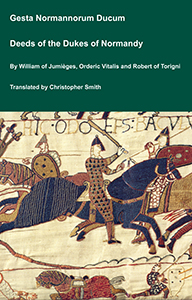
The Deeds of the Dukes of Normandy
The Gesta Normannorum Ducum [The Deeds of the Dukes of Normandy] is a landmark medieval chronicle tracing the rise and fall of the Norman dynasty from its early roots through the pivotal events surrounding the Norman Conquest of England. Originally penned in Latin by the monk William of Jumièges shortly before 1060 and later expanded at the behest of William the Conqueror, the work chronicles the deeds, politics, battles, and leadership of the Norman dukes, especially William’s own claim to the English throne. The narrative combines earlier historical sources with firsthand information and oral testimony to present an authoritative account of Normandy’s transformation from a Viking settlement into one of medieval Europe’s most powerful realms. William’s history emphasizes the legitimacy, military prowess, and governance of the Norman line, framing their expansion, including the conquest of England, as both divinely sanctioned and noble in purpose. Later chroniclers such as Orderic Vitalis and Robert of Torigni continued the history, extending the coverage into the 12th century, providing broader context on ducal rule and its impact. Today this classic work remains a foundational source for understanding Norman identity, medieval statesmanship, and the historical forces that reshaped England and Western Europe between 800AD and 1100AD.
Available at Amazon in eBook and Paperback format.

On 25th November 1718 Elizabeth Tulse [aged 57] died at Croydon Palace.
On 21st October 1585 Francis Howard was born to William aka Francis Howard [aged 45] and Frances Gouldwell [aged 32] at Halling House. He married 4th July 1604 Jane Monson and had issue.