

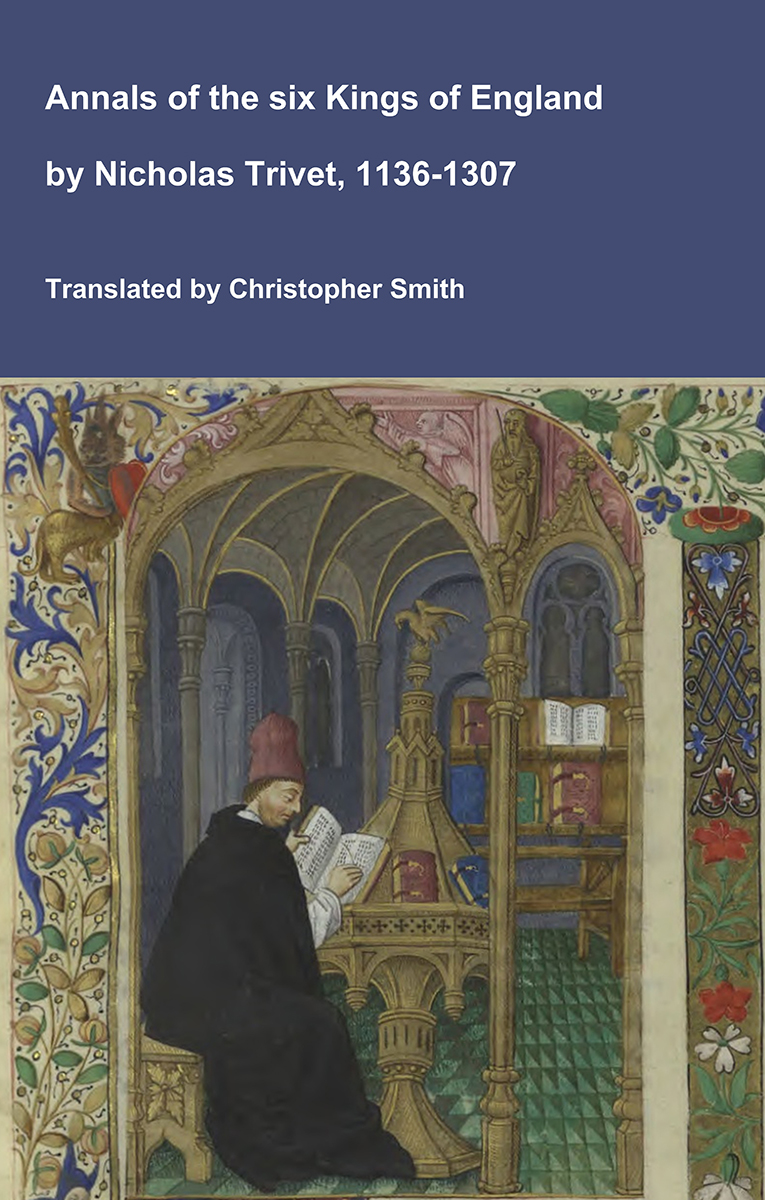
Annals of the six Kings of England by Nicholas Trivet
Translation of the Annals of the Six Kings of England by that traces the rise and rule of the Angevin aka Plantagenet dynasty from the mid-12th to early 14th century. Written by the Dominican scholar Nicholas Trivet, the work offers a vivid account of English history from the reign of King Stephen through to the death of King Edward I, blending political narrative with moral reflection. Covering the reigns of six monarchs—from Stephen to Edward I—the chronicle explores royal authority, rebellion, war, and the shifting balance between crown, church, and nobility. Trivet provides detailed insight into defining moments such as baronial conflicts, Anglo-French rivalry, and the consolidation of royal power under Edward I, whose reign he describes with particular immediacy. The Annals combines careful year-by-year reporting with thoughtful interpretation, presenting history not merely as a sequence of events but as a moral and political lesson. Ideal for readers interested in medieval history, kingship, and the origins of the English state, this chronicle remains a valuable and accessible window into the turbulent world of the Plantagenet kings.
Available at Amazon in eBook and Paperback format.
Jersey is in Channel Islands [Map].
Around 1168 Philip de Albini was born to William Meschines Brito de Albini [aged 38] and Maud de Clare [aged 36] at Jersey.

In 1533 Henry Ughtred was born to Anthony Ughtred [aged 55] and Elizabeth Seymour Baroness Cromwell Oakham [aged 15] at Jersey. He married before 4th November 1576 his sixth cousin Elizabeth Paulett Countess Devon, daughter of John Paulet 2nd Marquess Winchester and Elizabeth Willoughby.
On 6th October 1534 Anthony Ughtred [aged 56] died at Jersey. He was buried at Mont Orgueil Chapel, Jersey.
Around April 1646 King Charles II of England Scotland and Ireland [aged 15] travelled to Jersey.


In September 1649 King Charles II of England Scotland and Ireland [aged 19] travelled to Jersey.
In 1988 Frederick William John Augustus Hervey 7th Marquess of Bristol [aged 33] was imprisoned for a year in Jersey for cocaine possession and trafficking. He served seven months of the sentence and was released in April 1989.
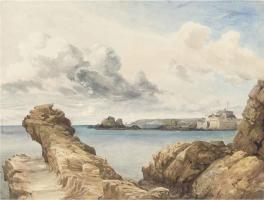
After 1837 James Bridges [aged 35]. "Elizabeth Castle from the rocks, and two rocky costal scenes". First inscribed "The Hermitage and the Rocks, where Cattle Vessell of France was wrecked about 1837 near here" and further inscribed "Old Landing Place Jersey by James Bridges".
In 1738 Frances Carteret [aged 80] died at Grouville Jersey.
La Hogue Bie is also in Prehistoric Channel Islands.
Archaeologia Volume 8 Section XXXV. Description of a Druidical Monument [La Hogue Bie [Map]] in the Island of Jersey; in a Letter from the Right Honourable Henry Seymour. Conway [aged 63], Governor of Jersey, to the Earl of Leicester, P. S. A. Read March 8, 1787.

Archaeologia Volume 8 Section XXXIV. Description of the Druid Temple [La Hogue Bie [Map]] lately discovered on the top of the Hill near St. Hillary in Jersey. Communicated by Mr. Molseworth. Read January 11, 1787.
On 18th May 1961 Norman Victor Lacey Rybot [aged 85] died at the Jersey General Hospital.
La Moye aka Quesnel Menhir is also in Prehistoric Channel Islands.
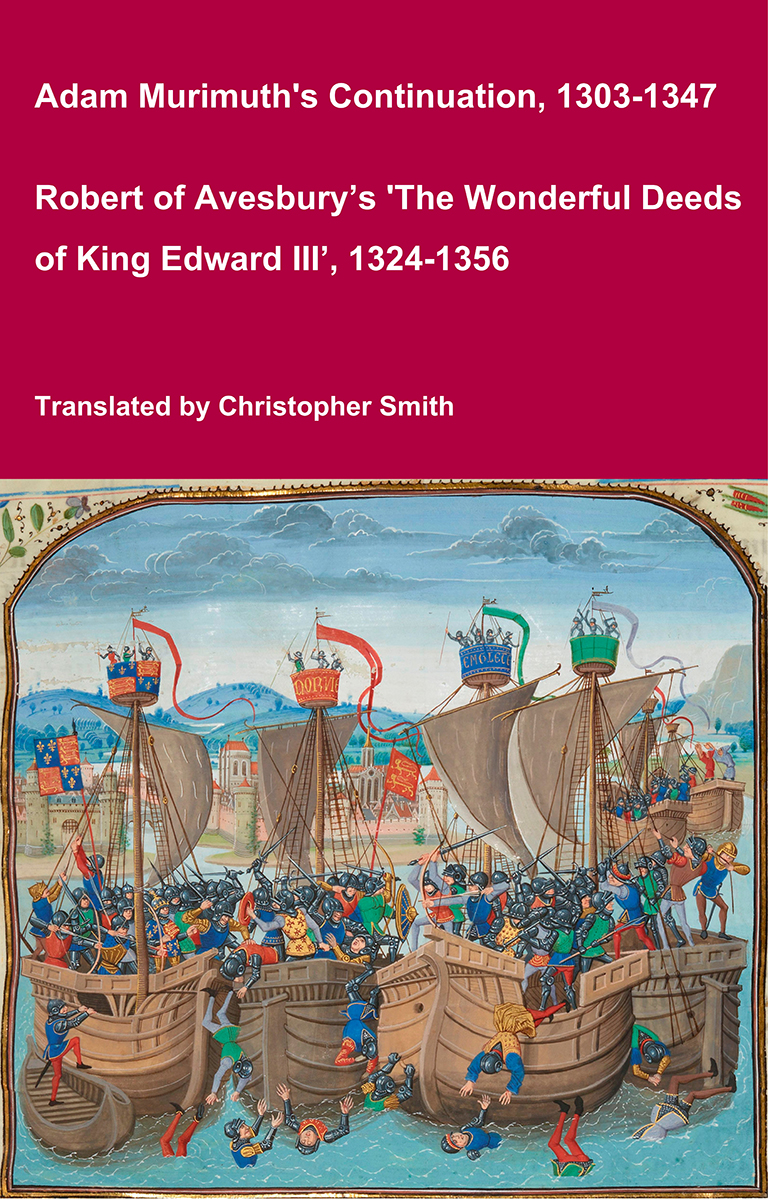
Adam Murimuth's Continuation and Robert of Avesbury’s 'The Wonderful Deeds of King Edward III'
This volume brings together two of the most important contemporary chronicles for the reign of Edward III and the opening phases of the Hundred Years’ War. Written in Latin by English clerical observers, these texts provide a vivid and authoritative window into the political, diplomatic, and military history of fourteenth-century England and its continental ambitions. Adam Murimuth Continuatio's Chronicarum continues an earlier chronicle into the mid-fourteenth century, offering concise but valuable notices on royal policy, foreign relations, and ecclesiastical affairs. Its annalistic structure makes it especially useful for establishing chronology and tracing the development of events year by year. Complementing it, Robert of Avesbury’s De gestis mirabilibus regis Edwardi tertii is a rich documentary chronicle preserving letters, treaties, and official records alongside narrative passages. It is an indispensable source for understanding Edward III’s claim to the French crown, the conduct of war, and the mechanisms of medieval diplomacy. Together, these works offer scholars, students, and enthusiasts a reliable and unembellished account of a transformative period in English and European history. Essential for anyone interested in medieval chronicles, the Hundred Years’ War, or the reign of Edward III.
Available at Amazon in eBook and Paperback format.
In 1639 Philip Carteret was born to Helier Carteret [aged 20] at Manoir de la Hougue, Jersey.

Samuel Pepys' Diary. 24th June 1663. We did talk highly of Sir W. Batten's [aged 62] corruption, which Mr. Coventry [aged 35] did very kindly say that it might be only his heaviness and unaptness for business, that he do things without advice and rashly, and to gratify people that do eat and drink and play with him, and that now and then he observes that he signs bills only in anger and fury to be rid of men. Speaking of Sir G. Carteret [aged 53], of whom I perceive he speaks but slightly, and diminishing of him in his services for the King [aged 33] in Jersey; that he was well rewarded, and had good lands and rents, and other profits from the King, all the time he was there; and that it was always his humour to have things done his way. He brought an example how he would not let the Castle there be victualled for more than a month, that so he might keep it at his beck, though the people of the town did offer to supply it more often themselves, which, when one did propose to the King, Sir George Carteret being by, says Sir George, "Let me know who they are that would do it, I would with all my heart pay them". "Ah, by God", says the Commander that spoke of it, "that is it that they are afeard of, that you would hug them", meaning that he would not endure them. Another thing he told me, how the Duke of York [aged 29] did give Sir G. Carteret and the Island his profits as Admirall, and other things, toward the building of a pier there. But it was never laid out, nor like to be. So it falling out that a lady being brought to bed, the Duke was to be desired to be one of the godfathers; and it being objected that that would not be proper, there being no peer of the land to be joyned with him, the lady replied, "Why, let him choose; and if he will not be a godfather without a peer, then let him even stay till he hath made a pier of his own1".
Note 1. In the same spirit, long after this, some question arising as to the best material to be used in building Westminster Bridge, Lord Chesterfield [aged 29] remarked, that there were too many wooden piers (peers) at Westminster already. B.
In 1666 Hardress Waller [aged 62] died at Mont Orgueil, Jersey.
On 6th October 1534 Anthony Ughtred [aged 56] died at Jersey. He was buried at Mont Orgueil Chapel, Jersey.
In 1593 Helier Carteret died at St Brelade Jersey.
Le Mont Ubé is also in Prehistoric Channel Islands.
Le Mont Ubé [Map] was discovered in 1848 by workmen quarrying for stone. The passge leads into bottle shaped chamber that used to have four internal compartments each blocked with low stone slabs. The capstones were taken as well as all but one of the internal compartments. Within the passage stand three stones that may also have had a low sill at some time. These were later used to block of the passage so it could be used as a pigsty. Finds recovered from the workmens spoil heaps included 10 or 12 pots, a Jersey bowl, vase supports, flint and stone tools, stone axes, polished stone pendants and a grape cup (unique to the Channel Islands). Burnt and unburnt human remains were noted in the cists.
Quarterly Journal of Science 1870 I. The cromlech of Mont Ubé [Map], although devoid of its capstones, is still most instructive, being remarkable for the regularity of its form, which exhibits the original plan of the (Celtic?) architects, perhaps more perfectly than any other cromlech in the Channel Islands. This cromlech is more fully imbedded in the soil than the denuded remains of the Pocquelaye and Le Couperon, which may tend to its ultimate preservation. It consists of a large western chamber elongated towards the orientated narrowed passage, and is divided into several chambers. Two of the upright stone pillars which separate the cists have been worked into somewhat obelisk-like forms, perhaps to adapt them for the reception of an imposed capstone. It is much to be regretted that several important stones have been removed from this cromlech.
Around 1509 Margaret Carteret was born to Helier Carteret [aged 22] at Samarès St Clement Jersey. She married her first cousin Helier Carteret and had issue.
In 1609 Margaret Carteret died at Samarès St Clement Jersey.
Adam Murimuth's Continuation and Robert of Avesbury’s 'The Wonderful Deeds of King Edward III'
This volume brings together two of the most important contemporary chronicles for the reign of Edward III and the opening phases of the Hundred Years’ War. Written in Latin by English clerical observers, these texts provide a vivid and authoritative window into the political, diplomatic, and military history of fourteenth-century England and its continental ambitions. Adam Murimuth Continuatio's Chronicarum continues an earlier chronicle into the mid-fourteenth century, offering concise but valuable notices on royal policy, foreign relations, and ecclesiastical affairs. Its annalistic structure makes it especially useful for establishing chronology and tracing the development of events year by year. Complementing it, Robert of Avesbury’s De gestis mirabilibus regis Edwardi tertii is a rich documentary chronicle preserving letters, treaties, and official records alongside narrative passages. It is an indispensable source for understanding Edward III’s claim to the French crown, the conduct of war, and the mechanisms of medieval diplomacy. Together, these works offer scholars, students, and enthusiasts a reliable and unembellished account of a transformative period in English and European history. Essential for anyone interested in medieval chronicles, the Hundred Years’ War, or the reign of Edward III.
Available at Amazon in eBook and Paperback format.
On 17th February 1649 George Carteret 1st Baronet [aged 39] at St Helier, Jersey [Map] had Charles II [aged 18] proclaimed King after his father Charles I was executed; an act that Charles II never forgot.
Before 27th April 1899 Adelbert Salusbury Cockayne-Cust 5th Baron Brownlow [aged 31] and Maud Buckle Baroness Brownlow [aged 28] were married at St Helier, Jersey [Map].
Ville-ès-Nouaux Burial is also in Prehistoric Channel Islands.
Ville-ès-Nouaux is a gallery tomb, 5.8 meters long, with a south facing entrance, and a dolmen surrounded by a stone circle. Inside, ceramic vessels were found, including goblets and bowls, as well as an archery plate
La Pouquelaye de Faldouet is also in Prehistoric Channel Islands.
Around 4000BC. La Pouquelaye de Faldouet [Map] is a Neolithic passage grave that leads onto a unique double chamber covered by a 24 ton cpastone.
The primary chamber is open and is surrounded by a series of small stone cists (boxes), while the end chamber is capped by a massive 24-ton stone. Originally, the entire site was encircled by a low mound, with two drystone walls and a ring of upright stones. Within the cists, archaeologists discovered human remains. The chamber yielded an array of artifacts, including pottery vessels, polished stone axes, and stone pendants.
Quarterly Journal of Science 1870 I. The most important of the Jersey cromlechs is undoubtedly that one named the "Pocquelaye [Map]," near Gorey Harbour, Jersey; the only visible portion twenty years ago was the largest capstone, the sustaining props and other stones being entirely hidden beneath the remains of the tumulus. About the year 1848 excavations were made by Mr. Fauvel, and it was then discovered that this large stone formed the covering of a chamber of nine side blocks arranged in a horse-shoe form, whilst this chamber was again divided by partition-stones forming a smaller kist, a separate grave as it were, within a tomb. Further excavations were made, and five or six more chambers were discovered to the eastward of the first-mentioned. One chamber alone on the north side had a capstone in situ; this capstone was thrown down by the treasure- seeking proprietor, but is now restored as nearly as possible to its original position. Other blocks of stone were also thrown down at the same time, but have been replaced; great doubt unfortunately must always attach to any attempted restorations of such structures. Remains were found, but unfortunately no proper records of their position in the catacomb exist, whilst the pottery, relics, and stone implements associated with the human skeletons were sold to the British Museum, where they now are.
The narrow eastern gallery is well exhibited in this example, as also the remains of a double circular stone wall not dissimilar to that at L'Ancresse [Map], but if anything of a larger diameter. Four upright stones now standing between these stone walls may have formed a portion of a peristalith, but unhappily there is a want of trustworthy evidence as to their really being in situ, as the walls and remains generally have been meddled with to such an extent that it is well-nigh impossible to separate the modern restoration from the original design.
Le Couperon is also in Prehistoric Channel Islands.
Le Couperon [Map]. An 8m long, capstoned chamber surrounded by a ring of eighteen curb stones. Originally covered by a long mound what remains today is largely the work of restorers. When first excavated in 1868 the capstones had fallen into the chamber. These stones, including a porthole stone were lifted and placed as capstones. In 1919 the Société Jersiaise removed the porthole stone which had been incorrectly placed as a capstone and moved it to its current position at the eastern end of the chamber. Finds included a few flint flakes and pottery fragments.
Quarterly Journal of Science 1870 I. The Couperon Cromlech [Map] in the same parish as above (St. Martin's) was formerly a gem in its way, being a small stone (Jersey conglomerate) structure of two parallel walls covered with cap-stones, with an oval peristalith surrounding it. Sad to relate, only two capstones were actually in situ, and the other stones scattered; still worse, however, these stones have been rearranged, and the remains cooked up to form a modern restoration of a pre- historic sepulchre. One of the present capstones (the fifth) is manifestly part of an upright which formed half of a partition, as exactly similar hand-worked stones are found forming partitions (to allow of entrance) in the covered allées of Brittany, and have been specially noticed by Mr. Lukis.