

William of Worcester's Chronicle of England
William of Worcester, born around 1415, and died around 1482 was secretary to John Fastolf, the renowned soldier of the Hundred Years War, during which time he collected documents, letters, and wrote a record of events. Following their return to England in 1440 William was witness to major events. Twice in his chronicle he uses the first person: 1. when writing about the murder of Thomas, 7th Baron Scales, in 1460, he writes '… and I saw him lying naked in the cemetery near the porch of the church of St. Mary Overie in Southwark …' and 2. describing King Edward IV's entry into London in 1461 he writes '… proclaimed that all the people themselves were to recognize and acknowledge Edward as king. I was present and heard this, and immediately went down with them into the city'. William’s Chronicle is rich in detail. It is the source of much information about the Wars of the Roses, including the term 'Diabolical Marriage' to describe the marriage of Queen Elizabeth Woodville’s brother John’s marriage to Katherine, Dowager Duchess of Norfolk, he aged twenty, she sixty-five or more, and the story about a paper crown being placed in mockery on the severed head of Richard, 3rd Duke of York.
Available at Amazon in eBook and Paperback format.
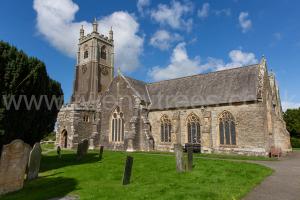
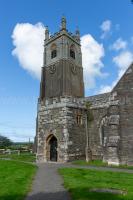
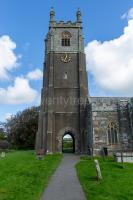
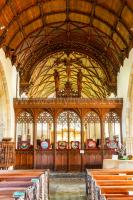
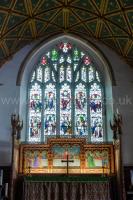
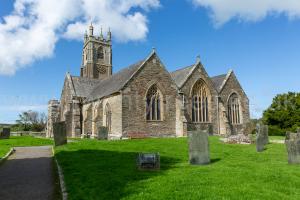
St Columb's Church, St Columb is in St Columb Major, Cornwall.
St Columb's Church, St Columb.
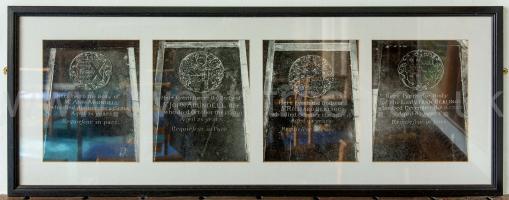
Photographs of the ledger stones at St Columb's Church, St Columb of members of the Arundell and Bellings-Arundell family, left to right: Anne Gage (age 17), John Arundell of Lanherne (age 78), Richard Bellings (age 79) and Frances Arundell (age 41).
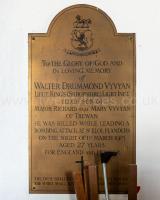
1st March 1915. Memorial at St Columb's Church, St Columb to Walter Drummond Vyvyan, killed on the 1st March 1915. His parents were Richard Walter Comyn Vyvyan and Mary (née Foster). Walter was educated at Clifton College, Bedford Grammar School and RMC Sandhurst from where he was gazetted, in May 1907, to the King's Shropshire Light Infantry. Initially joining the 1st Battalion at Bordon, he was sent to the 2nd Battalion in India in September 1909, being promoted to Lieutenant in March 1910. After returning to England in November 1914, he was sent to France in December and, while his battalion was at Winchester preparing for front-line service, Walter was attached to the Army Cyclists of the 27th Division where he was to command a platoon of bombers. On the night of 1 March 1915, Walter was with his men at the head of an attack made by another battalion on German trenches near St Eloi (just south of Ypres) when he was killed by machine-gun fire. Owing to this fire it proved impossible to recover his body. For this action, Lt. Vyvyan was mentioned in the Dispatches of Sir John French of 31 May 1915 (with the action receiving a mention in the dispatch of 5 April).
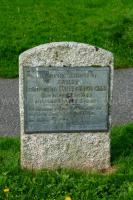
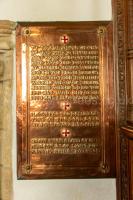
Memorials at St Columb's Church, St Columb.
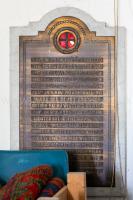
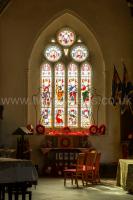
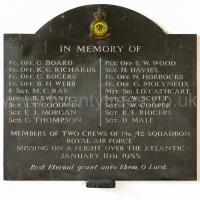
After 11th January 1955. Memorial at St Columb's Church, St Columb. On 11 January 1955, two squadron Shackleton MR.2s (WG531 and WL743) disappeared while operating near Fastnet Rock. Both missing believed to have collided. Eighteen aircrew missing presumed killed. The two Shackletons departed on a routine exercise off Fastnet Rock on the southwest Irish coast. The two maritime patrol aircraft took off from RAF St Eval at 10:14 and 10:20 respectively to carry out search exercises as part of their 15-hour patrol. Radio messages received from the two airplanes through 20:00 that night indicated that they were flying at the prescribed 85 mi (137 km) distance from one another, despite their having departed St. Eval with only six minutes' separation. From 20:58 all contact was lost. A three-day search was conducted, but both aircraft remained missing without a trace, leading to the assumption that there had been a mid-air collision. In 1966, the starboard outer (No. 4) engine of WL743 was recovered about 75 miles north of where authorities had long assumed the collision had occurred.