


The True Chronicles of Jean le Bel Volume 1 Chapters 1-60 1307-1342
The True Chronicles of Jean le Bel offer one of the most vivid and immediate accounts of 14th-century Europe, written by a knight who lived through the events he describes, and experienced some of them first hand. Covering the early decades of the Hundred Years’ War, this remarkable chronicle follows the campaigns of Edward III of England, the politics of France and the Low Countries, and the shifting alliances that shaped medieval warfare. Unlike later historians, Jean le Bel writes with a strong sense of eyewitness authenticity, drawing on personal experience and the testimony of fellow soldiers. His narrative captures not only battles and sieges, but also the realities of military life, diplomacy, and the ideals of chivalry that governed noble society. A key source for Jean Froissart, Le Bel’s chronicle stands on its own as a compelling and insightful work, at once historical record and literary achievement. This translation builds on the 1905 edition published in French by Jules Viard, adding extensive translations from other sources Rymer's Fœdera, the Chronicles of Adam Murimuth, William Nangis, Walter of Guisborough, a Bourgeois of Valenciennes, Geoffrey le Baker of Swinbroke and Richard Lescot to enrich the original text and Viard's notes.
Available at Amazon in eBook and Paperback format.
St James' Church, Didsbury is in Didsbury, Churches in Lancashire.
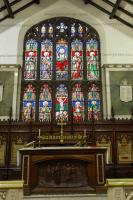
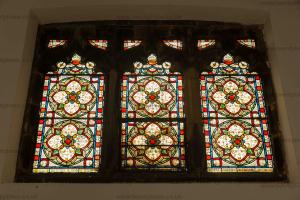
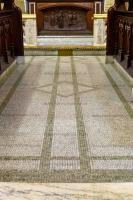
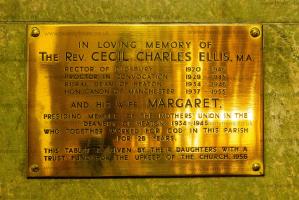
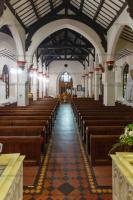
Interior of St James' Church, Didsbury [Map]
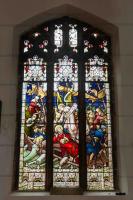
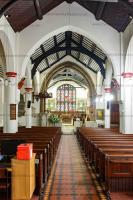
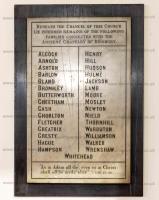
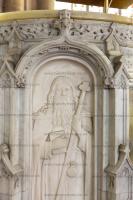
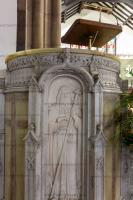
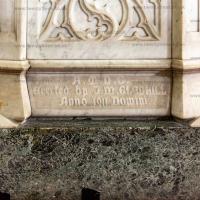
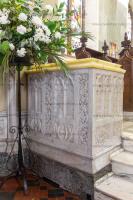
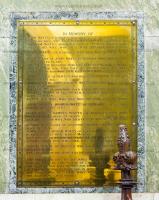
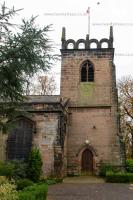
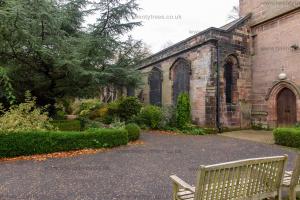
Exterior of St James' Church, Didsbury [Map]
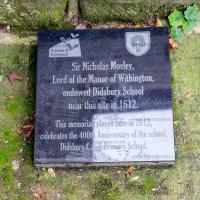
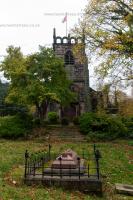
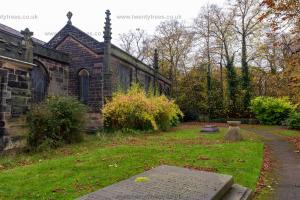
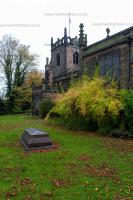
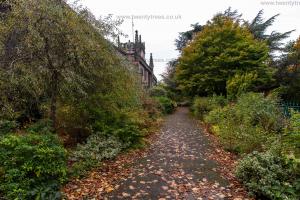
In 1235 Albertus de Gresley granted land to Nicholas de Longford, Lord of the Manor of Withington, for the foundation of his own chapel in Didsbury - St James' Church, Didsbury [Map].
In 1352, the Bishop of Lichfield gave permission for the consecration of a churchyard at St James' Church, Didsbury [Map] for the burial of the victims of the Black Death.
On 12th December 1612 Nicholas Mosley [aged 85] died. His son Edward Mosley [aged 43] inherited parcels of his father's property and £1,450 in cash.
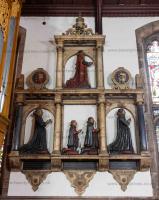
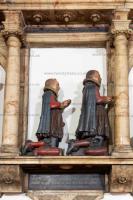
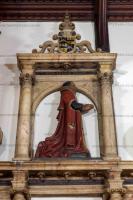
Monument at St James' Church, Didsbury [Map] with Nicholas top centre in the robes of the Lord Mayor of London, Rowland Mosley [aged 54] bottom left, Nicholas's sons Edward and Edward Mosley, bottom centre, and Nicholas' wife Margery Whitbroke.
Nicholas Mosley: Around 1527 he was born to Edward Mosley. In 1599 he was appointed Lord Mayor of London.
Rowland Mosley: In 1558 he was born to Nicholas Mosley. 24th December 1594. Grant of property in Stockport, Offerton and Bredbury in Cheshire by Alexander Lowe of Stockport, esq to Rowland Mosley and Richard Elcocke of London, clothworkers. In 1616 Rowland Mosley died.
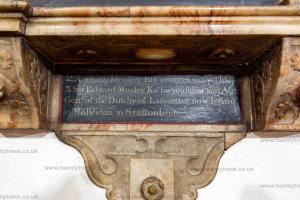
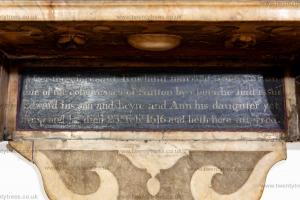
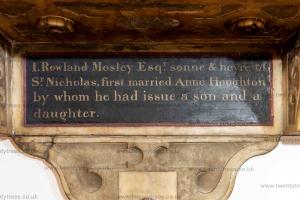
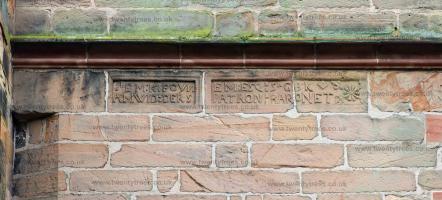
1620. A memorial stone over the north door of St James' Church, Didsbury [Map] commemorates its benefactors including Edward Mosley [aged 50]
On 31st March 1685 John Bland 4th Baronet [aged 21] and Ann Mosley [aged 20] were married at St James' Church, Didsbury [Map].
On 25th July 1695 Edward Mosley [aged 76] died. He was buried at St James' Church, Didsbury [Map].
On 8th July 1697 Meriell Saltonstall [aged 63] died. She was buried at St James' Church, Didsbury [Map].
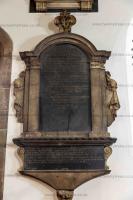
On 25th October 1715 John Bland 4th Baronet [aged 51] died. Monument at St James' Church, Didsbury [Map]. His son John [aged 24] succeeded 5th Baronet Bland of Kippax Park in Yorkshire.
John Bland 4th Baronet: On 2nd November 1663 he was born to Francis Bland 2nd Baronet and Jane Lowther. On 14th December 1668 Thomas Bland 3rd Baronet died. His brother John succeeded 4th Baronet Bland of Kippax Park in Yorkshire. On 31st March 1685 he and Ann Mosley were married at St James' Church, Didsbury [Map].
John Bland 5th Baronet: On or before 10th September 1691, the date he was baptised, he was born to John Bland 4th Baronet and Ann Mosley. On 9th April 1743 he died. His son John succeeded 6th Baronet Bland of Kippax Park in Yorkshire.
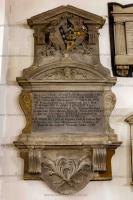
On 26th July 1734 Ann Mosley [aged 69] died. She was buried at St James' Church, Didsbury [Map].
Ann Mosley: Around 28th August 1664 she was born to Edward Mosley and Meriell Saltonstall. On 18th May 1709 Ann Mosley laid the foundation stone of St Ann's Church, Manchester [Map]. She had provided funds for its construction. On 17th July 1712, the St Ann's Church, Manchester [Map] was consecrated by the Bishop of Chester and was dedicated to Saint Anne, the Virgin Mary's mother, which was a compliment both to the founder Ann Mosley, and to the reigning monarch, Queen Anne.
This is a translation of the 'Memoires of Jacques du Clercq', published in 1823 in two volumes, edited by Frederic, Baron de Reissenberg. In his introduction Reissenberg writes: 'Jacques du Clercq tells us that he was born in 1424, and that he was a licentiate in law and a counsellor to Philip the Good, Duke of Burgundy, in the castellany of Douai, Lille, and Orchies. It appears that he established his residence at Arras. In 1446, he married the daughter of Baldwin de la Lacherie, a gentleman who lived in Lille. We read in the fifth book of his Memoirs that his father, also named Jacques du Clercq, had married a lady of the Le Camelin family, from Compiègne. His ancestors, always attached to the counts of Flanders, had constantly served them, whether in their councils or in their armies.' The Memoires cover a period of nineteen years beginning in in 1448, ending in in 1467. It appears that the author had intended to extend the Memoirs beyond that date; no doubt illness or death prevented him from carrying out this plan. As Reissenberg writes the 'merit of this work lies in the simplicity of its narrative, in its tone of good faith, and in a certain air of frankness which naturally wins the reader’s confidence.' Du Clercq ranges from events of national and international importance, including events of the Wars of the Roses in England, to simple, everyday local events such as marriages, robberies, murders, trials and deaths, including that of his own father in Book 5; one of his last entries.
Available at Amazon in eBook and Paperback format.

On 30th December 1821 Joseph Farington [aged 74] died. He was staying with his brother Richard at Parrs Wood House, Didsbury [Map], Manchester. While attending a New Year's Eve service at St James' Church, Didsbury [Map], Farrington fell down the steps of the church and died shortly thereafter.
In 1850 St James' Church, Didsbury [Map] became the parish church of Didsbury. The nave was constructed in 1855, the chancel in 1871 and the east part of the south aisle in 1895. The church is of red sandstone with slate roofs.
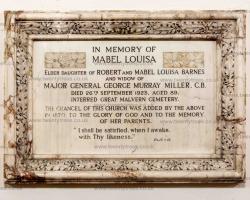
After 26th September 1923. St James' Church, Didsbury [Map]. Memorial to Mabel Louisa Barnes.
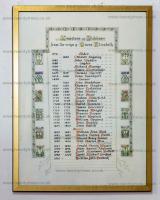
After 2010. Ministers of St James' Church, Didsbury [Map].