

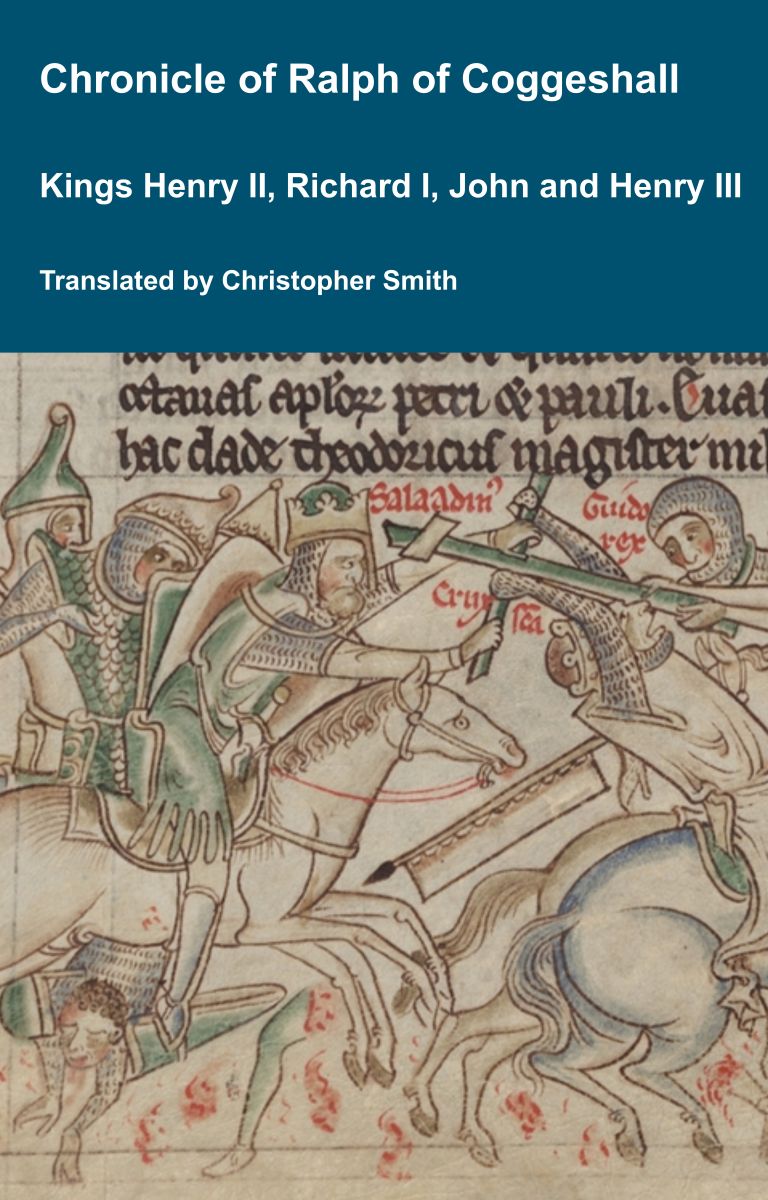
Chronicle of Abbot Ralph of Coggeshall
The Chronicle of Abbot Ralph of Coggeshall (Chronicon Anglicanum) is an indispensable medieval history that brings to life centuries of English and European affairs through the eyes of a learned Cistercian monk. Ralph of Coggeshall, abbot of the Abbey of Coggeshall in Essex in the early 13th century, continued and expanded his community’s chronicle, documenting events from the Norman Conquest of 1066 into the tumultuous reign of King Henry III. Blending eyewitness testimony, careful compilation, and the monastic commitment to record-keeping, this chronicle offers a rare narrative of political intrigue, royal power struggles, and social upheaval in England and beyond. Ralph’s work captures the reigns of pivotal figures such as Richard I and King John, providing invaluable insights into their characters, decisions, and the forces that shaped medieval rule. More than a simple annal, Chronicon Anglicanum conveys the texture of medieval life and governance, making it a rich source for scholars and readers fascinated by English history, monastic authorship, and the shaping of the medieval world.
Available at Amazon in eBook and Paperback format.
St Martin's Church, Ancaster is in Ancaster [Map], Churches in Lincolnshire.
Interior of St Martin's Church, Ancaster [Map].


Exterior of St Martin's Church, Ancaster [Map].


Before 1400. Two effigies in St Martin's Church, Ancaster [Map] porch.


After 22nd March 1742. St Martin's Church, Ancaster [Map]. Memorial to John Black.

After 1784. St Martin's Church, Ancaster [Map]. Memorial to Anthony Lucas of Ancaster Hall (age 55), Christian Calcraft (age 54), their sons George Lucas-Calcraft (age 18) and Anthony Lucas-Calcraft (age 15), and John Calcraft.
After 7th March 1796. St Martin's Church, Ancaster [Map]. Memorial to William and Elizabeth Roe, and John Roe sculpted by T King of Bath.


After 1842. St Martin's Church, Ancaster [Map]. Memorials to the Allix family including Mary Elizabeth Hammond, Frederick William Allix (age 25), Charles Hammond Allix and Mary Sophia Nevile (age 21).
On 4th March 1842 Mary Elizabeth Hammond died. She was buried at St Martin's Church, Ancaster [Map]

After 1851. St Martin's Church, Ancaster [Map]. Memorial to John Charles Lucas Calcraft (deceased) and Sophia Birch.
John Charles Lucas Calcraft: In 1770 he was born to Anthony Lucas of Ancaster Hall and Christian Calcraft. Before 1837 he and Sophia Birch were married. In 1851 he died.
Sophia Birch: In 1769 she was born to Reverend John Neville Birch of Leasingham. On 30th May 1837 she died.

After 5th November 1854. St Martin's Church, Ancaster [Map]. Memorial to Captain William Kent Allix (deceased) who was killed at the Battle of Inkerman.
Captain William Kent Allix: Before 5th November 1804 he was appointed Aide-de-Camp to General George de Lacy Evans. On 9th April 1823 he was born to Colonel Charles Allix and Mary Elizabeth Hammond at Willoughby Hall. He was educated at Harrow School where there is a memorial plaque to him.
On 22nd January 1866 Colonel Charles Allix (age 83) died. He was buried at St Martin's Church, Ancaster [Map]. Frederick William Allix (age 49) inherited Willoughby Hall.
Chronicle of a Bourgeois of Valenciennes
Récits d’un bourgeois de Valenciennes aka The Chronicle of a Bourgeois of Valenciennes is a vivid 14th-century vernacular chronicle written by an anonymous urban chronicler from Valenciennes in the County of Hainaut. It survives in a manuscript that describes local and regional history from about 1253 to 1366, blending chronology, narrative episodes, and eyewitness-style accounts of political, military, and social events in medieval France, Flanders, and the Low Countries. The work begins with a chronological framework of events affecting Valenciennes and its region under rulers such as King Philip VI of France and the shifting allegiances of local nobility. It includes accounts of conflicts, sieges, diplomatic manoeuvres, and the impact of broader struggles like the Hundred Years’ War on urban life in Hainaut. Written from the perspective of a burgher (bourgeois) rather than a monastery or royal court, the chronicle offers a rare lay viewpoint on high politics and warfare, reflecting how merchants, townspeople, and civic institutions experienced the turbulence of the 13th and 14th centuries. Its narrative style combines straightforward reporting of events with moral and civic observations, making it a valuable source for readers interested in medieval urban society, regional politics, and the lived experience of war and governance in pre-modern Europe.
Available at Amazon in eBook and Paperback format.

After 12th November 1873. St Martin's Church, Ancaster [Map]. Memorial to William G T Newton.

After 1919. St Martin's Church, Ancaster [Map]. Memorial to those killed in the First World War.

After 1945. St Martin's Church, Ancaster [Map]. Memorial to those killed in the Second World War.