


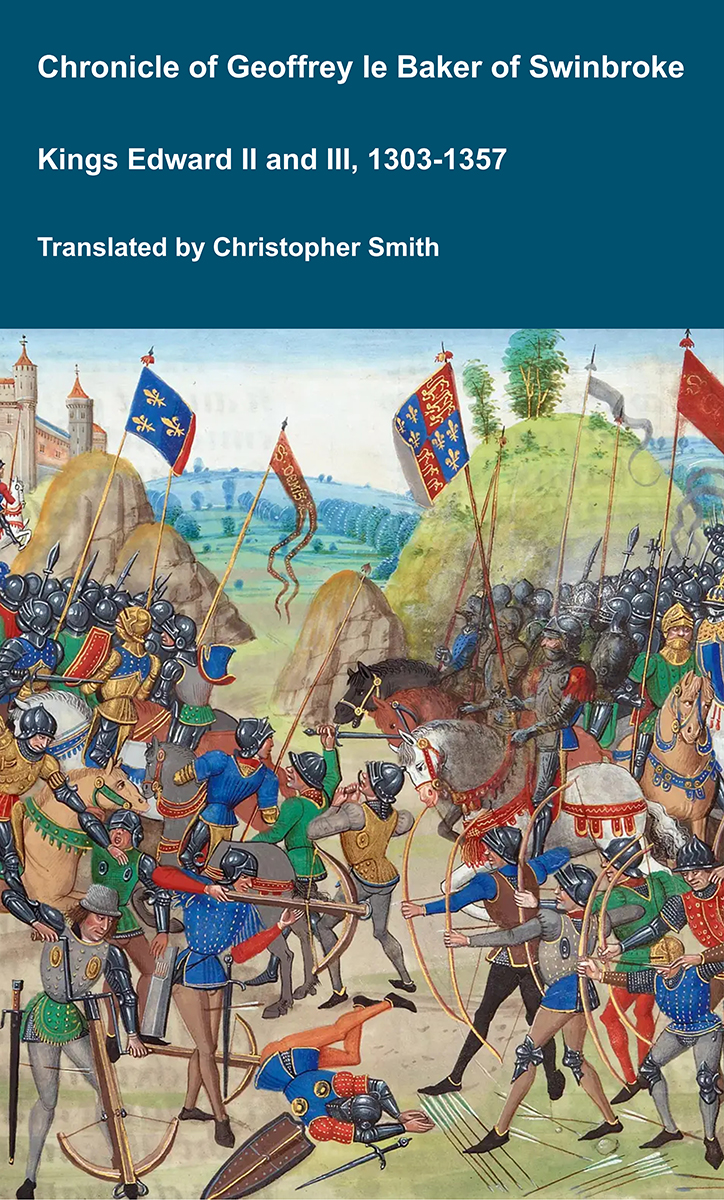
Chronicle of Geoffrey le Baker of Swinbroke
Baker was a secular clerk from Swinbroke, now Swinbrook, an Oxfordshire village two miles east of Burford. His Chronicle describes the events of the period 1303-1356: Gaveston, Bannockburn, Boroughbridge, the murder of King Edward II, the Scottish Wars, Sluys, Crécy, the Black Death, Winchelsea and Poitiers. To quote Herbert Bruce 'it possesses a vigorous and characteristic style, and its value for particular events between 1303 and 1356 has been recognised by its editor and by subsequent writers'. The book provides remarkable detail about the events it describes. Baker's text has been augmented with hundreds of notes, including extracts from other contemporary chronicles, such as the Annales Londonienses, Annales Paulini, Murimuth, Lanercost, Avesbury, Guisborough and Froissart to enrich the reader's understanding. The translation takes as its source the 'Chronicon Galfridi le Baker de Swynebroke' published in 1889, edited by Edward Maunde Thompson.
Available at Amazon in eBook and Paperback format.
Stafford, Staffordshire is in Staffordshire.
See: , Baswich, Stafford [Map], Bromwich Hall, Stafford, St Mary's Church Stafford [Map], St Thomas' Priory, Stafford [Map], Stafford Castle.
Anglo-Saxon Chronicle. 913. This year, about Martinmas, King Edward (age 39) had the northern fortress built at Hertford [Map], betwixt the Memer, and the Benwic, and the Lea. After this, in the summer, betwixt gang-days and midsummer, went King Edward with some of his force into Essex, to Maldon [Map]; and encamped there the while that men built and fortified the town of Witham [Map]. And many of the people submitted to him, who were before under the power of the Danes. And some of his force, meanwhile, built the fortress at Hertford [Map] on the south side of the Lea. This year by the permission of God went Ethelfleda (age 43), lady of Mercia, with all the Mercians to Tamworth [Map]; and built the fort there in the fore-part of the summer; and before Lammas that at Stafford [Map]: in the next year that at Eddesbury [Map], in the beginning of the summer; and the same year, late in the autumn, that at Warwick [Map]. Then in the following year was built, after mid-winter, that at Chirbury and that at Warburton; and the same year before mid-winter that at Runkorn [Map].
In 1081 Nicholas Stafford was born to Robert Stafford (age 42) and Avice de Clare (age 37) at Stafford, Staffordshire [Map]. He married Maud Meolte and had issue.
Around 1120 Juliana Stafford was born to Nicholas Stafford (age 39) and Maud Meolte at Stafford, Staffordshire [Map].
In 1125 Richard Stafford was born to Robert II Stafford (age 18) and Avice Anastasia Unknown at Stafford, Staffordshire [Map]. He married Annabilla Lancashire and had issue.
Around 1142 Robert III Stafford was born to Robert II Stafford (age 35) and Avice Anastasia Unknown at Stafford, Staffordshire [Map]. He married Basilia Unknown.
Around 1153 Millicent Stafford was born to Robert II Stafford (age 46) and Avice Anastasia Unknown at Stafford, Staffordshire [Map]. She married Hervey Bagot and had issue.
In 1153 Hervey Bagot was born at Stafford, Staffordshire [Map].
Chronicle of a Bourgeois of Valenciennes
Récits d’un bourgeois de Valenciennes aka The Chronicle of a Bourgeois of Valenciennes is a vivid 14th-century vernacular chronicle written by an anonymous urban chronicler from Valenciennes in the County of Hainaut. It survives in a manuscript that describes local and regional history from about 1253 to 1366, blending chronology, narrative episodes, and eyewitness-style accounts of political, military, and social events in medieval France, Flanders, and the Low Countries. The work begins with a chronological framework of events affecting Valenciennes and its region under rulers such as King Philip VI of France and the shifting allegiances of local nobility. It includes accounts of conflicts, sieges, diplomatic manoeuvres, and the impact of broader struggles like the Hundred Years’ War on urban life in Hainaut. Written from the perspective of a burgher (bourgeois) rather than a monastery or royal court, the chronicle offers a rare lay viewpoint on high politics and warfare, reflecting how merchants, townspeople, and civic institutions experienced the turbulence of the 13th and 14th centuries. Its narrative style combines straightforward reporting of events with moral and civic observations, making it a valuable source for readers interested in medieval urban society, regional politics, and the lived experience of war and governance in pre-modern Europe.
Available at Amazon in eBook and Paperback format.
In 1154 Annabilla Stafford was born to Richard Stafford (age 29) and Annabilla Lancashire at Stafford, Staffordshire [Map].
In January 1224 Millicent Stafford (age 71) died at Stafford, Staffordshire [Map].
On 6th July 1336 Katherine Hastings Baroness Stafford (age 32) died at Stafford, Staffordshire [Map].
On 30th September 1487 John Sutton 1st Baron Dudley (age 86) died at Stafford, Staffordshire [Map]. He was buried at Dudley Priory [Map]. His grandson Edward (age 28) succeeded 2nd Baron Dudley.
The River Sow rises near Fair Oak, Staffordshire [Map]. From there it flows past Outlands, Staffordshire [Map], Bishops Offley, Staffordshire [Map], Copmere End, Staffordshire [Map], Eccleshall Castle, Staffordshire [Map], Chebsey, Staffordshire [Map], Little Bridgeford, Staffordshire [Map], Great Bridgeford, Staffordshire [Map], Stafford, Staffordshire [Map] to Baswich, Stafford [Map] where it is joined by the River Penk.
After Baswich the River Penk flows past Milford, Staffordshire [Map] to Essex Bridge [Map] where it joins the River Trent.
Nicholas Stafford died at Stafford, Staffordshire [Map].
The River Sow rises near Fair Oak, Staffordshire [Map]. From there it flows past Outlands, Staffordshire [Map], Bishops Offley, Staffordshire [Map], Copmere End, Staffordshire [Map], Eccleshall Castle, Staffordshire [Map], Chebsey, Staffordshire [Map], Little Bridgeford, Staffordshire [Map], Great Bridgeford, Staffordshire [Map], Stafford, Staffordshire [Map] to Baswich, Stafford [Map] where it is joined by the River Penk.
After Baswich the River Penk flows past Milford, Staffordshire [Map] to Essex Bridge [Map] where it joins the River Trent.
The River Penk rises near Perton, Staffordshire [Map] from where it flows past Pendeford, Staffordshire [Map], Coven, Staffordshire [Map], Brewood Staffordshire [Map], Stretton, Staffordshire [Map], Penkridge, Staffordshire [Map], Acton Trussell, Staffordshire [Map] to Baswich, Stafford [Map] where it joins the River Sow.
On 7th October 1534 John Stanley (age 64) died at Bromwich Hall, Stafford.
St Mary's Church Stafford is also in Churches in Staffordshire.
Jean de Waurin's Chronicle of England Volume 6 Books 3-6: The Wars of the Roses
Jean de Waurin was a French Chronicler, from the Artois region, who was born around 1400, and died around 1474. Waurin’s Chronicle of England, Volume 6, covering the period 1450 to 1471, from which we have selected and translated Chapters relating to the Wars of the Roses, provides a vivid, original, contemporary description of key events some of which he witnessed first-hand, some of which he was told by the key people involved with whom Waurin had a personal relationship.
Available at Amazon in eBook and Paperback format.

Around 1650. Monument at St Michael's Church, Penkridge [Map] to the family of Richard Drakeford whose eldest son is named Littleton. Apparently there is more of the monument at St Mary's Church Stafford [Map]
St Thomas' Priory, Stafford is also in Priories in England.
Around 1174 St Thomas' Priory, Stafford [Map] was a Augustinian Priory founded by Gerard fitz-Brian, a local landowner and burgess, and settled by canons from Darley Abbey, Derbyshire [Map].
Before 27th April 1279 Robert Ferrers 6th Earl of Derby (age 40) died. Earl Derby extinct. He was buried at St Thomas' Priory, Stafford [Map].
by 1522 Edward Littleton (age 17) was appointed Gentleman Usher. Around the same time he was appointed Constable of Stafford Castle.