


Wigmore Abbey is in Wigmore, Herefordshire [Map], Abbeys in England.
In 1291 Wigmore Abbey [Map] was recorded as holding lands in Cynham, Snitton, Shobdon, Leintwardine, Presteigne, Aymestrey, Bredwardine, Choulton, Kinlet, Walton, Neen Savage, Westwood, Mambe, Billebure, Ludlow, Colkeshale, La Neuton, Assiston, Clungunford, Burford, Greete, Moeles Brace, Ratlinghope and Wigmore together with the churches of Burley, Aymestrey, Shobdon, Presteigne, Byton, Staunton, Bredwardine, Hopton Wafre, Cleobury Mortimer, Momel, Nene Solars, Limebrook, Chelmarsh, Higley, Kinlet, Neen Savage, Chetton, Moeles Brace, Ledbury, Bucknell, Bishop's Castle, Leintwardine and the chapels of Burrington and Downtown.
Around 1104 Ranulph Mortimer (age 35) died. He was buried at Wigmore Abbey [Map].
In 1127 Hawise Mortimer Countess Aumale died. She was buried at Wigmore Abbey [Map].
In 1127 Stephen Blois Count Aumale (age 57) died. He was buried at Wigmore Abbey [Map]. Earl Holderness Feudal extinct.
Before 1148 Abbot Simon Merlymond was the first Abbot of Wigmore Abbey [Map]. The community moved around Herefordshire, initially at Shobdon, Herefordshire, a number of times following its creation before settling at Wigmore Abbey [Map].
From 1148 to 1155 Andrew of St Victor (age 48) was Abbot of Wigmore Abbey [Map].
From 1162 to 1175 Andrew of St Victor (age 62) was Abbot of Wigmore Abbey [Map].
In 1172 Andrew Staunton fled his Marcher lands with his wife, Matilda Port and claimed sanctuary in Wigmore Abbey [Map] after bribing the abbot with the gift of Bucknell church in Shropshire. Matilda remained in the abbey until after 1174, by which time her husband had fled from the abbey to Scotland and then returned with a Scottish army to attack King Henry II.

Chronicle of a Bourgeois of Valenciennes
Récits d’un bourgeois de Valenciennes aka The Chronicle of a Bourgeois of Valenciennes is a vivid 14th-century vernacular chronicle written by an anonymous urban chronicler from Valenciennes in the County of Hainaut. It survives in a manuscript that describes local and regional history from about 1253 to 1366, blending chronology, narrative episodes, and eyewitness-style accounts of political, military, and social events in medieval France, Flanders, and the Low Countries. The work begins with a chronological framework of events affecting Valenciennes and its region under rulers such as King Philip VI of France and the shifting allegiances of local nobility. It includes accounts of conflicts, sieges, diplomatic manoeuvres, and the impact of broader struggles like the Hundred Years’ War on urban life in Hainaut. Written from the perspective of a burgher (bourgeois) rather than a monastery or royal court, the chronicle offers a rare lay viewpoint on high politics and warfare, reflecting how merchants, townspeople, and civic institutions experienced the turbulence of the 13th and 14th centuries. Its narrative style combines straightforward reporting of events with moral and civic observations, making it a valuable source for readers interested in medieval urban society, regional politics, and the lived experience of war and governance in pre-modern Europe.
Available at Amazon in eBook and Paperback format.
Between 1174 and 1179 Hugh Mortimer granted St Mary Magdalene's Church, Leintwardine [Map] to his new foundation of Wigmore Abbey [Map]. The St Mary Magdalene's Church, Leintwardine [Map] is built partly in the vallum, or ditch, that enclosed the Roman town of Bravonium. The foundations are Saxon and Norman but the main part of the church is 13th and 14th century. The earliest detail in the church is the blocked 12th-century W. doorway, which is probably not in situ. Towards the end of the thirteenth century a south aisle was added to the nave and in the first half of the fourteenth century a north aisle and two chapels were added together with a new chancel and an impressive south tower of five storeys over a powerful porch.
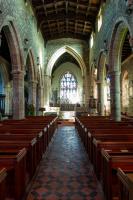
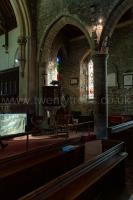
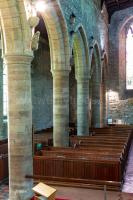
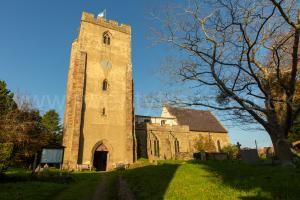
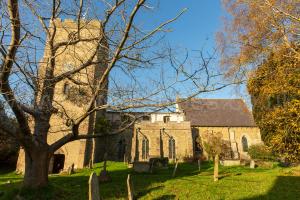
In 1179 Wigmore Abbey [Map] was consecrated by Bishop Gilbert Foliot. It had been founded by Hugh Mortimer (age 79) in 1172 - see Wigmore Chroncle.
On 26th February 1181, possibly, the date uncertain, Hugh Mortimer (age 81) died. He was buried at his foundation Wigmore Abbey [Map].
Around 1193 Brian Brampton died. He was buried in the Mortimer Chapel of Wigmore Abbey [Map] of which he was one of the founders.
In 1202 Hugh Mortimer of Chelmarsh (age 48) died. He was buried at Wigmore Abbey [Map].
Before 8th July 1214 Roger Mortimer (age 62) died. He was buried at Wigmore Abbey [Map].
In 1227 Hugh Mortimer died in a tournament. He was buried at Wigmore Abbey [Map]; his viscera were buried at Reading Abbey, Berkshire [Map]. His widow Eleanor Braose became a nun at Iffley.
On 6th August 1246 Ralph Mortimer (age 56) died. He was probably buried at Wigmore Abbey [Map].
On 30th October 1282 Roger Mortimer 1st Baron Mortimer of Wigmore (age 51) died. He was buried at Wigmore Abbey [Map] where the inscription of his tombstone reads "Here lies buried, glittering with praise, Roger the pure, Roger Mortimer the second, called Lord of Wigmore by those who held him dear. While he lived all Wales feared his power, and given as a gift to him all Wales remained his. It knew his campaigns, he subjected it to torment". His son Edmund (age 31) succeeded 2nd Baron Mortimer of Wigmore.
In 1287 Brian Brampton died. He was buried in the Mortimer Chapel of Wigmore Abbey [Map].
The History of William Marshal was commissioned by his son shortly after William’s death in 1219 to celebrate the Marshal’s remarkable life; it is an authentic, contemporary voice. The manuscript was discovered in 1861 by French historian Paul Meyer. Meyer published the manuscript in its original Anglo-French in 1891 in two books. This book is a line by line translation of the first of Meyer’s books; lines 1-10152. Book 1 of the History begins in 1139 and ends in 1194. It describes the events of the Anarchy, the role of William’s father John, John’s marriages, William’s childhood, his role as a hostage at the siege of Newbury, his injury and imprisonment in Poitou where he met Eleanor of Aquitaine and his life as a knight errant. It continues with the accusation against him of an improper relationship with Margaret, wife of Henry the Young King, his exile, and return, the death of Henry the Young King, the rebellion of Richard, the future King Richard I, war with France, the death of King Henry II, and the capture of King Richard, and the rebellion of John, the future King John. It ends with the release of King Richard and the death of John Marshal.
Available at Amazon in eBook and Paperback format.
In 1301 Maud de Braose (age 77) died at Wigmore, Herefordshire [Map]. She was buried at Wigmore Abbey [Map].
In July 1304 Edmund Mortimer 2nd Baron Mortimer of Wigmore (age 53) died at Wigmore Castle, Herefordshire [Map]. He was buried at Wigmore Abbey [Map]. His son Roger (age 17) succeeded 3rd Baron Mortimer of Wigmore. Joan Geneville Baroness Mortimer 2nd Baroness Geneville (age 18) by marriage Baroness Mortimer of Wigmore.
On 29th November 1330 Roger Mortimer 1st Earl March (age 43) was hanged, drawn and quartered at Tyburn [Map] accused of assuming royal power and of various other high misdemeanours. His body hung at the gallows for two days and nights. He was buried at Christ Church, Greyfriars [Map]. Isabella of France Queen Consort England (age 35) subsequently requested his burial at Wigmore Abbey [Map] and, after firstly refusing, King Edward III of England (age 18) allowed his remains to be removed to Wigmore Abbey [Map]. Earl March, Baron Mortimer of Wigmore forfeit.
On 16th December 1331 Edmund Mortimer (age 28) died. He was buried at Wigmore Abbey [Map].
On 7th February 1333 Margaret Fiennes (age 64) died. She was probably buried at Wigmore Abbey [Map].
On 3rd August 1336 Roger Mortimer 1st Baron Mortimer of Chirk (age 80) died at the Tower of London [Map] after four and a half years imprisonment. He was buried at either Wigmore Abbey [Map] or St Augustine's Priory, Bristol [Map]. His son Roger succeeded 2nd Baron Mortimer of Chirk although he was never summoned to Parliament.
On 19th October 1356 Joan Geneville Baroness Mortimer 2nd Baroness Geneville (age 70) died. She was buried at Wigmore Abbey [Map].
On 26th February 1360 Roger Mortimer 2nd Earl March (age 31) died. He was buried at Wigmore Abbey [Map]. His son Edmund (age 8) succeeded 3rd Earl March, 5th Baron Mortimer of Wigmore.
On 27th December 1381 Edmund Mortimer 3rd Earl March, Earl of Ulster (age 29) died. He was buried at Wigmore Abbey [Map]. His son Roger (age 7) succeeded 4th Earl March, 3rd Earl of Ulster, 6th Baron Mortimer of Wigmore.
On 20th July 1398 Roger Mortimer 4th Earl March 3rd Earl of Ulster (age 24) died at Kells, County Meath. He was buried at Wigmore Abbey [Map]. His son Edmund (age 6) succeeded Heir to the Throne of England, 5th Earl March, 4th Earl of Ulster, 7th Baron Mortimer of Wigmore.
In 1530 Wigmore Abbey [Map] was dissolved. The remains of the building were given to Sir T. Palmer.
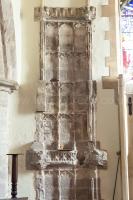
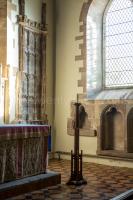
After 1530. Reredos removed from Wigmore Abbey [Map] following its dissolution. The oak stalls and misericords were acquired from the same source.
In 1998 the actor John Challis moved to Wigmore Abbey [Map].
In 2000 dendrochronological dating was undertaken what remains of Wigmore Abbey [Map]. Some woodwork in the undercroft has been dated to as early as 1213-1243. In the main building dates of 1482-1485, 1682 and 1729 were returned. The east wall contains a two light window which may date back to the thirteenth century. Some of the internal roof trusses would appear to be fourteenth century.

Anne Boleyn. Her Life as told by Lancelot de Carle's 1536 Letter.
In 1536, two weeks after the execution of Anne Boleyn, her brother George and four others, Lancelot du Carle, wrote an extraordinary letter that described Anne's life, and her trial and execution, to which he was a witness. This book presents a new translation of that letter, with additional material from other contemporary sources such as Letters, Hall's and Wriothesley's Chronicles, the pamphlets of Wynkyn the Worde, the Memorial of George Constantyne, the Portuguese Letter and the Baga de Secrets, all of which are provided in Appendices.
Available at Amazon in eBook and Paperback format.
On 20th October 2016 John Challis published "Wigmore Abbey [Map]: The Treasure of Mortimer". Published by Wigmore Books Ltd: "John Challis recounts his arrival in Herefordshire and why he and his wife, Carol, decided to buy Wigmore Abbey. Arriving there in the late '90s, they threw themselves into the task of restoring the abbot's lodging – the only habitable part remaining of what had once been a great monastery."
Transactions of the Woolhope Club 1969 Page 413. The Anglo-Norman Chronicle Of Wigmore Abbey [Map] By J. C. Dickinson And P. T. Ricketts