

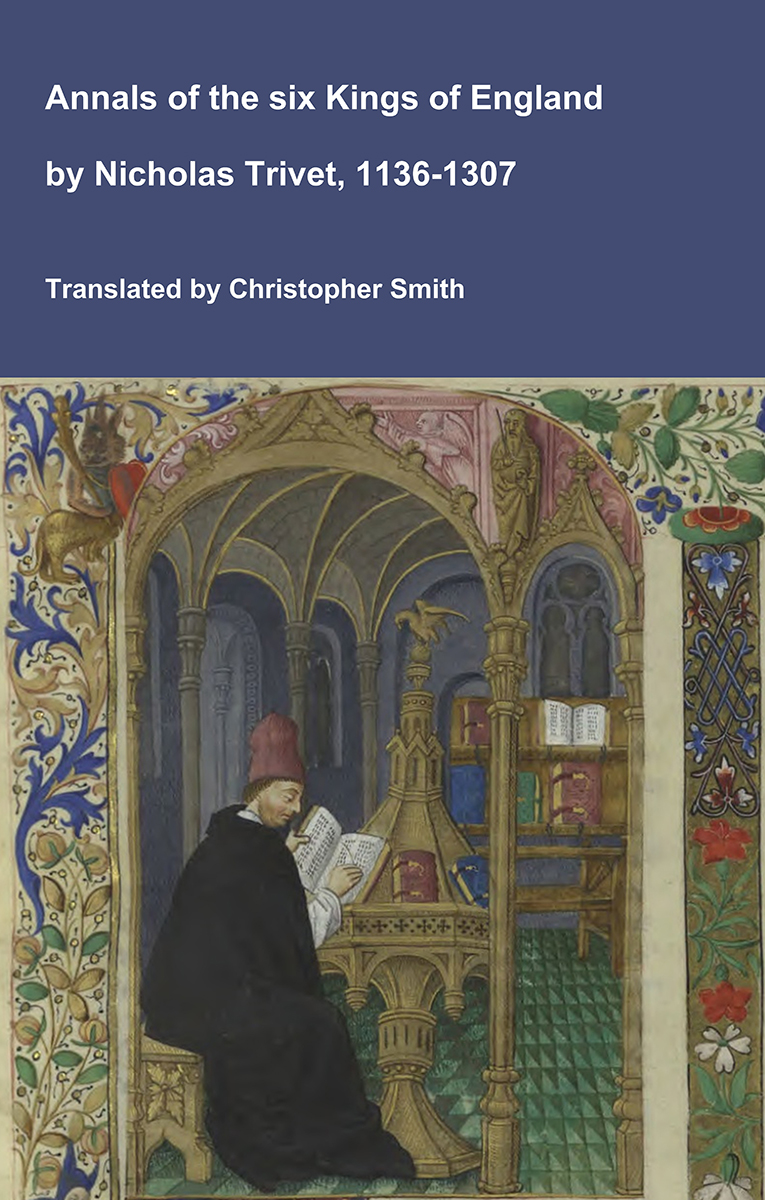
Annals of the six Kings of England by Nicholas Trivet
Translation of the Annals of the Six Kings of England by that traces the rise and rule of the Angevin aka Plantagenet dynasty from the mid-12th to early 14th century. Written by the Dominican scholar Nicholas Trivet, the work offers a vivid account of English history from the reign of King Stephen through to the death of King Edward I, blending political narrative with moral reflection. Covering the reigns of six monarchs—from Stephen to Edward I—the chronicle explores royal authority, rebellion, war, and the shifting balance between crown, church, and nobility. Trivet provides detailed insight into defining moments such as baronial conflicts, Anglo-French rivalry, and the consolidation of royal power under Edward I, whose reign he describes with particular immediacy. The Annals combines careful year-by-year reporting with thoughtful interpretation, presenting history not merely as a sequence of events but as a moral and political lesson. Ideal for readers interested in medieval history, kingship, and the origins of the English state, this chronicle remains a valuable and accessible window into the turbulent world of the Plantagenet kings.
Available at Amazon in eBook and Paperback format.
Willoughby-on-the-Wolds, Nottinghamshire is in Nottinghamshire.
See: Fosse Way, Willoughby-on-the-Wolds [Map], St Mary & All Saints Church, Willoughby-on-the-Wolds [Map].
Around 1175 Hugh Willoughby was born at Willoughby-on-the-Wolds, Nottinghamshire [Map].
Around 1233 Richard Bugge aka Willoughby was born to Robert Bugge de Bingham (age 38) at Willoughby-on-the-Wolds, Nottinghamshire [Map].
Around 1240 William Willoughby was born to Robert Willoughby (age 23) and Alice or Margaret Orreby (age 23) at Willoughby-on-the-Wolds, Nottinghamshire [Map]. He married Alice Beke, daughter of John Beke 1st Baron Beke and Sarah Furnival, and had issue.
Around 1290 Richard Willoughby was born to Richard Bugge aka Willoughby (age 57) at Willoughby-on-the-Wolds, Nottinghamshire [Map]. He married (1) 1310 Isabel Morteyn (2) 1333 Joan Grey, daughter of John Grey 1st Baron Grey and Avice Marmion Baroness Grey Rotherfield, and had issue (3) after 1342 Elizabeth Valletort.
In 1323 John Willoughby 3rd Baron Willoughby was born to John Willoughby 2nd Baron Willoughby (age 19) and Joan Roscelyn Baroness Willoughby and Latimer (age 15) at Willoughby-on-the-Wolds, Nottinghamshire [Map]. He married before 1349 Cecily Ufford Baroness Willoughby of Eresby, daughter of Robert Ufford 1st Earl Suffolk and Margaret Norwich Countess Suffolk, and had issue.
In 1325 Richard Bugge aka Willoughby (age 92) died at Willoughby-on-the-Wolds, Nottinghamshire [Map].
On 18th October 1333 Margaret Deincourt Baroness Willoughby of Eresby (age 63) died at Willoughby-on-the-Wolds, Nottinghamshire [Map].
In 1416 Isabel Annesley (age 33) died at Willoughby-on-the-Wolds, Nottinghamshire [Map].
On 30th May 1465 Robert Willoughby (age 55) died at Willoughby-on-the-Wolds, Nottinghamshire [Map]. He was buried at Campsey Nunnery, Campsey.
The History of William Marshal was commissioned by his son shortly after William’s death in 1219 to celebrate the Marshal’s remarkable life; it is an authentic, contemporary voice. The manuscript was discovered in 1861 by French historian Paul Meyer. Meyer published the manuscript in its original Anglo-French in 1891 in two books. This book is a line by line translation of the first of Meyer’s books; lines 1-10152. Book 1 of the History begins in 1139 and ends in 1194. It describes the events of the Anarchy, the role of William’s father John, John’s marriages, William’s childhood, his role as a hostage at the siege of Newbury, his injury and imprisonment in Poitou where he met Eleanor of Aquitaine and his life as a knight errant. It continues with the accusation against him of an improper relationship with Margaret, wife of Henry the Young King, his exile, and return, the death of Henry the Young King, the rebellion of Richard, the future King Richard I, war with France, the death of King Henry II, and the capture of King Richard, and the rebellion of John, the future King John. It ends with the release of King Richard and the death of John Marshal.
Available at Amazon in eBook and Paperback format.

Around 1548 Elizabeth Lyttelton was born to John Lyttelton of Frankley (age 28) and Bridget Packington at Willoughby-on-the-Wolds, Nottinghamshire [Map]. She married 1563 her half fifth cousin once removed Francis Willoughby and had issue.
On 5th July 1648 Michael Stanhope (age 24) was killed at Willoughby-on-the-Wolds, Nottinghamshire [Map] during the Battle of Willoughby Field.
After 5th July 1648 Michael Stanhope (deceased) was buried at Willoughby-on-the-Wolds, Nottinghamshire [Map].
Fosse Way 5f Leicester to Lincoln. Leaving Ratae Corieltavorum [Map] aka Leicester the Fosse way continues north-west through Thurmaston, Leicestershire [Map], past Syston [Map], where it makes a slight change in direction, through Six Hills, Leicestershire [Map] where Roman road (RM58) forks off north east to Grantham [Map]. Then passing Vernementum [Map] aka Willoughby-on-the-Wolds the Fosse Way make another minor change in alignment at Cotgrave [Map] before continuing through Margidunum, Nottinghamshire [Map], Ad Pontem [Map] aka East Stoke. Ad Pontem refers to it being close to the River Trent. The road continues through Newark on Trent, Nottinghamshire [Map] then Crococalana Roman Settlement [Map] near present day Brough. At Bracebridge [Map] the Fosse Way meets Ermine Street 2 before continuing into Lindum Colonia [Map] aka Lincoln.