

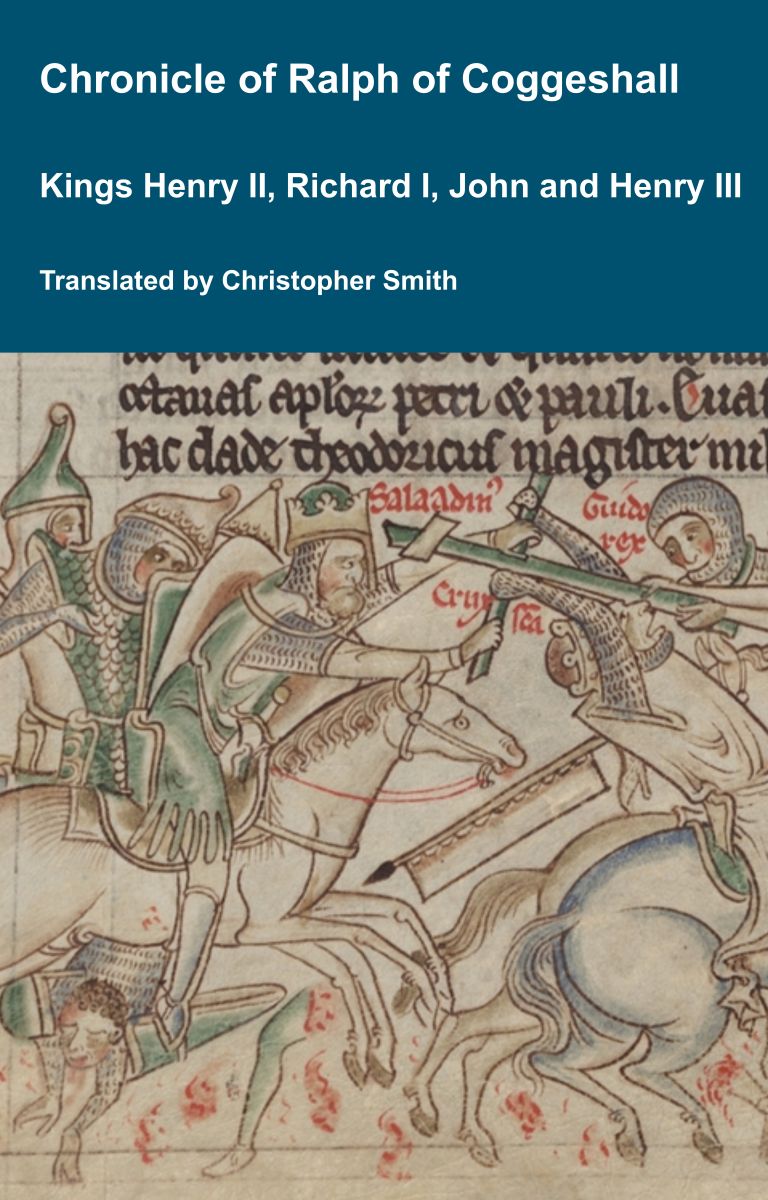
Chronicle of Abbot Ralph of Coggeshall
The Chronicle of Abbot Ralph of Coggeshall (Chronicon Anglicanum) is an indispensable medieval history that brings to life centuries of English and European affairs through the eyes of a learned Cistercian monk. Ralph of Coggeshall, abbot of the Abbey of Coggeshall in Essex in the early 13th century, continued and expanded his community’s chronicle, documenting events from the Norman Conquest of 1066 into the tumultuous reign of King Henry III. Blending eyewitness testimony, careful compilation, and the monastic commitment to record-keeping, this chronicle offers a rare narrative of political intrigue, royal power struggles, and social upheaval in England and beyond. Ralph’s work captures the reigns of pivotal figures such as Richard I and King John, providing invaluable insights into their characters, decisions, and the forces that shaped medieval rule. More than a simple annal, Chronicon Anglicanum conveys the texture of medieval life and governance, making it a rich source for scholars and readers fascinated by English history, monastic authorship, and the shaping of the medieval world.
Available at Amazon in eBook and Paperback format.
Winterbourne Stoke West Barrow 10 G67 is in Winterbourne Stoke West Barrows.

Colt Hoare 1812. No. 10 [Winterbourne Stoke West Barrow 10 G67 [Map]] was opened by Mr. Cunnington in the year 1804. In its form, it resembles the second class of Druid Barrows, is neatly ditched round, having the vallum without, and the tumulus rising gradually to its apex from the ditch. It contained an urn inverted over the burned bones, which had been wrapped up in a linen cloth, to protect them; and with the bones were found a small brass pin, employed probably for fastening the cloth, five rings of a dark brown colour, one of which was perforated for suspension, (Tumuli Plate XIII.) a small cone of the same materials perforated also for the same purpose, and several pully beads of glass, with one of jet, and another of amber.

Wiltshire Museum. DZSWS:STHEAD.70. 5 rings of Kimmeridge shale (one of which was perforated for suspension) found with a wrapped primary cremation under an inverted urn in disc barrow Winterbourne Stoke G67 [Map], excavated by William Cunnington.

Wiltshire Museum. DZSWS:STHEAD.70a. 1 conical button of Kimmerage shale (v-bored on base) found with a wrapped primary cremation under an inverted urn in disc barrow Winterbourne Stoke G67 [Map], excavated by William Cunnington.
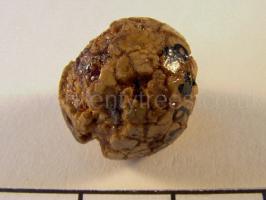
Wiltshire Museum. DZSWS:STHEAD.70c. 1 spherical amber bead found with a wrapped primary cremation under an inverted urn in disc barrow Winterbourne Stoke G67 [Map], excavated by William Cunnington.

Wiltshire Museum. DZSWS:STHEAD.70e. 3 segmented faience beads (2 four segment & 1 three segment bead) found with a wrapped primary cremation under an inverted urn in disc barrow Winterbourne Stoke G67 [Map], excavated by William Cunnington.