

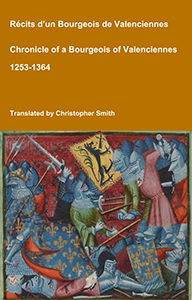
Chronicle of a Bourgeois of Valenciennes
Récits d’un bourgeois de Valenciennes aka The Chronicle of a Bourgeois of Valenciennes is a vivid 14th-century vernacular chronicle written by an anonymous urban chronicler from Valenciennes in the County of Hainaut. It survives in a manuscript that describes local and regional history from about 1253 to 1366, blending chronology, narrative episodes, and eyewitness-style accounts of political, military, and social events in medieval France, Flanders, and the Low Countries. The work begins with a chronological framework of events affecting Valenciennes and its region under rulers such as King Philip VI of France and the shifting allegiances of local nobility. It includes accounts of conflicts, sieges, diplomatic manoeuvres, and the impact of broader struggles like the Hundred Years’ War on urban life in Hainaut. Written from the perspective of a burgher (bourgeois) rather than a monastery or royal court, the chronicle offers a rare lay viewpoint on high politics and warfare, reflecting how merchants, townspeople, and civic institutions experienced the turbulence of the 13th and 14th centuries. Its narrative style combines straightforward reporting of events with moral and civic observations, making it a valuable source for readers interested in medieval urban society, regional politics, and the lived experience of war and governance in pre-modern Europe.
Available at Amazon in eBook and Paperback format.
Master of the Rolls is in Master.
In May 1286 Bishop John Langton was appointed Master of the Rolls.
On 20th January 1334 Michael de Wath was appointed Master of the Rolls.
In 1462 Bishop John Alcock [aged 32] was appointed Master of the Rolls.
In March 1472 Cardinal John Morton [aged 52] was appointed Master of the Rolls.
On 4th January 1479 Bishop Robert Morton [aged 44] was appointed Master of the Rolls.
On 13th November 1485 Bishop Robert Morton [aged 50] was appointed Master of the Rolls.
From 5th May 1492 to 13th February 1494 Bishop John Blythe [aged 32] was appointed Master of the Rolls.
Letters and Papers Foreign and Domestic Henry VIII 1509. 11th June 1509. 44. John Yonge [aged 44], Ll.D. Confirmation of grant, 22 Jan., 23 Henry VII., of the office of keeper or master of rolls, books and records of Chancery, with the house of the Converts to dwell in, a tun of Gascon wine annually, &c. Del. Westm., 11 June, 1 Henry VIII. S.B. (countersigned: Will'mus Cantuar., T. Surrey, Oxynford, C. Somerset., Thomas Rowthale.) Pat. 1 Henry VIII, p. 2, m. 5. [165.]
On 12th May 1516 Bishop Cuthbert Tunstall [aged 42] was appointed Master of the Rolls.
On 16th January 1542 Robert Southwell [aged 36] was appointed Master of the Rolls which position he held until 1550.
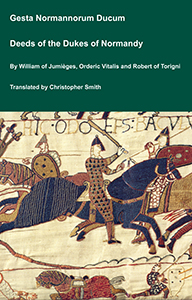
The Deeds of the Dukes of Normandy
The Gesta Normannorum Ducum [The Deeds of the Dukes of Normandy] is a landmark medieval chronicle tracing the rise and fall of the Norman dynasty from its early roots through the pivotal events surrounding the Norman Conquest of England. Originally penned in Latin by the monk William of Jumièges shortly before 1060 and later expanded at the behest of William the Conqueror, the work chronicles the deeds, politics, battles, and leadership of the Norman dukes, especially William’s own claim to the English throne. The narrative combines earlier historical sources with firsthand information and oral testimony to present an authoritative account of Normandy’s transformation from a Viking settlement into one of medieval Europe’s most powerful realms. William’s history emphasizes the legitimacy, military prowess, and governance of the Norman line, framing their expansion, including the conquest of England, as both divinely sanctioned and noble in purpose. Later chroniclers such as Orderic Vitalis and Robert of Torigni continued the history, extending the coverage into the 12th century, providing broader context on ducal rule and its impact. Today this classic work remains a foundational source for understanding Norman identity, medieval statesmanship, and the historical forces that reshaped England and Western Europe between 800AD and 1100AD.
Available at Amazon in eBook and Paperback format.
Wriothesley's Chronicle [1508-1562]. 16th January 1542. This yeare, the 16th daye of Januarye, 1541 [1542], beganne the Parliament at Westminster, and that daye was masse of the Holy Ghost, the Kinge rydinge from his pallace at Westminster in his Parliament robes, with all his lordes spirituall and temporall in theyr robes, and so rode to the church of St. Petersc; and that daye the Kinge made knightes in the Parliament Chamber, Mr. Robert Southwell, Mr of the Rolles, and Mr. Pollard [aged 37], the King's Rememberancer.
Note c. Westminster Abbey.
In 1553 Nicholas Hare [aged 69] was appointed Master of the Rolls.
In 1603 Edward Bruce 1st Lord Kinloss [aged 55] was appointed Master of the Rolls.
In 1611 Edward Phelips [aged 54] was appointed Master of the Rolls which office he held until his death in 1614.