

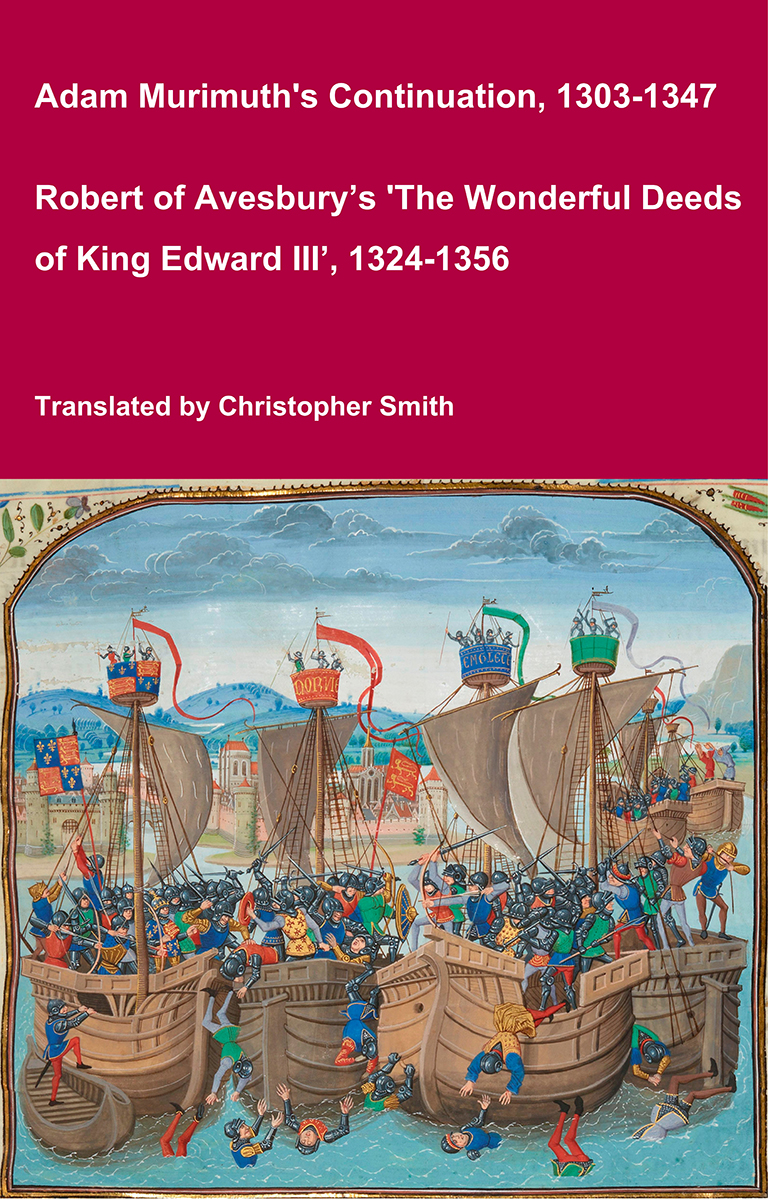
Adam Murimuth's Continuation and Robert of Avesbury’s 'The Wonderful Deeds of King Edward III'
This volume brings together two of the most important contemporary chronicles for the reign of Edward III and the opening phases of the Hundred Years’ War. Written in Latin by English clerical observers, these texts provide a vivid and authoritative window into the political, diplomatic, and military history of fourteenth-century England and its continental ambitions. Adam Murimuth Continuatio's Chronicarum continues an earlier chronicle into the mid-fourteenth century, offering concise but valuable notices on royal policy, foreign relations, and ecclesiastical affairs. Its annalistic structure makes it especially useful for establishing chronology and tracing the development of events year by year. Complementing it, Robert of Avesbury’s De gestis mirabilibus regis Edwardi tertii is a rich documentary chronicle preserving letters, treaties, and official records alongside narrative passages. It is an indispensable source for understanding Edward III’s claim to the French crown, the conduct of war, and the mechanisms of medieval diplomacy. Together, these works offer scholars, students, and enthusiasts a reliable and unembellished account of a transformative period in English and European history. Essential for anyone interested in medieval chronicles, the Hundred Years’ War, or the reign of Edward III.
Available at Amazon in eBook and Paperback format.
Societies is in England.
On 7th November 1779 Joseph Sabine [aged 9] was elected Fellow of the Linnean Society of London.
In 1788 the Linnean Society of London by botanist Sir James Edward Smith. The society takes its name from the Swedish naturalist Carl Linnaeus, the 'father of taxonomy'.
In 1820 the Royal Astronomical Society was founded as Astronomical Society of London.
In 1828 John Lubbock 3rd Baronet [aged 24] became a Fellow of the Royal Astronomical Society.
In 1831 the Astronomical Society of London became the Royal Astronomical Society upon receiving a Royal Charter from King William IV of the United Kingdom [aged 65].
Henry George Herbert 2nd Earl Carnarvon was appointed Vice President of the Royal Horticultural Society.
From 1810 to 1830 Joseph Sabine [aged 39] was appointed honourary secretary of the Royal Horticultural Society.
In 1912 Adrian Jones [aged 66] became a member of the Royal Society of British Sculptors. He was elected Fellow in 1923.
In 1818 Henry Gastineau [aged 27] the Society of Painters in Water-colours when he exhibited for the first time.
In 1821 Henry Gastineau [aged 30] was appointed Associate of the Society of Painters in Water-colours.
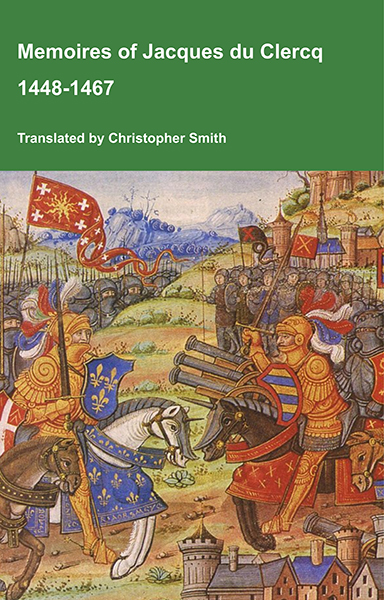
This is a translation of the 'Memoires of Jacques du Clercq', published in 1823 in two volumes, edited by Frederic, Baron de Reissenberg. In his introduction Reissenberg writes: 'Jacques du Clercq tells us that he was born in 1424, and that he was a licentiate in law and a counsellor to Philip the Good, Duke of Burgundy, in the castellany of Douai, Lille, and Orchies. It appears that he established his residence at Arras. In 1446, he married the daughter of Baldwin de la Lacherie, a gentleman who lived in Lille. We read in the fifth book of his Memoirs that his father, also named Jacques du Clercq, had married a lady of the Le Camelin family, from Compiègne. His ancestors, always attached to the counts of Flanders, had constantly served them, whether in their councils or in their armies.' The Memoires cover a period of nineteen years beginning in in 1448, ending in in 1467. It appears that the author had intended to extend the Memoirs beyond that date; no doubt illness or death prevented him from carrying out this plan. As Reissenberg writes the 'merit of this work lies in the simplicity of its narrative, in its tone of good faith, and in a certain air of frankness which naturally wins the reader’s confidence.' Du Clercq ranges from events of national and international importance, including events of the Wars of the Roses in England, to simple, everyday local events such as marriages, robberies, murders, trials and deaths, including that of his own father in Book 5; one of his last entries.
Available at Amazon in eBook and Paperback format.
In 1823 Henry Gastineau [aged 32] was appointed Member of the Society of Painters in Water-colours.
In 1710 Maurice Johnson [aged 22] founded the Spalding Gentlemen's Society.

Memoirs of Sir Isaac Newton's Life. 20th February 1721. A Lincolnshire feast was held at the Ship tavern, Temple bar. when I went into the dining room above stairs, where the better sort of company was; it was talkd, that there was an old gentleman belowstairs whom they fancied to be Sir Isaac Newton [aged 78]. I instantly went down, & finding it to be so, sat down with him. they above sent to desire us to walk up into the chief room. I answerd, the chief room was where Sir Isaac Newton sat. upon which the upper room was immediately left to the ordinary company, and the better sort came to us.
Sir Isaac enjoy'd himself extremely in this society of his countrymen; & talkd much, & pleasantly. particularly I remember one part of the conversation turn'd upon musick, of which Sir Isaac was fond; & of the opera's then beginning to be in vogue among us. it was no wonder, his soul should be delighted with harmony. Sir Isaac said they were very fine entertainments; but that "there was too much of a good thing; it was like a surfiet at dinner. I went to the last opera," says he, "The first act gave me the greatest pleasure. The second quite tired me: at the third I ran away." He left 5 guineas, & desired the stewards to call upon him for every subscription relating to his countrymen .
About this time upon the request of my friend Mr Maurice Johnson, he readily enterd himself a member of the literary society at Spalding, which still subsists. he made them a present of books: desirous of incouraging every laudable attempt to promote learning, in any branch.
He carryed me with him in his chariot to see the coinage at the Mint, in the Tower: their method of weighing to an extreme nicety, & the rest of thir operations.
In 1723 George Lynn [aged 16] joined the Spalding Gentlemen's Society.
On 18th May 1727 Henry Hare 3rd Baron Coleraine [aged 34] was elected a member of Spalding Gentlemen's Society.
In 1730 Samuel Pegge [aged 25] was elected to the Spalding Gentlemen's Society.
In 1733 Smart Lethieullier [aged 31] was elected a Member of the Spalding Gentlemen's Society.
Before 1749 Edward Bellamy joined the Spalding Gentlemen's Society.