


The History of William Marshal was commissioned by his son shortly after William’s death in 1219 to celebrate the Marshal’s remarkable life; it is an authentic, contemporary voice. The manuscript was discovered in 1861 by French historian Paul Meyer. Meyer published the manuscript in its original Anglo-French in 1891 in two books. This book is a line by line translation of the first of Meyer’s books; lines 1-10152. Book 1 of the History begins in 1139 and ends in 1194. It describes the events of the Anarchy, the role of William’s father John, John’s marriages, William’s childhood, his role as a hostage at the siege of Newbury, his injury and imprisonment in Poitou where he met Eleanor of Aquitaine and his life as a knight errant. It continues with the accusation against him of an improper relationship with Margaret, wife of Henry the Young King, his exile, and return, the death of Henry the Young King, the rebellion of Richard, the future King Richard I, war with France, the death of King Henry II, and the capture of King Richard, and the rebellion of John, the future King John. It ends with the release of King Richard and the death of John Marshal.
Available at Amazon in eBook and Paperback format.
Historic Avebury is in Avebury Henge and Stones [Map].

1663. John Aubrey (age 36). Ground Plan of Avebury from Monumenta Brittannica.
In 1663 John Aubrey (age 36) visited Avebury with King Charles II (age 32).


1663. John Aubrey (age 36). Ground Plan of Avebury with the West Kennet Avenue, The Sanctuary [Map] and Silbury Hill [Map] from Monumenta Brittannica.

July 1663. John Aubrey (age 37). Ground Plan of Avebury.

Avebury by William Stukeley. 1724. Table I. Frontspiece. The Groundplot of the Brittish Temple now the town of Aubury Wilts. Ao. 1724. [Note. This drawing shows the location of a number of stones that were destroyed and the year in which they were destroyed. Curiously it shows the outer circle and inner north circle as being composed on two rings of stones rather than the one ring we presume today. Also interesting is that there is a note on the east entrance staying 'road to Marlborough' - this being the route to the Ridgeway.]

Colt Hoare 1812. Plate XII represents a ground plan of the Grand Circle at Abury, taken by Dr. Stukeley (age 36) in the year 1724.; but from the inaccuracy of its outline, and the position of the two concentric temples, I doubt whether this plan was taken from actual survey1. It is, however, particularly interesting to the present age, as recording the state the circle at, a distant period, when it appears to have had eighteen stones standing, and twenty-seven fallen of the outward circumvallation; two standing, and nine fallen of the outward circle of the Northern Temple; one standing, and five fallen of the Inner Circle, and two out of three large upright stones that formed the COVE [Map]. Of the adjoining Southern Temple, four stones of the outward circle were standing in their original situation, and seven were fallen down; but one stone alone remained standing of the interior circle.

Druidical Temples in the County of Wilts Chapter V. Chapter V. On The Serpent At Abury.
Druidical Temples in the County of Wilts Chapter VI. Chapter VI. The Temples At Abury.


Wiltshire Archaeological Magazine 1857 V4 Pages 307-363. Abury By William Long, Esq., M.A.
William Long: Wiltshire Archaeological Magazine 1878 V17 Pages 327-335. Abury Notes. By William Long, Esq., M.A., F.S.A. Archaeologia Volume 84 1935 Section VI. Lukis and Smith also noted and planned several pits in which stones originally stood. Hoare noted eight of these depressions, but Smith and Lukis were able to add twenty-five others not previously recorded. This increased William Long's table of stones in 1857 from twenty-nine to forty-seven. A number of these stones of Smith and Lukis were declared by Stukeley to have been demolished before he made his plan in 1724.


Wiltshire Archaeological Magazine 1857 V4 Pages 307-363. Aubury is four miles west from Marleborough in Wiltshire, and is peradventure the most eminent and entire monument of this kind in the Isle of Great Britaigne. (I take this old ill-shapened monument to be the greatest, most considerable, and the least ruinated of any of this kind in our British Isle.) It is very strange that so eminent an Antiquitie should lye so long unregarded by our Chorographers: Mr......... only names it.
"It is environed with an extraordinary great vallum [or Rampart] as great, and as high as that at Winchester, [which is the greatest Bulwark that I have seen]: within which is a Graffe [ditch] of a depth and breadth proportionable to it: wherefore it could not be designed for a Fortification, for then the Graffe would have been on the outside of the Rampart.
"From the entrance at a to that at β is sixty perches.
"From the entrance at γ to that at δ the same distance: and the breadth of the rampart is fower perches; and the breadth of the Graff the same distance. (See plate 2, section 1.)
"Round about the Graffe, (sc. on the edge or border of it) are pitched on end huge stones, as big, or rather bigger than those at Stoneheng: but rude and unhewen as they are drawn out of the earth:—whereas those at Stoneheng are roughly-hewen. Most of the stones thus pitched on end, are taken away: only here and there doe still remain some curvilineous segments: but by these one may boldly conclude, that heretofore they stood quite round about, like a Crowne;
'sed longa vetustas
Destruit, et saxo longa senecta nocet.'1
Note 1. but a long age, It destroys, and harms the long old stone.'
 Become a Member via our Buy Me a Coffee page to read more.
Jean de Waurin's Chronicle of England Volume 6 Books 3-6: The Wars of the Roses
Jean de Waurin was a French Chronicler, from the Artois region, who was born around 1400, and died around 1474. Waurin’s Chronicle of England, Volume 6, covering the period 1450 to 1471, from which we have selected and translated Chapters relating to the Wars of the Roses, provides a vivid, original, contemporary description of key events some of which he witnessed first-hand, some of which he was told by the key people involved with whom Waurin had a personal relationship.
Available at Amazon in eBook and Paperback format.
Wiltshire Archaeological Magazine 1866 V10 Pages 209-216. Excavations at Avebury. Under the Direction of the Secretaries of the Wiltshire Archaeological and Natural History Society, September 29th,— October 5th, 1865.
Note. In preparing the following account, I have had the advantage of comparing the notes which Mr. King and Mr. Cunnington also took of our daily work as it proceeded, and from the three several accounts I have compiled this paper. Alfred Charles Smith.
Wiltshire Archaeological Magazine 1878 V17 Pages 327-335. Abury Notes. By William Long, Esq., M.A., F.S.A.

1896. John Benjamin Stone (age 57). Photograph of the Great Stone [ [Map]] at Avebury.

1896. John Benjamin Stone (age 57). Photograph of the Silbury Hill [Map] at Avebury.

Wessex from the Air Plate 36. Avebury
Archaeologia Volume 84 1935 Section VI. The Avebury Excavations, 1908-1922. By H. St. George Gray (age 62), Esq., F.S.A. Read 15th November 1934.

1936. Paul Nash (age 46). Avebury, 1936.
Keiller's Slides TR000011. 1938. General view of the south west sector of the henge at Avebury, prior to restoration.
Keiller's Slides TR000020. 1938. General view of men working on an excavation around an unidentified stone in the henge at Avebury

Antiquity 1939 Volume 13 Pages 223-233. Avebury. Summary of Excavations, 1937 and 1938 by Alexander Keiller (age 49).
Note 1. See Plate I, facing p. 232. My thanks are expressed to Major Allen for permitting the use of this air-photograph.
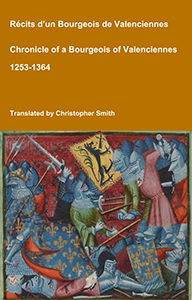
Chronicle of a Bourgeois of Valenciennes
Récits d’un bourgeois de Valenciennes aka The Chronicle of a Bourgeois of Valenciennes is a vivid 14th-century vernacular chronicle written by an anonymous urban chronicler from Valenciennes in the County of Hainaut. It survives in a manuscript that describes local and regional history from about 1253 to 1366, blending chronology, narrative episodes, and eyewitness-style accounts of political, military, and social events in medieval France, Flanders, and the Low Countries. The work begins with a chronological framework of events affecting Valenciennes and its region under rulers such as King Philip VI of France and the shifting allegiances of local nobility. It includes accounts of conflicts, sieges, diplomatic manoeuvres, and the impact of broader struggles like the Hundred Years’ War on urban life in Hainaut. Written from the perspective of a burgher (bourgeois) rather than a monastery or royal court, the chronicle offers a rare lay viewpoint on high politics and warfare, reflecting how merchants, townspeople, and civic institutions experienced the turbulence of the 13th and 14th centuries. Its narrative style combines straightforward reporting of events with moral and civic observations, making it a valuable source for readers interested in medieval urban society, regional politics, and the lived experience of war and governance in pre-modern Europe.
Available at Amazon in eBook and Paperback format.

Historic Avebury. 26th August 1939. Denis Grant King's Diary Pages 97 and 98.
Saturday, August 26th 1939
Beautiful sunny weather that must remind the older folk of August 1914. It is difficult to believe in the reality of the international crisis, or indeed that the human race lacks the intelligence and good will to compose its differences without recourse to war. Still, the forces which lead nations to war gather momentum in fair weather and in foul; and every intelligent person who has lived and observed events during the past twenty years would be unduly sanguine if he had not expected another holocaust sometime. The question is, when?
No doubt statesmen will try to put it off as long as possible, that is, as far as delay is consistent with imperial interests. Churchill suggested that the zero hour would occur in August.
Anyway, Alexander Keiller (age 49) believes that war is imminent and has asked us all to continue work on Saturday afternoon to reveal the "Z arrangement" as much as possible, and complete the records, before the Government calls up all the men.
Another reminder of 1914 came in the person of Commander Gould, R.N., who fought at the Battle of Jutland. He was then on his to way to Bath to take up duties under the Admiralty and called in at the caravan, where Alexander Keiller introduced him to me. He is a six foot man, 18 stone, so he says, clean shaven and grey hair; also very friendly and talkative, giving an account of various talks he had broadcast from the B.B.C., mostly, I understood, of an informative character on a variety of topics.
His object in calling was to leave certain manuscripts of value to be deposited in the Museum, which he considered to be a place of comparative safety. L.V. Grinsell also sent us some of his MMS [manuscripts] for safe keeping.
After Commander Gould said good-bye, Alexander Keiller told me a little about him. It appears that after the War was over, his wife left him, and his distress affected him mentally, so much so that he lost his job and sank into very low water. He then spent ten years perfecting the Harrison chronometer and making it work (which apparently it never did before), for which service the government rewarded him with the paltry sum of £100. One should see his work in the Greenwich Naval Museum. A queer story. One would not have thought that such an immense robust fellow could have been so upset by a little bit of fluff; but that is life!"
Become a Member via our Buy Me a Coffee page to read more.

1942. Paul Nash (age 52). Black and white negative, Stones at Avebury. "The great stones were in their wild state, so to speak. Some were half covered by the grass, others stood up in cornfields or were entangled and overgrown in the copses, some were buried under the turf. But they were wonderful and disquieting, and as I saw them then, I shall always remember them."
In 1943 Alexander Keiller (age 53) sold his holdings in Avebury to the National Trust for £12,000.

