

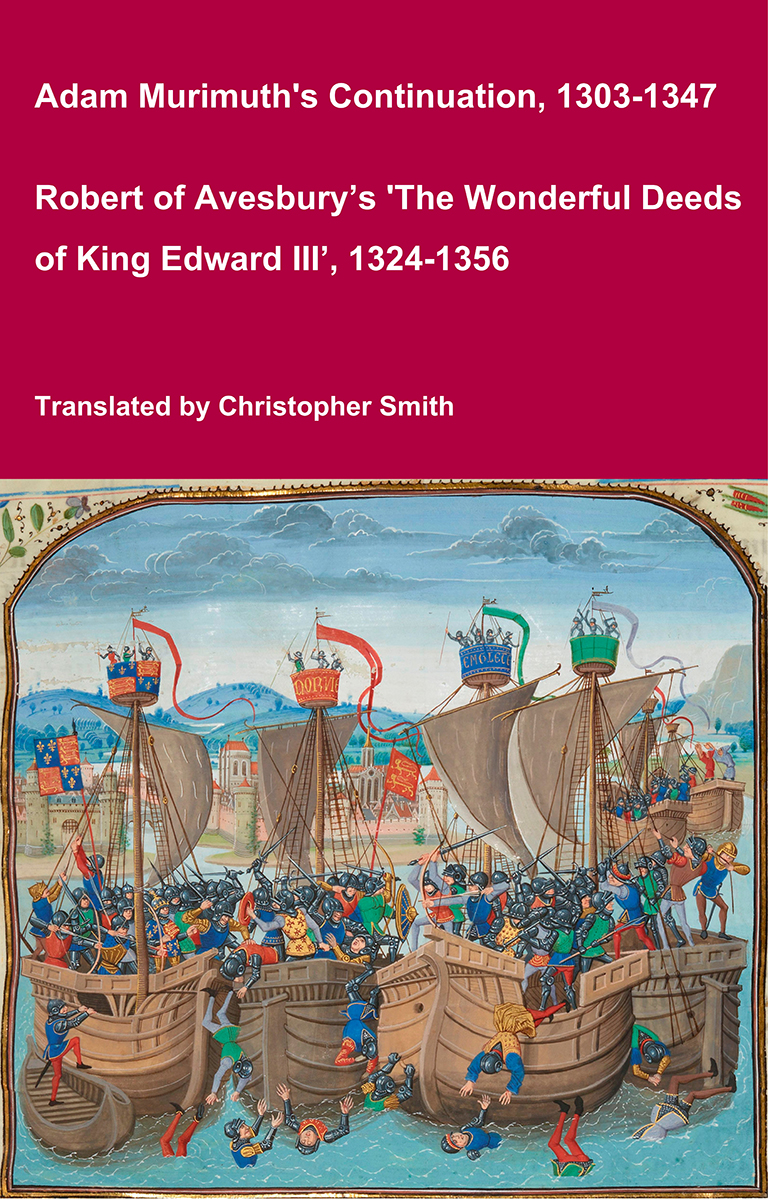
Adam Murimuth's Continuation and Robert of Avesbury’s 'The Wonderful Deeds of King Edward III'
This volume brings together two of the most important contemporary chronicles for the reign of Edward III and the opening phases of the Hundred Years’ War. Written in Latin by English clerical observers, these texts provide a vivid and authoritative window into the political, diplomatic, and military history of fourteenth-century England and its continental ambitions. Adam Murimuth Continuatio's Chronicarum continues an earlier chronicle into the mid-fourteenth century, offering concise but valuable notices on royal policy, foreign relations, and ecclesiastical affairs. Its annalistic structure makes it especially useful for establishing chronology and tracing the development of events year by year. Complementing it, Robert of Avesbury’s De gestis mirabilibus regis Edwardi tertii is a rich documentary chronicle preserving letters, treaties, and official records alongside narrative passages. It is an indispensable source for understanding Edward III’s claim to the French crown, the conduct of war, and the mechanisms of medieval diplomacy. Together, these works offer scholars, students, and enthusiasts a reliable and unembellished account of a transformative period in English and European history. Essential for anyone interested in medieval chronicles, the Hundred Years’ War, or the reign of Edward III.
Available at Amazon in eBook and Paperback format.
Charles II Count Alençon was created Count Alençon.
On 16th August 1290 [his father] Charles Valois I Count Valois and [his mother] Margaret Capet Countess Valois were married. She by marriage Countess Valois. She the daughter of [his grandfather] Charles II King Naples and [his grandmother] Mary of Hungary Queen Consort Naples. He the son of King Philip III of France and Isabella Barcelona Queen Consort France.
In 1297 Charles II Count Alençon was born to [his father] Charles Valois I Count Valois and [his mother] Margaret Capet Countess Valois.
On 31st December 1299 [his mother] Margaret Capet Countess Valois died.
In 1302 [his father] Charles Valois I Count Valois and [his step-mother] Catherine Courtenay Countess Valois were married. She by marriage Countess Valois. He the son of [his grandfather] King Philip III of France and [his grandmother] Isabella Barcelona Queen Consort France.
On 19th May 1305 [his brother-in-law] William of Avesnes I Count Hainaut III Count Avesnes III Count Holland II Count Zeeland and [his sister] Joan Valois Countess Zeeland Holland Avesnes and Hainaut were married. She by marriage Countess Zeeland, Countess Holland, Countess Avesnes, Countess Hainault. She the daughter of [his father] Charles Valois I Count Valois and [his mother] Margaret Capet Countess Valois. He the son of John of Avesnes II Count Hainaut II Count Holland and Philippa Luxemburg Countess Hainaut and Holland.
In 1307 Hugh Chatillon II Count Blois died. [his future brother-in-law] Guy Chatillon I Count Blois succeeded I Count Blois. [his sister] Margaret Valois by marriage Countess Blois.
In 1308 [his father] Charles Valois I Count Valois and [his step-mother] Mahaut Chatillon Countess Valois were married. She by marriage Countess Valois. The difference in their ages was 22 years. She the daughter of Guy Chatillon IV Count Saint Pol and Marie Capet. He the son of [his grandfather] King Philip III of France and [his grandmother] Isabella Barcelona Queen Consort France.
In 1310 [his brother-in-law] Guy Chatillon I Count Blois and [his sister] Margaret Valois were married. She the daughter of [his father] Charles Valois I Count Valois and [his mother] Margaret Capet Countess Valois. He the son of Hugh Chatillon II Count Blois and Beatrix Dampierre Countess Blois.
In April 1314 Charles II Count Alençon and Jeanne Joigny were married. She by marriage Countess Alençon. He the son of Charles Valois I Count Valois and Margaret Capet Countess Valois.
On 30th April 1315 Enguerrand de Marigny was hanged. He had been arrested on the orders of Louis X King France I Navarre at the instigation of [his father] Charles of Valois. Twenty-eight articles of accusation including charges of receiving bribes were brought against him but none could be found to be true. Charles then brought forward a charge of sorcery which was more effectual. He was condemned at once and hanged on the public gibbet of Montfaucon.
In 1320 [his brother-in-law] Robert III Artois and [his sister] Joan Valois Countess Zeeland Holland Avesnes and Hainaut were married. She the daughter of [his father] Charles Valois I Count Valois and [his mother] Margaret Capet Countess Valois.
On 16th December 1325 [his father] Charles Valois I Count Valois died.
On 1st February 1328 Charles IV King France I King Navarre died. On 1st April 1328 [his brother] King Philip "Fortunate" VI of France succeeded VI King France: Capet Valois. The succession somewhat complicated by Charles' wife Blanche of Burgundy Queen Consort France being pregnant. The child Blanche Capet was born two months later on 1st April 1328. A girl child therefore excluded from the succession confirming Philip's as King. Charles the last of the House of Capet. Philip the first of the House of Valois. Joan Capet II Queen Navarre succeeded II Queen Navarre. Her husband Philip "Noble" III King Navarre by marriage III King Navarre.
In 1335 [his brother-in-law] Charles IV King Bohemia Holy Roman Emperor Luxemburg and [his half-sister] Blanche Valois Holy Roman Empress Luxemburg were married. She the daughter of [his father] Charles Valois I Count Valois and [his step-mother] Mahaut Chatillon Countess Valois. He the son of King John I of Bohemia and Queen Elizabeth of Bohemia.
In April 1335 Charles Évreux and [his future wife] Maria de la Cerda Y Lara Countess Alençon were married. He the son of [his uncle] Louis I Count Évreux and Margaret Artois Countess Évreux.
In December 1336 Charles II Count Alençon and Maria de la Cerda Y Lara Countess Alençon were married. She by marriage Countess Alençon. The difference in their ages was 22 years. He the son of Charles Valois I Count Valois and Margaret Capet Countess Valois.
In 1337 [his son] Charles Valois Archbishop of Lyons was born to Charles II Count Alençon and [his wife] Maria de la Cerda Y Lara Countess Alençon.
In 1339 [his son] Cardinal Philippe Valois was born to Charles II Count Alençon and [his wife] Maria de la Cerda Y Lara Countess Alençon.
In 1340 [his son] Peter Valois II Count Alençon was born to Charles II Count Alençon and [his wife] Maria de la Cerda Y Lara Countess Alençon. He married 10th October 1371 Marie Chamaillart Countess Alençon and had issue.
In 1342 [his sister] Margaret Valois died.
In 1342 [his son] Isabelle Valois was born to Charles II Count Alençon and [his wife] Maria de la Cerda Y Lara Countess Alençon.
In 1344 [his son] Robert Valois was born to Charles II Count Alençon and [his wife] Maria de la Cerda Y Lara Countess Alençon.
On 26th August 1346 the army of King Edward III of England defeated the French army at the Battle of Crécy. The English army was commanded by King Edward III of England, his son Edward "Black Prince", Thomas Beauchamp 11th Earl Warwick, William Bohun 1st Earl of Northampton and John Beauchamp 1st Baron Beauchamp Warwick.
The English army was included: Bishop Thomas of Hatfield, Hugh Despencer 1st Baron Despencer, Bernard Brocas, Thomas Felton, James Audley, Robert Bourchier 1st Baron Bourchier, Bartholomew "The Elder" Burghesh 1st Baron Burghesh, Bartholomew "The Younger" Burghesh 2nd Baron Burghesh, Reginald Cobham 1st Baron Cobham, John Darcy 1st Baron Darcy of Knayth, Robert Ferrers 3rd Baron Ferrers of Chartley, Richard Scrope 1st Baron Scrope of Bolton, William Scrope, Stephen Scrope, William Latimer 4th Baron Latimer of Corby, John Lisle 2nd Baron Lisle, Gerard Lisle 1st Baron Lisle, Nicholas Longford, Edward Montagu 1st Baron Montagu, Walter Paveley 4th Baron Burghesh, Michael Poynings 1st Baron Poynings, Robert Ufford 1st Earl Suffolk, John de Vere 7th Earl of Oxford, Thomas West, John Willoughby 2nd Baron Willoughby, John Wingfield, Henry Percy 11th and 3rd Baron Percy, Hugh Courtenay 2nd or 10th Earl Devon (possibly), Walter "Elder" Devereux, John Devereux, Enion Sais Brecon, John Chandos, Richard Pembridge and John Sully.
The French army suffered significant casualties. [his brother] King Philip "Fortunate" VI of France was wounded. William de Coucy and his son Enguerrand 6th Lord de Coucy and were killed.
Charles II Count Alençon was killed. Charles Valois Archbishop of Lyons succeeded Count Alençon.
Louis Chatillon II Count Blois I Count Chatillon was killed. Louis Chatillon III Count Blois Count Soissons succeeded III Count Blois.
Louis Dampierre II Count Nevers I Count Flanders was killed. Louis of Male III Count Nevers II Count Flanders succeeded III Count Nevers, II Count Flanders.
King John I of Bohemia was killed. Charles IV King Bohemia Holy Roman Emperor Luxemburg succeeded IV King Bohemia, Holy Roman Emperor Luxemburg. Blanche Valois Holy Roman Empress Luxemburg by marriage Holy Roman Empress Luxemburg.
Rudolph "Valiant" Metz I Duke Lorraine was killed. John Metz I Duke Lorraine succeeded I Duke Lorraine.
Jean IV de Harcourt was killed.
On 13th March 1375 [his former wife] Maria de la Cerda Y Lara Countess Alençon died.
When they were at Arras together with the other lords of France, one may well know that there was great power and a great assembly of good men-at-arms; that is to say: the lords of France, the King; Sir John, his eldest son, then Duke of Normandy2, the young King David of Scotland, the King of Navarre3, Sir Louis of Clermont, Duke of Burgundy4, Sir Charles, Count of Alençon5, the Duke of Brittany, the Duke of Athens6, the Count of Blois, the Count of Flanders7, the Count of Armagnac8, the Count of Harcourt9, the Viscount of Thouars10, the Viscount of Ventadour11, the noble prelate the Bishop of Beauvais12, the Lord of Noyers13, and a great many other high knights, barons, and bannerets whom I cannot name.
Quant ilz furent à Arras avecques les aultres seigneurs de France, chascun peut sçavoir que grand puissance y avoit et grande assemblée de bonnes gens d'armes; c'est assavoir: les seigneurs de France, le roy, messire Jehan, son aisné filz, adoncques duc de Normendye; et sy y estoit le jœune roy David d'Escoce, le roy de Navarre, messire Loys de Clermont, duc de Bourgongne, messire Charles, conte d'Alenchon, le duc de Bretaigne, le duc d'Atheynes, le conte de Bloys, le conte de Flandres, le conte d'Armignack, le conte de Harecourt, le visconte de Thouart, le visconte de Vantadour, le gentil prelat l'evesque de Beauvaiz, le sire de Noyers et grand foison d'aultres haults chevaliers, barons, bannerès que je ne sçay nommer.
Note 1. In the army assembled at Bouvines, Philip VI commanded a "battle" in which were Agot des Baux, Miles de Noyers, Butler of France, Louis of Savoy, lord of Vaud, Amé de Poitiers, and others, all with numerous companies. (Bibliothèque nationale, ms. fr. nouv. acq. 9239, fols. 247r–249v.)
1. Dans l'armée qui fut réunie à Bouvines, Philippe VI commaudait une «bataille» dans laquelle étaient Agot des Baux, Miles de Noyers, bouteiller de France, Louis de Savoie, seigneur de Vaud, Amé de Poitiers, etc., tous avec une nombreuse compagnie. (Bibl. nat., ms. fr. nouv. acq. 9239, fol. 247 ro à 249 vo.)
Note 2. Jean, Duke of Normandy, who was the king’s lieutenant, commanded a corps of the army in which were Gautier, Duke of Athens; Louis de Poitiers, Count of Valentinois; Jean, Count of Saarbrücken; Jean de Châlon, lord of Arlay; Pons de Mortagne, Viscount of Aunay; and Édouard, lord of Beaujeu. (Ibid., fols. 223v–227r.)
2. Jean, duc de Normandie, qui fut lieutenant du roi, commandait un corps d'armée dans lequel figuraient Gautier, duc d'Athènes, Lonis de Poitiers, comte de Valentinois, Jean, comte de Sarrebrück, Jean de Chälon, sire d'Arlay, Pons de Mortagne, vicomte d'Aunay, Édouard, seigneur de Beaujeu. (Ibid., fol. 223 vo à 227 ro.)
Note 3. The muster of the men-at-arms of the "battle" of Philip, King of Navarre, was held before Jean, called Desramé de Beaumont, and Pierre de Sacquainville, knights and marshals of that division. The men enrolled in this muster served until 27th September, for varying lengths of time beginning in the month of May. (Ibid., fols. 227–231.)
3. La montre des hommes d'armes de «la bataille» de Philippe, roi de Navarre, fut faite devant Jean, dit Desramé de Beaumont, et Pierre de Sacquainville, chevaliers, maréchaux de cette bataille. Les hommes inscrits dans cette montre servirent jusqu'au 27 septembre, pendant un nombre de jours plus ou moins grand, à partir du mois de mai. (Ibid., fol. 227 à 231.)
Note 4. The men-at-arms of the company of Odo, Duke of Burgundy, Count of Artois, served "on the frontiers and in the host, both before the coming of my lord the Duke of Normandy, lieutenant of our lord the king, and after," from 16th April to 27th September 1340. (Ibid., fol. 214.)
4. Les gens d'armes de la compagnie d'Eudes, duc de Bourgogne, comte d'Artois, servirent «sur les frontieres et en lost, tant avant la venue monseigneur le duc de Normandie, lieutenant du roy nostre sire, comme après,» du 16 avril au 27 septembre 1340, (Ibid., fol. 214.)
Note 5. The muster of the men-at-arms of the "battle" of the Count of Alençon [Charles II Count Alençon] was held before Hervieu Le Cok, knight and marshal of the said division, and Robert de Saint-Cler, his companion. Most of the men enrolled in this muster served until 26 or 27 September, for varying lengths of time beginning in the month of May. (Ibid., fols. 231v–241.)
5. La montre des gens d'armes de «la bataille» du comte d'Alençon fut faite par-devant Hervieu Le Cok, chevalier, maréchal de ladite bataille, et Robert de Saint-Cler son compagnon. La plupart des hommes inscrits dans cette montre servirent jusqu'au 26 ou au 27 septembre, pendant un nombre de jours plus ou moins considérable, à partir du mois de mai. (Ibid., fol. 231 vo à 241.)
Note 6. Walter, Duke of Athens, was, from 24th April to 7th June, captain "in the parts of Thiérache," and from 7th June until 27th September he was placed under the command of the Duke of Normandy. (Bibliothèque nationale, ms. fr. nouv. acq. 9239, fol. 223v.)
6. Gautier, duc d'Athènes, fut, du 24 avril au 7 juin, capitaine «es parties de Theraische» et, à partir du 7 juin jusqu'au 27 septembre, il fut placé sous le commandement du duc de Normandie. (Bibl, nat., ms. fr. nouv. acq. 9239, fol. 223 vw)
Note 7. The corps of troops assembled by Louis, Count of Flanders, served from 26th March to 27th September 1340, "both before the coming of my lord the Duke of Normandy, lieutenant of our lord the king, to Aire and to Bapaume, in the defense of the frontiers of Flanders, and after the arrival of the said lord duke at the sieges before Escaudœuvres and Thun-l’Évêque, and in the host of the said lord at Bouvines." (Ibid., fol. 191.)
7. Le corps d'armée réuni par Louis, comte de Flandre, ser. vit du 26 mars au 27 septembre 1340, «tant avant la venue de monseigneur le duc de Normandie, lieutenant du roy nostre sire, à Aire et à Rappaumes, en la garde des frontieres de Flandres, comme après la venue dudit monseigneur le duc es sièges devant Escaudeuvre, de Thun l'Evesque, et en l'ost dudit seigneur à Bouvines.» (Ibid., fol. 191.)
Note 8. John, Count of Armagnac, who was at the head of a corps of troops, began his service on 16th June with 4 other bannerets, 21 bachelor knights, 1 squire-banneret, 83 squires mounted at full pay, 16 squires mounted at lesser pay, and 6 minstrels. His marshal and steward, Guibelin Jourdain, began his service on 1st June. They remained until 27th September. (Ibid., fols. 241–243v.)
8. Jean, comte d'Armagnac, qui était à la tête d'un corps d'armée, commença son service le 16 juin avec 4 autres bannerets, 21 bacheliers, 1 écuyer banneret, 83 écuyers montés au prix, 16 écuyers montés à moins de prix et 6 ménestrels. Son maréchal et maître d'hôtel, Guibelin Jourdain, commença son service le 1er juin. Ils restèrent jusqu'au 27 septembre. (Ibid., fol. 241 à 243 vo.)
Note 9. Jean, Count of Harcourt, a banneret knight, served from 18th May, with 4 bachelor knights and 32 squires, in the company of the Count of Alençon. (Ibid., fol. 231v.)
9. Jean, comte d'Harcourt, chevalier banneret, servit, avec 4 chevaliers bacheliers et 32 écuyers, à partir du 18 mai, en la compagnie du comte d'Alençon. (Ibid., fol. 231 vo.)
Note 10. Louis, Viscount of Thouars, a banneret knight, served with 3 bachelor knights and 11 squires from 19th May to 1st June in the "battle" of the King of Navarre. Then, from 1st June to 26th September, he passed, together with Miles de Thouars, into the "battle" of the Count of Alençon. He then had with him a larger number of knights and squires. (Ibid., fols. 227v and 233r.)
10. Louis, vicomte de Thouars, chevalier banneret, servit, avec 3 bacheliers et II écuyers, du 19 mai au 1er juin, dans «la bataille» du roi de Navarre, puis, du 1er juin au 26 septembre, il passa, en même temps que Miles de Thouars, dans «la bataille» du comte d'Alençon. Il eut alors avec lui un plus grand nombre de chevaliers et d'écuyers. (Ibid., fol. 227 ve et 233 ro.)
Note 11. Bernard, Viscount of Ventadour, a banneret knight, served in the corps of the Count of Alençon from 6th June to 26th September. (Ibid., fol. 233v.)
11. Bernard, vicomte de Ventadour, chevalier banneret, servit, dans le corps d'armée du comte d'Alençon, du 6 juin au 26 septembre. (Ibid., fol. 233 vo.)
Note 12. The Bishop of Beauvais at that time was Jean I de Marigny, who occupied the episcopal see from January 1313 until 1347.
12. L'évêque de Beauvais était alors Jean I' de Marigny, qui occupa le siège épiscopal de janvier 1313 à 1347.
Note 13. Miles de Noyers, Butler of France, served with a numerous company in the "battle" of the king. (Bibliothèque nationale, ms. fr. nouv. acq. 9239, fol. 248.)
13. Miles de Noyers, bouteiller de France, servit, avec une nombreuse compagnie, dans «la bataille» du roi. (Bibl. nat., ms. fr. nouv. acq. 9239, fol. 248.)
 Become a Member via our Buy Me a Coffee page to read more.