


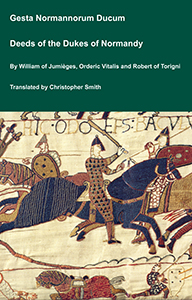
The Deeds of the Dukes of Normandy
The Gesta Normannorum Ducum [The Deeds of the Dukes of Normandy] is a landmark medieval chronicle tracing the rise and fall of the Norman dynasty from its early roots through the pivotal events surrounding the Norman Conquest of England. Originally penned in Latin by the monk William of Jumièges shortly before 1060 and later expanded at the behest of William the Conqueror, the work chronicles the deeds, politics, battles, and leadership of the Norman dukes, especially William’s own claim to the English throne. The narrative combines earlier historical sources with firsthand information and oral testimony to present an authoritative account of Normandy’s transformation from a Viking settlement into one of medieval Europe’s most powerful realms. William’s history emphasizes the legitimacy, military prowess, and governance of the Norman line, framing their expansion, including the conquest of England, as both divinely sanctioned and noble in purpose. Later chroniclers such as Orderic Vitalis and Robert of Torigni continued the history, extending the coverage into the 12th century, providing broader context on ducal rule and its impact. Today this classic work remains a foundational source for understanding Norman identity, medieval statesmanship, and the historical forces that reshaped England and Western Europe between 800AD and 1100AD.
Available at Amazon in eBook and Paperback format.
Count Évreux is in Counts of France.
Around 989 Robert Normandy Archbishop of Rouen (age 1) was created 1st Count Évreux.
In 1037 Robert Normandy Archbishop of Rouen (age 49) died. His son Richard (age 22) succeeded 2nd Count Évreux.
After 1040 Richard Normandy 2nd Count Évreux (age 25) and Adelaide aka Godehildis Ramon were married. She by marriage Countess Évreux. He the son of Robert Normandy Archbishop of Rouen and Herleva Countess Évreux.
In 1067 Richard Normandy 2nd Count Évreux (age 52) died. His son William succeeded I Count Évreux.
In 1115 Amaury Montfort Count Évreux (age 44) and Richilde Flanders Countess Évreux (age 20) were married. She by marriage Countess Évreux. The difference in their ages was 24 years. She the daughter of Baldwin II Count Hainaut and Ida Reginar Countess Hainaut. They were half fourth cousin once removed.
On 16th April 1118 William Normandy I Count Évreux died without issue. His nephew Amaury (age 47) succeeded Count Évreux.
On 19th April 1137 Amaury Montfort Count Évreux (age 66) died at Eure, Haute Normandie. His son Amaury (age 15) succeeded 3rd Count Évreux.
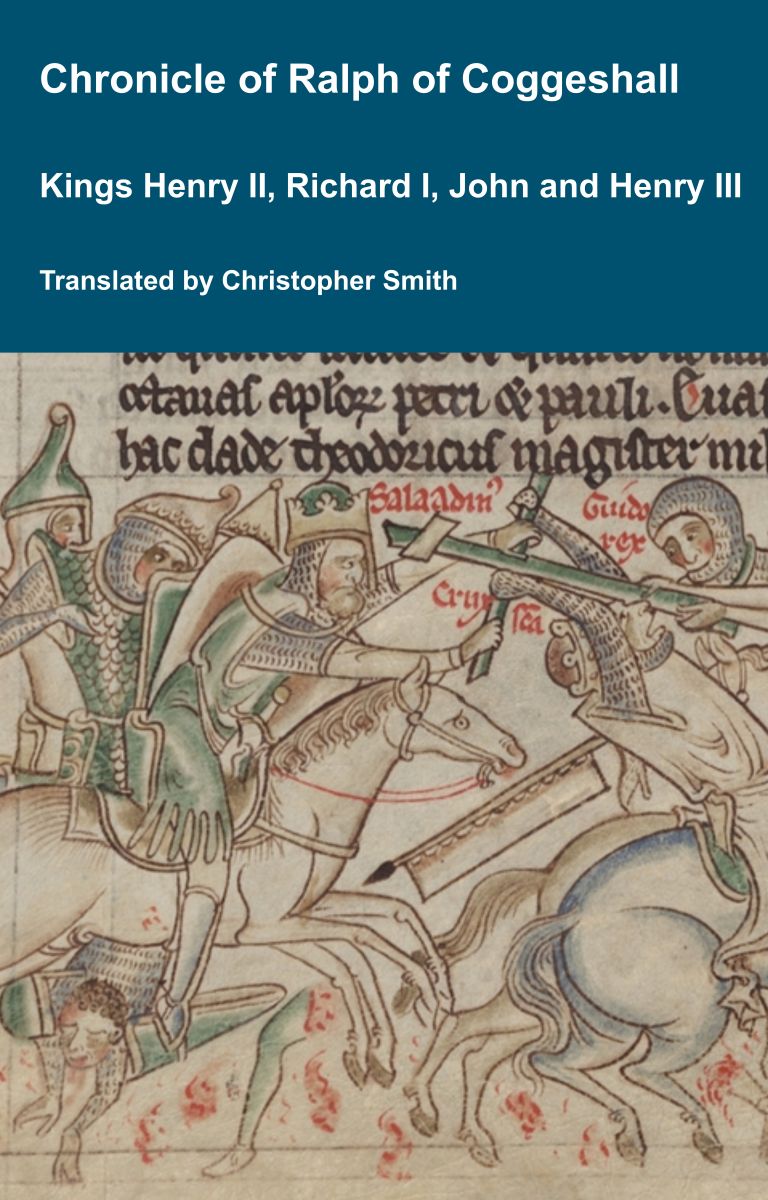
Chronicle of Abbot Ralph of Coggeshall
The Chronicle of Abbot Ralph of Coggeshall (Chronicon Anglicanum) is an indispensable medieval history that brings to life centuries of English and European affairs through the eyes of a learned Cistercian monk. Ralph of Coggeshall, abbot of the Abbey of Coggeshall in Essex in the early 13th century, continued and expanded his community’s chronicle, documenting events from the Norman Conquest of 1066 into the tumultuous reign of King Henry III. Blending eyewitness testimony, careful compilation, and the monastic commitment to record-keeping, this chronicle offers a rare narrative of political intrigue, royal power struggles, and social upheaval in England and beyond. Ralph’s work captures the reigns of pivotal figures such as Richard I and King John, providing invaluable insights into their characters, decisions, and the forces that shaped medieval rule. More than a simple annal, Chronicon Anglicanum conveys the texture of medieval life and governance, making it a rich source for scholars and readers fascinated by English history, monastic authorship, and the shaping of the medieval world.
Available at Amazon in eBook and Paperback format.
In 1140 Amaury IV Montfort 3rd Count Évreux (age 18) died. His brother Simon (age 12) succeeded 4th Count Évreux.
On 13th March 1181 Simon "Chauve" Montfort 4th Count Évreux (age 53) died at Évreux, Haute Normandie. His son Amaury succeeded 5th Count Évreux, 5th Seigneur Montfort.
In 1182 Amaury V Montfort 5th Count Évreux died. His son Amaury succeeded 5th Count Évreux.
In 1298 Louis I Count Évreux (age 21) was created I Count Évreux.
In or before 1303 Louis I Count Évreux (age 26) and Margaret Artois Countess Évreux (age 17) were married. She by marriage Countess Évreux. He the son of King Philip III of France and Maria of Brabant Queen Consort France (age 46). They were second cousin once removed. He a great x 3 grandson of King Henry "Curtmantle" II of England. She a great granddaughter of King Henry III of England.
On 19th May 1319 Louis I Count Évreux (age 43) died. His son Philip (age 13) succeeded Count Évreux.
In 1421 John Stewart of Darnley 1st Count Évreux (age 41) was created 1st Lord Concressault, 1st Lord Aubigny, 1st Count Évreux. Elizabeth Lennox Countess Évreux (age 51) by marriage Lord Concressault, Lord Aubigny, Countess Évreux.
Amaury IV Montfort 3rd Count Évreux and Eve Alice Countess Évreux were married. She by marriage Countess Évreux. He the son of Amaury Montfort Count Évreux.
The Deeds of the Dukes of Normandy
The Gesta Normannorum Ducum [The Deeds of the Dukes of Normandy] is a landmark medieval chronicle tracing the rise and fall of the Norman dynasty from its early roots through the pivotal events surrounding the Norman Conquest of England. Originally penned in Latin by the monk William of Jumièges shortly before 1060 and later expanded at the behest of William the Conqueror, the work chronicles the deeds, politics, battles, and leadership of the Norman dukes, especially William’s own claim to the English throne. The narrative combines earlier historical sources with firsthand information and oral testimony to present an authoritative account of Normandy’s transformation from a Viking settlement into one of medieval Europe’s most powerful realms. William’s history emphasizes the legitimacy, military prowess, and governance of the Norman line, framing their expansion, including the conquest of England, as both divinely sanctioned and noble in purpose. Later chroniclers such as Orderic Vitalis and Robert of Torigni continued the history, extending the coverage into the 12th century, providing broader context on ducal rule and its impact. Today this classic work remains a foundational source for understanding Norman identity, medieval statesmanship, and the historical forces that reshaped England and Western Europe between 800AD and 1100AD.
Available at Amazon in eBook and Paperback format.
Simon "Chauve" Montfort 4th Count Évreux and Mathilde Unknown Countess Évreux were married. She by marriage Countess Évreux. He the son of Amaury Montfort Count Évreux.
Robert Normandy Archbishop of Rouen and Herleva Countess Évreux were married. She by marriage Countess Évreux. He the son of Richard "Fearless" Normandy I Duke Normandy and Gunnora Countess Ponthieu.
Amaury V Montfort 5th Count Évreux and Mabel Fitzrobert Countess Évreux were married. She by marriage Countess Évreux. She the daughter of William Fitzrobert 2nd Earl Gloucester and Hawise Beaumont Countess Gloucester. He the son of Simon "Chauve" Montfort 4th Count Évreux and Mathilde Unknown Countess Évreux. They were half third cousin twice removed. She a great granddaughter of King Henry I "Beauclerc" England.