

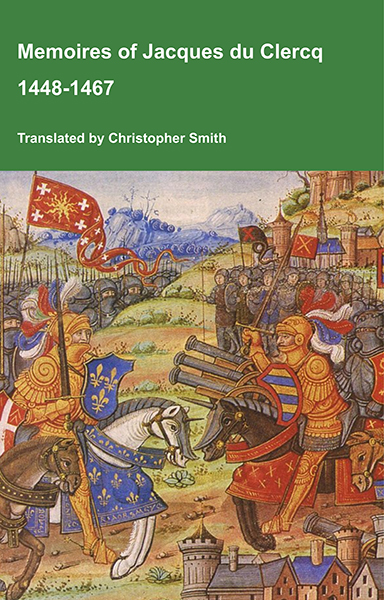
This is a translation of the 'Memoires of Jacques du Clercq', published in 1823 in two volumes, edited by Frederic, Baron de Reissenberg. In his introduction Reissenberg writes: 'Jacques du Clercq tells us that he was born in 1424, and that he was a licentiate in law and a counsellor to Philip the Good, Duke of Burgundy, in the castellany of Douai, Lille, and Orchies. It appears that he established his residence at Arras. In 1446, he married the daughter of Baldwin de la Lacherie, a gentleman who lived in Lille. We read in the fifth book of his Memoirs that his father, also named Jacques du Clercq, had married a lady of the Le Camelin family, from Compiègne. His ancestors, always attached to the counts of Flanders, had constantly served them, whether in their councils or in their armies.' The Memoires cover a period of nineteen years beginning in in 1448, ending in in 1467. It appears that the author had intended to extend the Memoirs beyond that date; no doubt illness or death prevented him from carrying out this plan. As Reissenberg writes the 'merit of this work lies in the simplicity of its narrative, in its tone of good faith, and in a certain air of frankness which naturally wins the reader’s confidence.' Du Clercq ranges from events of national and international importance, including events of the Wars of the Roses in England, to simple, everyday local events such as marriages, robberies, murders, trials and deaths, including that of his own father in Book 5; one of his last entries.
Available at Amazon in eBook and Paperback format.
4th Century Events is in 1st Millennium Events.
In 383 the Romans withdrew from Britain.
Gildas. 19. No sooner were they gone, than the Piets and Scots, like worms which in the heat of mid-day come forth from their holes, hastily land again from their canoes, in which they had been carried beyond the Cichican valley, differing one from another in manners, but inspired with the same avidity for blood, and all more eager to shroud their villainous faces in bushy hair than to cover with decent clothing those parts of their body which required it. Moreover, having heard of the departure of our friends, and their resolution never to return, they seized with greater boldness than before on all the country towards the extreme north as far as the wall. To oppose them there was placed on the heights a garrison equally slow to fight and ill adapted to run away, a useless and panic-struck company, which slumbered away days and nights on their unprofitable watch. Meanwhile the hooked weapons of their enemies were not idle, and our wretched countrymen were dragged from the wall and dashed against the ground. Such premature death, however, painful as it was, saved them from seeing the miserable sufferings of their brothers and children. But why should I say more? They left their cities, abandoned the protection of the wall, and dispersed themselves in flight more desperately than before. The enemy, on the other hand, pursued them with more unrelenting cruelty than before, and butchered our countrymen like sheep, so that their habitations were like those of savage beasts; for they turned their arms upon each other, and for the sake of a little sustenance, imbrued their hands in the blood of their fellow-countrymen. Thus foreign calamities were augmented by domestic feuds; so that the whole country was entirely destitute of provisions, save such as could be procured in the chase.