


Anne Boleyn. Her Life as told by Lancelot de Carle's 1536 Letter.
In 1536, two weeks after the execution of Anne Boleyn, her brother George and four others, Lancelot du Carle, wrote an extraordinary letter that described Anne's life, and her trial and execution, to which he was a witness. This book presents a new translation of that letter, with additional material from other contemporary sources such as Letters, Hall's and Wriothesley's Chronicles, the pamphlets of Wynkyn the Worde, the Memorial of George Constantyne, the Portuguese Letter and the Baga de Secrets, all of which are provided in Appendices.
Available at Amazon in eBook and Paperback format.
Battle of Waterloo is in 1800-1850 Act of Union, Trafalgar and Waterloo.
On 18th June 1815 the Battle of Waterloo was fought.
Beaumont Hotham 3rd Baron Hotham [aged 20] was present.
Charles Augustus Fitzroy [aged 19] was wounded.
Lieutenant-Colonel Henry Edward Irby [aged 31] fought.
Henry William Paget 1st Marquess Anglesey [aged 47] led the charge of the British heavy cavalry against Comte d'Erlon's column which checked and in part routed the French Army. He was hit by one of the last cannon shots of the day necessitating the amputation of this leg during the Battle of Quatre Bras.
Fletcher Norton 3rd Baron Grantley [aged 16] fought and was wounded.
Charles Francis Rowley Lascelles fought.
Edward Kerrison 1st Baronet [aged 38] commanded his Regiment.
George Orlando Gunning [aged 18] was killed whilst serving as a Lieutenant in the 10th Hussars.
On 19th June 1815 Lieutenant Colonel Alexander Gordon [aged 29] died having had his leg amputated the previous day.
Charles Henry Farrington 2nd Baronet [aged 20] fought.


Between 1810 and 1814 Trevor Wheler 9th Baronet [aged 17] served in the Peninsular Wars. He was present at the Battle of Waterloo.
On 18th June 1815 Frederick Howard [aged 29] was killed during the Battle of Waterloo. He was buried at Castle Howard Mausoleum.
On 18th June 1815 Henry Lascelles 3rd Earl Harewood [aged 18] fought at the Battle of Waterloo.
On 18th June 1815 Major-General William Ponsonby [aged 42] was killed at the Battle of Waterloo.
On 18th June 1815 Edward Hawkins Cheney [aged 36] fought at the Battle of Waterloo.
On 18th June 1815 Algernon Frederick Greville [aged 16] fought at Battle of Waterloo.
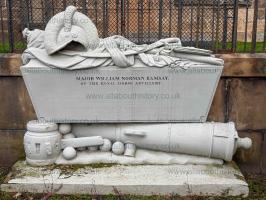
On 18th June 1815 Major Norman William Ramsay [aged 33] was killed in action at the Battle of Waterloo. Monument at St Michal's Church, Inveresk [Map].
Major Norman William Ramsay: In 1782 he was born.
On 18th June 1815, at the Battle of Waterloo, Charles Ewart [aged 46] captured the Regimental Eagle of the 45e Régiment de Ligne. One of the most prized honours of the Scots Greys and, in commemoration of this, their cap badge shows the Eagle. The Eagle is now in Edinburgh Castle Museum. It is one of two Regimental Eagles captured during the Waterloo Campaign.

After 18th January 1867. Melbourne Cemetery, Derbyshire [Map]. Grave of Ensign Henry Edward Gooch of the Coldstream Guards, one of four men responsble for the pivotal closing of the gate at Hougomont Chateau during the Battle of Waterloo.
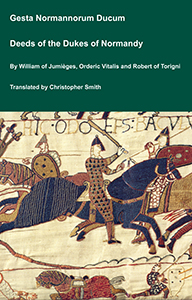
The Deeds of the Dukes of Normandy
The Gesta Normannorum Ducum [The Deeds of the Dukes of Normandy] is a landmark medieval chronicle tracing the rise and fall of the Norman dynasty from its early roots through the pivotal events surrounding the Norman Conquest of England. Originally penned in Latin by the monk William of Jumièges shortly before 1060 and later expanded at the behest of William the Conqueror, the work chronicles the deeds, politics, battles, and leadership of the Norman dukes, especially William’s own claim to the English throne. The narrative combines earlier historical sources with firsthand information and oral testimony to present an authoritative account of Normandy’s transformation from a Viking settlement into one of medieval Europe’s most powerful realms. William’s history emphasizes the legitimacy, military prowess, and governance of the Norman line, framing their expansion, including the conquest of England, as both divinely sanctioned and noble in purpose. Later chroniclers such as Orderic Vitalis and Robert of Torigni continued the history, extending the coverage into the 12th century, providing broader context on ducal rule and its impact. Today this classic work remains a foundational source for understanding Norman identity, medieval statesmanship, and the historical forces that reshaped England and Western Europe between 800AD and 1100AD.
Available at Amazon in eBook and Paperback format.
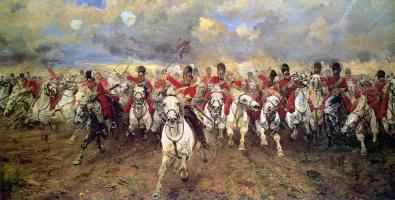
1881. Elizabeth Thompson Lady Butler [aged 34]. "Scotland Forever!" A depiction of the start of the charge of the Royal Scots Greys, a British heavy cavalry regiment that charged with other British heavy cavalry at the Battle of Waterloo in 1815.