

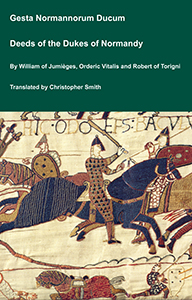
The Deeds of the Dukes of Normandy
The Gesta Normannorum Ducum [The Deeds of the Dukes of Normandy] is a landmark medieval chronicle tracing the rise and fall of the Norman dynasty from its early roots through the pivotal events surrounding the Norman Conquest of England. Originally penned in Latin by the monk William of Jumièges shortly before 1060 and later expanded at the behest of William the Conqueror, the work chronicles the deeds, politics, battles, and leadership of the Norman dukes, especially William’s own claim to the English throne. The narrative combines earlier historical sources with firsthand information and oral testimony to present an authoritative account of Normandy’s transformation from a Viking settlement into one of medieval Europe’s most powerful realms. William’s history emphasizes the legitimacy, military prowess, and governance of the Norman line, framing their expansion, including the conquest of England, as both divinely sanctioned and noble in purpose. Later chroniclers such as Orderic Vitalis and Robert of Torigni continued the history, extending the coverage into the 12th century, providing broader context on ducal rule and its impact. Today this classic work remains a foundational source for understanding Norman identity, medieval statesmanship, and the historical forces that reshaped England and Western Europe between 800AD and 1100AD.
Available at Amazon in eBook and Paperback format.
Scarborough Castle Rebellion is in 1553-1558 Queen Mary.
On 25th April 1557 Thomas Stafford [aged 24] sailed from Dieppe with two ships and over 30 men. He took Scarborough Castle [Map] and declared himself Protector of the Realm.
On 28th April 1557 Henry Neville 5th Earl of Westmoreland [aged 32] retook Scarborough Castle [Map] and captured the rebels.
Henry Machyn's Diary. April 1557. The (blank) day of Aprell suffered dethe in [several] plases in the Northe for entrying in-to Sk[arborough] castyll [Map], (for) the wyche at London master Thomas [Stafford] [aged 24] was heddyd on Towre hylle [Map]; and at Tyborne [Map] John Procter aleas Wylliamsun, Wyllyam Stowe, John Bradford, and more in dyvers plases; [in York]shyre, John Wylborne, Clement Tyllyd, John Cawsewelle, and Robart Hunter, at York, [by the] dethe of hangyng, drahyns, and quarter[ing].
On 25th April 1557 Thomas Stafford [aged 24] landed at Scarborough, North Yorkshire [Map].
Henry Machyn's Diary. 2nd May 1557. The ij day of May dyd pryche at Powlles crosse [Map] dyd pryche docthur Chadsay, and mad a godly sermon, and ther he declaryd that serten trayturs that was taken at Skarborow castyll [Map], the wyche they fled over the see a-for ....
Henry Machyn's Diary. 25th May 1557. The xxv day of May was raynyd at Westmynster one, a Frenche man, that was taken at Skarborow when that Thomas Stafford [aged 24] was taken with ys adherentes, and cast to dee, and so cared to the Towre agayn.
Note. P. 135. Scarborough castle. Strype in his Memorials, vol. iii. Appen. lxxiii. has printed "the Names of the Prisoners taken in Scarborowe Castell the 28th of Apryll, An. 1557." Five were committed to the Tower of London, and twenty-seven remained in York Castle.
Note. Pp. 135, 136. Death and Funeral of sir Jaques Granado. He was a native of Brabant: having distinguished himself in the campaign in Scotland in 1547 (Holinshed, 1st edit. p. 1620), he was one of the knights made at its close by the duke of Somerset at Berwick, Sept. 28. (Ibid. p. 1633). An annuity of 50l. was granted March 10, 1549-50, to sir Jaques Granado and Magdalen his wife, and to the longer liver: see the patent printed in Rymer, xv. 210. He appears to have filled the office of equerry or some similar post, as in Oct. 1551, he had a passport to conduct sixteen horses sent by Edward VI. to the French king. His widow "Mawdelyn" became the second wife of sir Robert Chester, and his daughter Katharine was married to Edward Chester, sir Robert's son and heir. (MS. Harl. 897, f. 55b.)
Henry Machyn's Diary. 28th May 1557. [The xxviij day of May Thomas Stafford [aged 24] was beheaded on Tower hill [Map], by nine of the clock, master Wode being his] gostly father; and after ther wher iij more [drawn from the To] wre, and thrugh London unto Tyburne [Map], and ther [they were] hangyd and quartered; and the morow after was master [Stafford] quartered, and hangyd on a care, and so to Nuwgatt to [boil.]
On 28th May 1557 Thomas Stafford [aged 24] was beheaded at Tower Hill [Map].
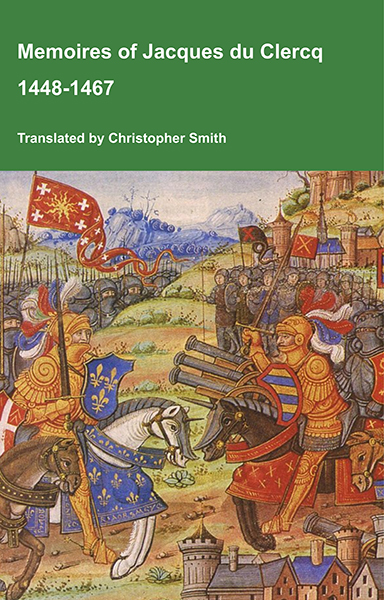
This is a translation of the 'Memoires of Jacques du Clercq', published in 1823 in two volumes, edited by Frederic, Baron de Reissenberg. In his introduction Reissenberg writes: 'Jacques du Clercq tells us that he was born in 1424, and that he was a licentiate in law and a counsellor to Philip the Good, Duke of Burgundy, in the castellany of Douai, Lille, and Orchies. It appears that he established his residence at Arras. In 1446, he married the daughter of Baldwin de la Lacherie, a gentleman who lived in Lille. We read in the fifth book of his Memoirs that his father, also named Jacques du Clercq, had married a lady of the Le Camelin family, from Compiègne. His ancestors, always attached to the counts of Flanders, had constantly served them, whether in their councils or in their armies.' The Memoires cover a period of nineteen years beginning in in 1448, ending in in 1467. It appears that the author had intended to extend the Memoirs beyond that date; no doubt illness or death prevented him from carrying out this plan. As Reissenberg writes the 'merit of this work lies in the simplicity of its narrative, in its tone of good faith, and in a certain air of frankness which naturally wins the reader’s confidence.' Du Clercq ranges from events of national and international importance, including events of the Wars of the Roses in England, to simple, everyday local events such as marriages, robberies, murders, trials and deaths, including that of his own father in Book 5; one of his last entries.
Available at Amazon in eBook and Paperback format.
Henry Machyn's Diary. 29th May 1557. The xxix day of May was the iiij heds sett upon London bryge, and ther xvj quarters sett up, iij and ij, on evere gatt of London; the sam mornyng was Thomas Stafford('s) [deceased] body quartered.