

Chronicle of a Bourgeois of Valenciennes
Récits d’un bourgeois de Valenciennes aka The Chronicle of a Bourgeois of Valenciennes is a vivid 14th-century vernacular chronicle written by an anonymous urban chronicler from Valenciennes in the County of Hainaut. It survives in a manuscript that describes local and regional history from about 1253 to 1366, blending chronology, narrative episodes, and eyewitness-style accounts of political, military, and social events in medieval France, Flanders, and the Low Countries. The work begins with a chronological framework of events affecting Valenciennes and its region under rulers such as King Philip VI of France and the shifting allegiances of local nobility. It includes accounts of conflicts, sieges, diplomatic manoeuvres, and the impact of broader struggles like the Hundred Years’ War on urban life in Hainaut. Written from the perspective of a burgher (bourgeois) rather than a monastery or royal court, the chronicle offers a rare lay viewpoint on high politics and warfare, reflecting how merchants, townspeople, and civic institutions experienced the turbulence of the 13th and 14th centuries. Its narrative style combines straightforward reporting of events with moral and civic observations, making it a valuable source for readers interested in medieval urban society, regional politics, and the lived experience of war and governance in pre-modern Europe.
Available at Amazon in eBook and Paperback format.
St James' Day Battle is in 1660-1684 Restoration.
On 25th July 1666 the English fleet, commanded jointly between Prince Rupert Palatinate Simmern 1st Duke Cumberland [aged 46] and George Monck 1st Duke Albemarle [aged 57], inflicted a severe defeat on the Dutch fleet commanded by Admiral Michiel de Ruyter [aged 59]. Dutch casualties amounted to 1200 men, English 300. The Dutch only lost two ships: De Ruyter had been successful at saving almost the complete van, only Sneek and Tholen struck their flag. Tholen was the flagship of admiral Banckert who had moved his flag to another vessel. Both ships were burnt by the English.
Captain George Batts fought in Richard Utber's division in the White Squadron.
The Gloucester fought.


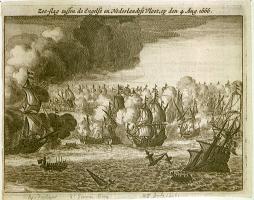
25th July 1666. Dutch text etching: "Zee-Slag tussen de Engelse en Nederlandtse Vloot, op den 4 Aug. 1666." Engraving showing the St. James' Day Battle
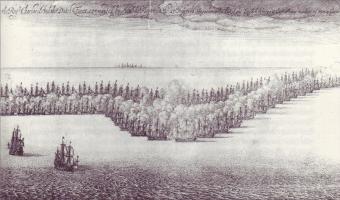
25th July 1666. St. James Day Fight by Wenceslaus Hollar
John Evelyn's Diary. 25th July 1666. The fleets engaged. I dined at Lord Berkeley's [aged 38], at St. James's, where dined my Lady Harrietta Hyde [aged 20], Lord Arlington [aged 48], and Sir John Duncomb [aged 44].


Samuel Pepys' Diary. 27th July 1666. He gone, I away by water from the Old Swan [Map] to White Hall. The waterman tells me that newes is come that our ship Resolution is burnt, and that we had sunke four or five of the enemy's ships. When I come to White Hall I met with Creed, and he tells me the same news, and walking with him to the Park I to Sir W. Coventry's [aged 38] lodging, and there he showed me Captain Talbot's letter, wherein he says that the fight begun on the 25th; that our White squadron begun with one of the Dutch squadrons, and then the Red with another so hot that we put them both to giving way, and so they continued in pursuit all the day, and as long as he stayed with them: that the Blue fell to the Zealand squadron; and after a long dispute, he against two or three great ships, he received eight or nine dangerous shots, and so come away; and says, he saw The Resolution burned by one of their fire-ships, and four or five of the enemy's. But says that two or three of our great ships were in danger of being fired by our owne fire-ships, which Sir W. Coventry, nor I, cannot understand. But upon the whole, he and I walked two or three turns in the Parke under the great trees, and do doubt that this gallant is come away a little too soon, having lost never a mast nor sayle. And then we did begin to discourse of the young gentlemen captains, which he was very free with me in speaking his mind of the unruliness of them; and what a losse the King [aged 36] hath of his old men, and now of this Hannam, of The Resolution, if he be dead, and that there is but few old sober men in the fleete, and if these few of the Flags that are so should die, he fears some other gentlemen captains will get in, and then what a council we shall have, God knows. He told me how he is disturbed to hear the commanders at sea called cowards here on shore, and that he was yesterday concerned publiquely at a dinner to defend them, against somebody that said that not above twenty of them fought as they should do, and indeed it is derived from the Duke of Albemarle [aged 57] himself, who wrote so to the King and Duke [aged 32], and that he told them how they fought four days, two of them with great disadvantage. The Count de Guiche, who was on board De Ruyter [aged 59], writing his narrative home in French of the fight, do lay all the honour that may be upon the English courage above the Dutch, and that he himself [Sir W. Coventry] was sent down from the King and Duke of Yorke after the fight, to pray them to spare none that they thought had not done their parts, and that they had removed but four, whereof Du Tell is one, of whom he would say nothing; but, it seems, the Duke of Yorke hath been much displeased at his removal, and hath now taken him into his service, which is a plain affront to the Duke of Albemarle; and two of the others, Sir W. Coventry did speake very slenderly of their faults. Only the last, which was old Teddiman, he says, is in fault, and hath little to excuse himself with; and that, therefore, we should not be forward in condemning men of want of courage, when the Generalls, who are both men of metal, and hate cowards, and had the sense of our ill successe upon them (and by the way must either let the world thinke it was the miscarriage of the Captains or their owne conduct), have thought fit to remove no more of them, when desired by the King and Duke of Yorke to do it, without respect to any favour any of them can pretend to in either of them.
Samuel Pepys' Diary. 29th July 1666. Lord's Day. Up and all the morning in my chamber making up my accounts in my book with my father and brother and stating them. Towards noon before sermon was done at church comes newes by a letter to Sir W. Batten [aged 65], to my hand, of the late fight, which I sent to his house, he at church. But, Lord! with what impatience I staid till sermon was done, to know the issue of the fight, with a thousand hopes and fears and thoughts about the consequences of either. At last sermon is done and he come home, and the bells immediately rung soon as the church was done. But coming; to Sir W. Batten to know the newes, his letter said nothing of it; but all the towne is full of a victory.

Calendar of State Papers Charles II 30 Jul 1666. 30th July 1666. Great Yarmouth, Norfolk [Map]. 80. Rich. Bower to Williamson. The Zealanders were engaged with the Blue squadron Wednesday and most of Thursday, but at length the Zealanders ran; the Dutch fleet escaped to the Weelings and Goree; only hears of six ships lost by them; 32 wounded men from the Victory and Vanguard have come to Southwold, Suffolk [Map]. The Victory being threatened by a fire-ship, the captain sent his lieutenant in a ketch to put the fire-ship by; the ketch followed the fire-ship too near the Dutch fleet, and being herself taken for a fire-ship, every one near let fly at ber, so the ketch was sadly shattered and the lieutenant killed. Capt. Talbot of the Elizabeth came into Aldborough [Map], with his vessel in good condition, walking the deck in his silk morning gown and powdered hair. The East India London also came into Aldborough [Map]; the captain was killed, and the surgeon's arm broken; the men declared they would not fight without a surgeon; other arrivals at Yarmouth [Map]. Sir Thomas Allin [aged 54] has taken and fired Banckart's flag ship, Banckart escaping in a boat. The Royal Charles is sent in; the generals remain on board the Royal James. The Hull fleet has sailed from Yarmouth [Map] for London without convoy. Begs the Gazettes regularly; 22 wounded men are brought ashore.
Samuel Pepys' Diary. 31st July 1666. Thence to Westminster Hall [Map] and walked an hour with Creed talking of the late fight, and observing the ridiculous management thereof and success of the Duke of Albemarle [aged 57].
Samuel Pepys' Diary. 31st July 1666. Thence parted and to Mrs. Martin's lodgings, and sat with her a while, and then by water home, all the way reading the Narrative of the late fight in order, it may be, to the making some marginal notes upon it. At the Old Swan [Map] found my Betty Michell at the doore, where I staid talking with her a pretty while, it being dusky, and kissed her and so away home and writ my letters, and then home to supper, where the brother and Mary Batelier are still and Mercer's two sisters. They have spent the time dancing this afternoon, and we were very merry, and then after supper into the garden and there walked, and then home with them and then back again, my wife and I and the girle, and sang in the garden and then to bed. Colville was with me this morning, and to my great joy I could now have all my money in, that I have in the world. But the times being open again, I thinke it is best to keepe some of it abroad.
Annals of the six Kings of England by Nicholas Trivet
Translation of the Annals of the Six Kings of England by that traces the rise and rule of the Angevin aka Plantagenet dynasty from the mid-12th to early 14th century. Written by the Dominican scholar Nicholas Trivet, the work offers a vivid account of English history from the reign of King Stephen through to the death of King Edward I, blending political narrative with moral reflection. Covering the reigns of six monarchs—from Stephen to Edward I—the chronicle explores royal authority, rebellion, war, and the shifting balance between crown, church, and nobility. Trivet provides detailed insight into defining moments such as baronial conflicts, Anglo-French rivalry, and the consolidation of royal power under Edward I, whose reign he describes with particular immediacy. The Annals combines careful year-by-year reporting with thoughtful interpretation, presenting history not merely as a sequence of events but as a moral and political lesson. Ideal for readers interested in medieval history, kingship, and the origins of the English state, this chronicle remains a valuable and accessible window into the turbulent world of the Plantagenet kings.
Available at Amazon in eBook and Paperback format.
Samuel Pepys' Diary. 3rd August 1666. The death of Everson, and the report of our success, beyond expectation, in the killing of so great a number of men, hath raised the estimation of the late victory considerably; but it is only among fools: for all that was but accidental. But this morning, getting Sir.W. Pen [aged 45] to read over the Narrative with me, he did sparingly, yet plainly, say that we might have intercepted their Zealand squadron coming home, if we had done our parts; and more, that we might have spooned before the wind as well as they, and have overtaken their ships in the pursuite, in all the while1.
Note 1. To spoom, or spoon, is to go right before the wind, without any sail. Sea Dictionary. Dryden [aged 34] uses the word "When virtue spooms before a prosperous gale, My heaving wishes help to fill the sail". Hind and Panther, iii. 96.


Samuel Pepys' Diary. 14th August 1666. Thanksgiving Day1. Up, and comes Mr. Foley and his man, with a box of a great variety of carpenter's and joyner's tooles, which I had bespoke, to me, which please me mightily; but I will have more. Then I abroad down to the Old Swan [Map], and there I called and kissed Betty Michell, and would have got her to go with me to Westminster, but I find her a little colder than she used to be, methought, which did a little molest me.
Note 1. A proclamation ordering August 14th to be observed in London and Westminster, and August 23rd in other places, as a day of thanksgiving for the late victory at sea over the Dutch, was published on August 6th.
Calendar of State Papers Charles II 27 Oct 1666. 27th October 1666. Whitehall. 62. H. Muddiman to Sir Edward Stradling, St. Donat's Castle [Map], Glamorganshire. The sickness is abating, 8 only have died of it at Plymouth, 8 at Sarum, decrease 17, one or two at Ipswich, and 8 at Norwich. The English are said to have been forced from the Canaries, leaving their estates in the hands of Spaniards. The Commissioners for payment of seamen daily pay off great numbers who are discharged from winter service, and bring their tickets with them, and the rest are ordered by beat of drum to repair aboard. The planting of hemp is much enconraged. The Commons have answered the Lords' reasons about importing French commodities, and are settling supplies. Sir Jeremy Smith has got as much credit by his late examination as his enemies wished him disgrace, the King [aged 36] and Duke of York [aged 33] being fully satisfied of his valour in the engagement. It appears that he had 147 men killed and wounded, while the most eminent of his accusers had but two or three. Peter Ceely of Cornwall, secured on suspicion of fanaticism, refused the liberty offered him if he would give security to the deputy lieutenants. The King has ordered a proclamation in Scotland for a convocation, which differs from a parliament in that it can levy money, but makes no laws. News from Germany, Brandenburg, Holland, and Munster. Sir Rich. Browne has brought into the House of Commons knives broad and sharp, able to pierce armour, of which 300 were found in the rubbish of a house where two Frenchmen lived; they can be guessed of no use but to massacre. A proclamation and other measures are proposed, for repressing the insolencies of the Papists. [8 pages.]


Calendar of State Papers Charles II 03 Nov 1666. 3rd November 1666. Declaration [by Lord Arlington]. The King [aged 36], haying maturely considered the charges brought against Sir Rob. Holmes [aged 44] by Sir Jeremy Smith, finds no cause to suspect Sir Robert of cowardice in the fight with the Dutch of June 25 and 26, but thinks that on the night of the 26th, he yielded too easily to the opinion of his pilot, without consulting those of the other ships, muzzled his ship, and thus obliged the squadron to do the same, and so the enemy, which might have been driven into the body of the King's fleet, then returning from the pursuit, was allowed to escape. [Hnt. Book 23, p. 264.]
John Evelyn's Diary. 29th July 1666. The pestilence now fresh increasing in our parish, I forbore going to church. In the afternoon came tidings of our victory over the Dutch, sinking some, and driving others aground, and into their ports.
Samuel Pepys' Diary. 28th October 1666. Lord's Day. Up, and to church with my wife, and then home, and there is come little Michell and his wife, I sent for them, and also comes Captain Guy to dine with me, and he and I much talk together. He cries out of the discipline of the fleete, and confesses really that the true English valour we talk of is almost spent and worn out; few of the commanders doing what they should do, and he much fears we shall therefore be beaten the next year. He assures me we were beaten home the last June fight, and that the whole fleete was ashamed to hear of our bonefires. He commends Smith, and cries out of Holmes [aged 44] for an idle, proud, conceited, though stout fellow. He tells me we are to owe the losse of so many ships on the sands, not to any fault of the pilots, but to the weather; but in this I have good authority to fear there was something more. He says the Dutch do fight in very good order, and we in none at all. He says that in the July fight, both the Prince [aged 46] and Holmes had their belly-fulls, and were fain to go aside; though, if the wind had continued, we had utterly beaten them. He do confess the whole to be governed by a company of fools, and fears our ruine.