

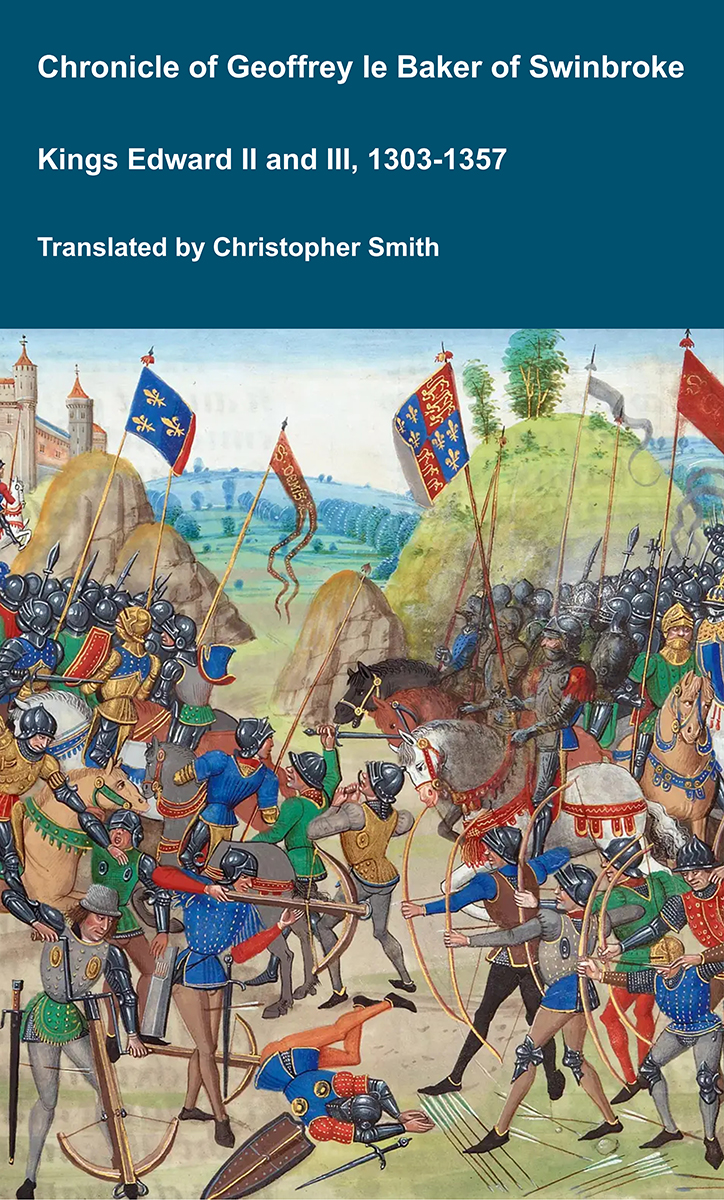
Chronicle of Geoffrey le Baker of Swinbroke
Baker was a secular clerk from Swinbroke, now Swinbrook, an Oxfordshire village two miles east of Burford. His Chronicle describes the events of the period 1303-1356: Gaveston, Bannockburn, Boroughbridge, the murder of King Edward II, the Scottish Wars, Sluys, Crécy, the Black Death, Winchelsea and Poitiers. To quote Herbert Bruce 'it possesses a vigorous and characteristic style, and its value for particular events between 1303 and 1356 has been recognised by its editor and by subsequent writers'. The book provides remarkable detail about the events it describes. Baker's text has been augmented with hundreds of notes, including extracts from other contemporary chronicles, such as the Annales Londonienses, Annales Paulini, Murimuth, Lanercost, Avesbury, Guisborough and Froissart to enrich the reader's understanding. The translation takes as its source the 'Chronicon Galfridi le Baker de Swynebroke' published in 1889, edited by Edward Maunde Thompson.
Available at Amazon in eBook and Paperback format.
Around 1283 John Sully was born.
On 19th July 1333 King Edward III of England defeated the Scots army at the Battle of Halidon Hill near Berwick-upon-Tweed, Northumberland. John of Eltham 1st Earl Cornwall commanded.
English archers, just as at the Battle of Dupplin Moor one year previously, had a significant impact on the massed ranks of Scottish schiltrons. Edward's army included: Thomas of Brotherton 1st Earl Norfolk, who commanded the right wing, Hugh Courtenay 1st or 9th Earl Devon, Robert Pierrepont, Hugh Courtenay 2nd or 10th Earl Devon, Henry Beaumont Earl Buchan and John Sully. One of the few English casualties was John Neville who was killed.
The Scottish army included King David II of Scotland. Alexander Bruce, Alan Stewart, James Stewart, John Stewart, William Douglas 1st Earl Atholl, Archibald Douglas who were all killed.
Hugh 4th Earl Ross was killed. William 5th Earl Ross succeeded 5th Earl Ross.
Malcolm Lennox 2nd Earl Lennox was killed. Domhnall Lennox Earl Lennox succeeded Earl Lennox.
Kenneth de Moravia Sutherland 4th Earl Sutherland was killed. William de Moravia Sutherland 5th Earl Sutherland succeeded 5th Earl Sutherland. Johanna Menteith Countess Sutherland by marriage Countess Sutherland.
On 26th August 1346 the army of King Edward III of England defeated the French army at the Battle of Crécy. The English army was commanded by King Edward III of England, his son Edward "Black Prince", Thomas Beauchamp 11th Earl Warwick, William Bohun 1st Earl of Northampton and John Beauchamp 1st Baron Beauchamp Warwick.
The English army was included: Bishop Thomas of Hatfield, Hugh Despencer 1st Baron Despencer, Bernard Brocas, Thomas Felton, James Audley, Robert Bourchier 1st Baron Bourchier, Bartholomew "The Elder" Burghesh 1st Baron Burghesh, Bartholomew "The Younger" Burghesh 2nd Baron Burghesh, Reginald Cobham 1st Baron Cobham, John Darcy 1st Baron Darcy of Knayth, Robert Ferrers 3rd Baron Ferrers of Chartley, Richard Scrope 1st Baron Scrope of Bolton, William Scrope, Stephen Scrope, William Latimer 4th Baron Latimer of Corby, John Lisle 2nd Baron Lisle, Gerard Lisle 1st Baron Lisle, Nicholas Longford, Edward Montagu 1st Baron Montagu, Walter Paveley 4th Baron Burghesh, Michael Poynings 1st Baron Poynings, Robert Ufford 1st Earl Suffolk, John de Vere 7th Earl of Oxford, Thomas West, John Willoughby 2nd Baron Willoughby, John Wingfield, Henry Percy 11th and 3rd Baron Percy, Hugh Courtenay 2nd or 10th Earl Devon (possibly), Walter "Elder" Devereux, John Devereux, Enion Sais Brecon, John Chandos, Richard Pembridge and John Sully.
The French army suffered significant casualties. King Philip "Fortunate" VI of France was wounded. William de Coucy and his son Enguerrand 6th Lord de Coucy and were killed.
Charles II Count Alençon was killed. Charles Valois Archbishop of Lyons succeeded Count Alençon.
Louis Chatillon II Count Blois I Count Chatillon was killed. Louis Chatillon III Count Blois Count Soissons succeeded III Count Blois.
Louis Dampierre II Count Nevers I Count Flanders was killed. Louis of Male III Count Nevers II Count Flanders succeeded III Count Nevers, II Count Flanders.
King John I of Bohemia was killed. Charles IV King Bohemia Holy Roman Emperor Luxemburg succeeded IV King Bohemia, Holy Roman Emperor Luxemburg. Blanche Valois Holy Roman Empress Luxemburg by marriage Holy Roman Empress Luxemburg.
Rudolph "Valiant" Metz I Duke Lorraine was killed. John Metz I Duke Lorraine succeeded I Duke Lorraine.
Jean IV de Harcourt was killed.
On 29th August 1350 the English fleet defeated a Castilian fleet at Winchelsea during the Battle of Winchelsea. Around twenty Castilian ships were captured; several were sunk. For the English King Edward III of England and his son Edward "Black Prince", James Audley, Henry Scrope 1st Baron Scrope of Masham, Henry of Grosmont 1st Duke Lancaster and John Sully fought.
On 19th September 1356 the army of Edward "Black Prince" defeated the French and Scottish army led by King John "The Good" II of France at the Battle of Poitiers
King John "The Good" II of France was captured by three captains including Ivon aka John Fane.
The the English army included: Bernard Brocas, Thomas Felton, James Audley, Thomas Beauchamp 11th Earl Warwick, Bartholomew "The Younger" Burghesh 2nd Baron Burghesh, Reginald Cobham 1st Baron Cobham, Edward Despencer 1st Baron Despencer, Baron Burghesh, Ralph Ferrers, William Scrope, William Montagu 2nd Earl Salisbury, Walter Paveley 4th Baron Burghesh, Robert Ufford 1st Earl Suffolk, William Ufford 2nd Earl Suffolk, John de Vere 7th Earl of Oxford, John Willoughby 3rd Baron Willoughby, Thomas Arderne, Enion Sais Brecon, John Chandos, Richard Pembridge, Jean Grailly, Robert de Fouleshurst and John Sully
John Savile of Shelley and Golcar probably fought having received letters of protection to travel overseas.
Hugh Courtenay 2nd or 10th Earl Devon protected the baggage train.
The French and Scottish army included: King John "The Good" II of France, Philip "Bold" Valois II Duke Burgundy, Jean Bourbon I Count La Marche, Archibald "Grim" Douglas 3rd Earl Douglas, John "Sans Terre" Artois 1st Count of Eu; all captured.
Guichard d'Angle 1st Earl Huntingdon and William Douglas 1st Earl Douglas fought.
Peter Bourbon Duke Bourbon was killed. Louis Bourbon II Duke Bourbon succeeded II Duke Bourbon.
Gauthier VI Comte de Brienne was killed.
 Become a Member via our Buy Me a Coffee page to read more.
On 23rd April 1362 John Sully was appointed 39th Knight of the Garter by King Edward III of England.
Around 1388 John Sully died.