

Abbot John Whethamstede’s Chronicle of the Abbey of St Albans
Abbot John Whethamstede's Register aka Chronicle of his second term at the Abbey of St Albans, 1451-1461, is a remarkable text that describes his first-hand experience of the beginning of the Wars of the Roses including the First and Second Battles of St Albans, 1455 and 1461, respectively, their cause, and their consequences, not least on the Abbey itself. His text also includes Loveday, Blore Heath, Northampton, the Act of Accord, Wakefield, and Towton, and ends with the Coronation of King Edward IV. In addition to the events of the Wars of the Roses, Abbot John, or his scribes who wrote the Chronicle, include details in the life of the Abbey such as charters, letters, land exchanges, visits by legates, and disputes, which provide a rich insight into the day-to-day life of the Abbey, and the challenges faced by its Abbot.
Available at Amazon in eBook and Paperback format.
Africa is in Continents.
On 16th April 1882 John Talbot Clifton [aged 63] died at Algeria. He was buried at St Cuthbert's Church, Lytham [Map].

On 16th May 1895 William Douglas Hamilton 12th Duke Hamilton 9th Duke Brandon [aged 50] died at Algiers. His fourth cousin Alfred [aged 33] succeeded 13th Duke Hamilton, 10th Duke Brandon of Suffolk, 9th Marquess Douglas, 10th Baron Dutton of Cheshire.
On 11th December 1900 Henry Ryder 4th Earl of Harrowby [aged 64] died at sea on his yacht Miranda at Algiers. His son John [aged 36] succeeded 5th Earl of Harrowby, 6th Baron Harrowby of Harrowby in Lincolnshire.
Samuel Pepys' Diary. 11th October 1664. This day with great joy Captain Titus [aged 41] told us the particulars of the French's expedition against Gigery upon the Barbary Coast, in the Straights, with 6,000 chosen men. They have taken the Fort of Gigery, wherein were five men and three guns, which makes the whole story of the King of France's [aged 26] policy and power to be laughed at.
On 3rd February 1911 George Grey [aged 44] died at Nairobi.

On 9th December 1941 David Arthur Coke [aged 26] was killed in action by enemy Bf 109s in Acroma, Libya. He was buried at the Knightsbridge War Cemetery, Acroma. Memorial at St Withburga's Church, Holkham [Map].
On 9th December 1941 David Arthur Coke [aged 26] was killed in action by enemy Bf 109s in Acroma, Libya. He was buried at the Knightsbridge War Cemetery, Acroma. Memorial at St Withburga's Church, Holkham [Map].
On 22nd November 1941 Henry Burrows Shiffner 7th Baronet [aged 39] was killed in action at Sidi Rezegh, Tobruk during Operation Crusader to raise the siege of Tobruk. His son Henry [aged 11] succeeded 8th Baronet Shiffner of Coombe in Sussex.
Samuel Pepys' Diary. 14th October 1663. Thence home and after dinner my wife and I, by Mr. Rawlinson's [aged 49] conduct, to the Jewish Synagogue: where the men and boys in their vayles, and the women behind a lattice out of sight; and some things stand up, which I believe is their Law, in a press to which all coming in do bow; and at the putting on their vayles do say something, to which others that hear him do cry Amen, and the party do kiss his vayle. Their service all in a singing way, and in Hebrew. And anon their Laws that they take out of the press are carried by several men, four or five several burthens in all, and they do relieve one another; and whether it is that every one desires to have the carrying of it, I cannot tell, thus they carried it round about the room while such a service is singing. And in the end they had a prayer for the King [aged 33], which they pronounced his name in Portugall; but the prayer, like the rest, in Hebrew. But, Lord! to see the disorder, laughing, sporting, and no attention, but confusion in all their service, more like brutes than people knowing the true God, would make a man forswear ever seeing them more and indeed I never did see so much, or could have imagined there had been any religion in the whole world so absurdly performed as this. Away thence with my mind strongly disturbed with them, by coach and set down my wife in Westminster Hall [Map], and I to White Hall, and there the Tangier Committee met, but the Duke and the Africa Committee meeting in our room, Sir G. Carteret [aged 53]; Sir Wm. Compton [aged 38], Mr. Coventry [aged 35], Sir W. Rider, Cuttance and myself met in another room, with chairs set in form but no table, and there we had very fine discourses of the business of the fitness to keep Sally, and also of the terms of our King's paying the Portugees that deserted their house at Tangier [Map], which did much please me, and so to fetch my wife, and so to the New Exchange about her things, and called at Thomas Pepys the turner's and bought something there, an so home to supper and to bed, after I had been a good while with Sir W. Pen [aged 42], railing and speaking freely our minds against Sir W. Batten [aged 62] and Sir J. Minnes [aged 64], but no more than the folly of one and the knavery of the other do deserve.


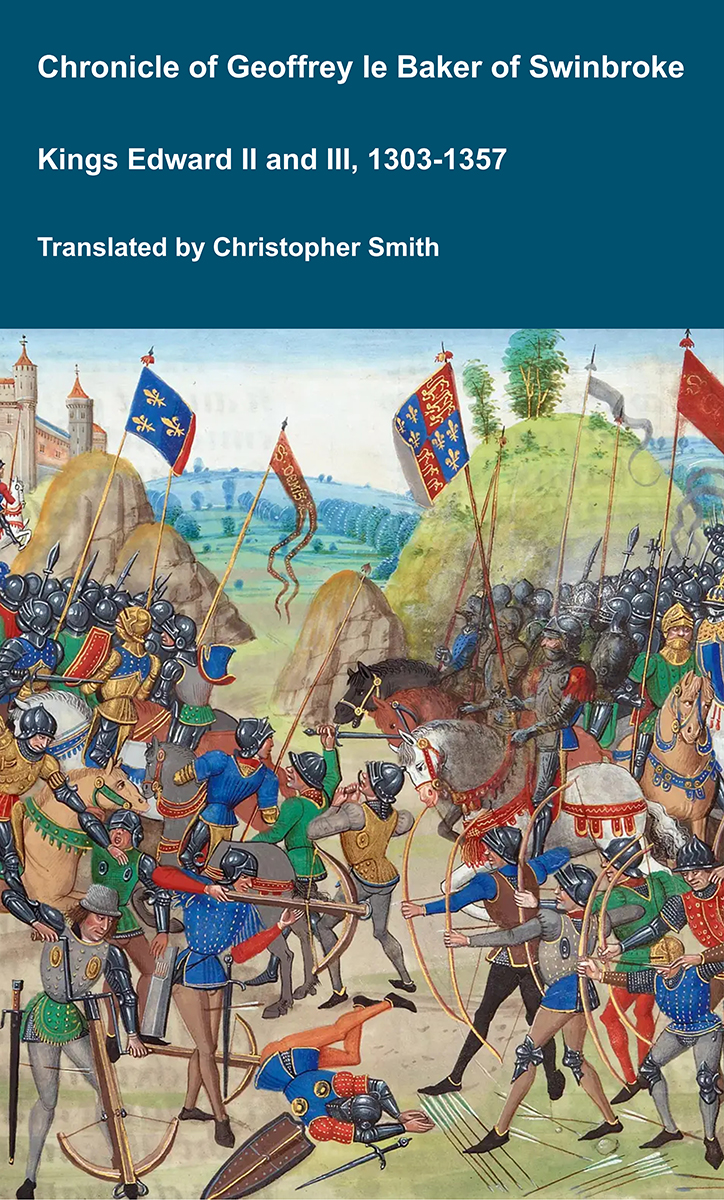
Chronicle of Geoffrey le Baker of Swinbroke
Baker was a secular clerk from Swinbroke, now Swinbrook, an Oxfordshire village two miles east of Burford. His Chronicle describes the events of the period 1303-1356: Gaveston, Bannockburn, Boroughbridge, the murder of King Edward II, the Scottish Wars, Sluys, Crécy, the Black Death, Winchelsea and Poitiers. To quote Herbert Bruce 'it possesses a vigorous and characteristic style, and its value for particular events between 1303 and 1356 has been recognised by its editor and by subsequent writers'. The book provides remarkable detail about the events it describes. Baker's text has been augmented with hundreds of notes, including extracts from other contemporary chronicles, such as the Annales Londonienses, Annales Paulini, Murimuth, Lanercost, Avesbury, Guisborough and Froissart to enrich the reader's understanding. The translation takes as its source the 'Chronicon Galfridi le Baker de Swynebroke' published in 1889, edited by Edward Maunde Thompson.
Available at Amazon in eBook and Paperback format.

After 1908. The Stanley Mausoleum, St Mary's Church [Map]. Memorial to Edward John Stanley [aged 29]. Buried at Sokoto, Nigeria.
Edward John Stanley: On 14th May 1878 he was born to Edward Lyulph Stanley 4th Baron Stanley 3rd Baron Eddisbury and Mary Catherine Bell Baroness Stanley. On 14th November 1908 Edward John Stanley died unmarried.
Around 1838 Martha Solomon Countess Stamford and Warrington was born at Cape Town the daughter of a freed slave Rebecca aka "Queen Rebecca".
On 3rd April 1919 Hugh Denis Charles Fitzroy 11th Duke Grafton was born to Charles Alfred Euston Fitzroy 10th Duke Grafton [aged 26] and Doreen Buxton Duchess Grafton [aged 21] at Cape Town. He married 12th October 1946 Ann Fortune Smith Duchess Grafton and had issue.
On 27th May 1900 Captain Ralph Nevile Fane [aged 30] died of pneumonia at Wynberg where he was buried.
From 5th February 1900 to 7th February 1900. The Battle of Vaal Krantz was fought at Vaal Krantz, Natal between General Redvers Buller's British army and Louis Botha's army of Boer irregulars and lift the Siege of Ladysmith. Buller tried, unsuccessfully, to force a bridgehead across the Tugela River.
John Spencer Cavendish [aged 24] was present.
Lieutenant Charles Duncombe Shafto [aged 22] was killed in action whilst serving with the Durham Light Infantry.
On 28th September 1928 Charles Grey [aged 55] died at Tabora.
In 1270 Eustachie Lusignan died at Carthage.
On 9th August 1270 Richard de Dover Plantagenet [aged 50] died in Carthage.
In July 1270 King Louis IX of France [aged 56] with Theobald "Young" II King Navarre [aged 30] travelled to Tunis [Map] to commence the Eighth Crusade.
On 6th August 1270 David Strathbogie 8th Earl Atholl died at Tunis [Map]. His son John [aged 4] succeeded 9th Earl Atholl.
On 20th August 1270 King Edward I of England [aged 31] and Eleanor of Castile Queen Consort England [aged 29] sailed from Dover, Kent [Map] to Tunis [Map] via Sicily [Map]. On arrival at Sicily [Map] King Charles Capet of Sicily [aged 43], brother of the recently deceased King Louis IX of France [aged 56], had signed a treaty with the Emir so Edward returned to Sicily [Map].
In 1271 Raoul Nesle died at Tunis [Map].