

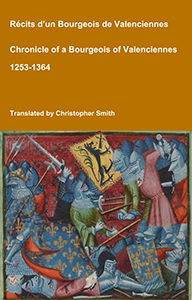
Chronicle of a Bourgeois of Valenciennes
Récits d’un bourgeois de Valenciennes aka The Chronicle of a Bourgeois of Valenciennes is a vivid 14th-century vernacular chronicle written by an anonymous urban chronicler from Valenciennes in the County of Hainaut. It survives in a manuscript that describes local and regional history from about 1253 to 1366, blending chronology, narrative episodes, and eyewitness-style accounts of political, military, and social events in medieval France, Flanders, and the Low Countries. The work begins with a chronological framework of events affecting Valenciennes and its region under rulers such as King Philip VI of France and the shifting allegiances of local nobility. It includes accounts of conflicts, sieges, diplomatic manoeuvres, and the impact of broader struggles like the Hundred Years’ War on urban life in Hainaut. Written from the perspective of a burgher (bourgeois) rather than a monastery or royal court, the chronicle offers a rare lay viewpoint on high politics and warfare, reflecting how merchants, townspeople, and civic institutions experienced the turbulence of the 13th and 14th centuries. Its narrative style combines straightforward reporting of events with moral and civic observations, making it a valuable source for readers interested in medieval urban society, regional politics, and the lived experience of war and governance in pre-modern Europe.
Available at Amazon in eBook and Paperback format.
Oyer and Terminer is in Legal Terms.
Oyer and Terminer. Literally "to hear and to determine". The Law French name for one of the commissions by which a judge of assize sat.
In November 1364 John Savile of Shelley and Golcar [aged 39] was a Commissioner of oyer and terminer of Conspiracies in Yorkshire.
In February 1365 John Savile of Shelley and Golcar [aged 40] was a Commissioner of oyer and terminer of disorder at Wortley.
In February 1370 John Savile of Shelley and Golcar [aged 45] was a Commissioner of oyer and terminer of poaching at Halifax.
In January 1381 John Savile of Shelley and Golcar [aged 56] was a Commissioner of oyer and terminer for liability for poll tax.
In November 1382 John Savile of Shelley and Golcar [aged 57] was a Commissioner of oyer and terminer for the goods of traitors.
In April 1388 John Savile of Shelley and Golcar [aged 63] was a Commissioner of oyer and terminer of obstructions to the Ouse.
In October 1388 and November 1388 John Savile of Shelley and Golcar [aged 63] was a Commissioner of oyer and terminer of escapes from York jail.
In May 1390 John Savile of Shelley and Golcar [aged 65] was a Commissioner of oyer and terminer of obstructions to the Ouse.
By 27th July 1453, says Griffiths, the situation in the north had deteriorated so badly that the crown effectively abrogated its authority in the region, by writing directly to the two earls [Note Henry Percy 2nd Earl of Northumberland [aged 60] and Richard Neville Earl Salisbury [aged 53]], laying responsibility for ending the dispute on them, and instructing them to keep their sons in order. It was at this point too, that the commission of oyer and terminer of 12 July was re-issued.
John Evelyn's Diary. 11th October 1660. The regicides who sat on the life of our late King, were brought to trial in the Old Bailey, before a commission of oyer and terminer.
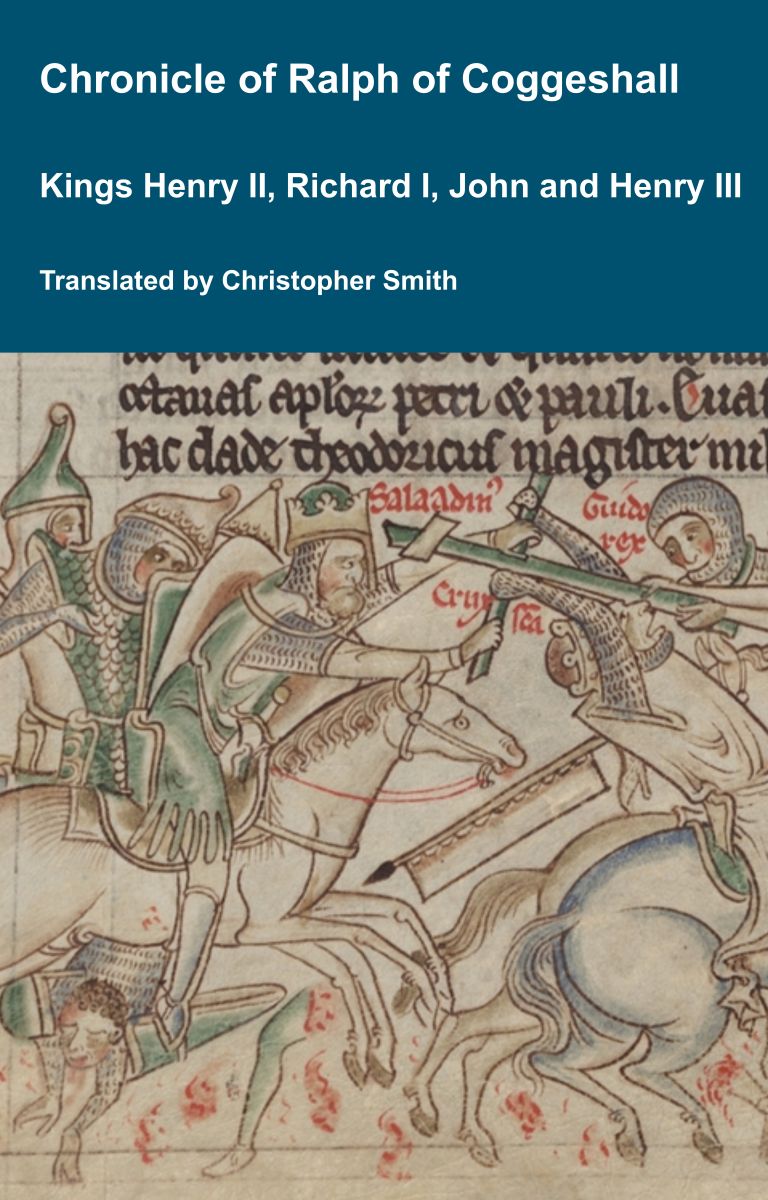
Chronicle of Abbot Ralph of Coggeshall
The Chronicle of Abbot Ralph of Coggeshall (Chronicon Anglicanum) is an indispensable medieval history that brings to life centuries of English and European affairs through the eyes of a learned Cistercian monk. Ralph of Coggeshall, abbot of the Abbey of Coggeshall in Essex in the early 13th century, continued and expanded his community’s chronicle, documenting events from the Norman Conquest of 1066 into the tumultuous reign of King Henry III. Blending eyewitness testimony, careful compilation, and the monastic commitment to record-keeping, this chronicle offers a rare narrative of political intrigue, royal power struggles, and social upheaval in England and beyond. Ralph’s work captures the reigns of pivotal figures such as Richard I and King John, providing invaluable insights into their characters, decisions, and the forces that shaped medieval rule. More than a simple annal, Chronicon Anglicanum conveys the texture of medieval life and governance, making it a rich source for scholars and readers fascinated by English history, monastic authorship, and the shaping of the medieval world.
Available at Amazon in eBook and Paperback format.
Samuel Pepys' Diary. 17th March 1663. Up betimes and to my office a while, and then home and to Sir W. Batten [aged 62], with whom by coach to St. Margaret's Hill in Southwark, Surrey [Map], where the judge of the Admiralty came, and the rest of the Doctors of the Civill law, and some other Commissioners, whose Commission of oyer and terminer was read, and then the charge, given by Dr. Exton, which methought was somewhat dull, though he would seem to intend it to be very rhetoricall, saying that justice had two wings, one of which spread itself over the land, and the other over the water, which was this Admiralty Court.

Samuel Pepys' Diary. 24th October 1663. It seems that, after the much talk of troubles and a plot, something is found in the North that a party was to rise, and some persons that were to command it are found, as I find in a letter that Mr. Coventry [aged 35] read to-day about it from those parts1.
Note 1. This refers to a rising in the West Riding of Yorkshire, which took place on October 12th, and was known as the Farneley Wood Plot. The rising was easily put down, and several prisoners were taken. A special commission of oyer and terminer was sent down to York to try the prisoners in January, 1663-64, when twenty-one were convicted and executed. (See Whitaker's "Loidis and Elmete", 1816.).