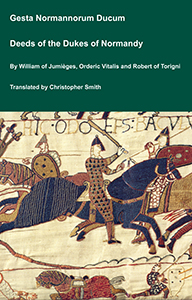
The Deeds of the Dukes of Normandy
The Gesta Normannorum Ducum [The Deeds of the Dukes of Normandy] is a landmark medieval chronicle tracing the rise and fall of the Norman dynasty from its early roots through the pivotal events surrounding the Norman Conquest of England. Originally penned in Latin by the monk William of Jumièges shortly before 1060 and later expanded at the behest of William the Conqueror, the work chronicles the deeds, politics, battles, and leadership of the Norman dukes, especially William’s own claim to the English throne. The narrative combines earlier historical sources with firsthand information and oral testimony to present an authoritative account of Normandy’s transformation from a Viking settlement into one of medieval Europe’s most powerful realms. William’s history emphasizes the legitimacy, military prowess, and governance of the Norman line, framing their expansion, including the conquest of England, as both divinely sanctioned and noble in purpose. Later chroniclers such as Orderic Vitalis and Robert of Torigni continued the history, extending the coverage into the 12th century, providing broader context on ducal rule and its impact. Today this classic work remains a foundational source for understanding Norman identity, medieval statesmanship, and the historical forces that reshaped England and Western Europe between 800AD and 1100AD.
Available at Amazon in eBook and Paperback format.
Earl of Ulster is in Earl Ireland.
See: Earl of Ulster, Earl of Ulster.
In or before 1259 Walter Burgh 1st Earl of Ulster [aged 28] and Aveline Fitzjohn Countess Ulster [aged 29] were married. She by marriage Countess of Ulster. They were fourth cousins.
On 16th November 1327 William Donn Burgh 3rd Earl of Ulster [aged 15] and Maud Plantagenet Countess Ulster [aged 17] were married. She by marriage Countess of Ulster. She the daughter of Henry Plantagenet 3rd Earl of Leicester 3rd Earl Lancaster [aged 46] and Maud Chaworth. They were second cousin once removed. He a great grandson of King Edward I of England. She a great granddaughter of King Henry III of England.
In 1352 Lionel of Antwerp 1st Duke of Clarence [aged 13] and Elizabeth Burgh Duchess of Clarence [aged 19] were married. He by marriage Earl of Ulster. She was the sole heir of her father and brought the de Burgh inheritance of the lands of Ulster to the marriage. As a consequence of their earlier betrothal he had been called Earl Ulster since 1347. She the daughter of William Donn Burgh 3rd Earl of Ulster and Maud Plantagenet Countess Ulster [aged 42]. He the son of King Edward III of England [aged 39] and Philippa of Hainaut Queen Consort England [aged 41]. They were half second cousin once removed. She a great x 2 granddaughter of King Henry III of England.
Around 1377 Lionel of Antwerp 1st Duke of Clarence was reburied at Clare Priory, Suffolk [Map]. Philippa Plantagenet Countess March 2nd Countess Ulster [aged 21] succeeded 5th Countess of Ulster.
On 5th January 1382 Philippa Plantagenet Countess March 2nd Countess Ulster [aged 26] died at Cork [Map]. She was buried at Wigmore, Herefordshire [Map]. Her son Roger [aged 7] succeeded Heir to the Throne of England, 6th Earl of Ulster
On 30th December 1460 the Lancastrian army took their revenge for the defeats of the First Battle of St Albans and the Battle of Northampton at the Battle of Wakefield near Sandal Castle [Map]. The Lancastrian army was commanded by Henry Holland 3rd Duke Exeter [aged 30], Henry Beaufort 2nd or 3rd Duke of Somerset [aged 24] and Henry Percy 3rd Earl of Northumberland [aged 39], and included John Courtenay 7th or 15th Earl Devon [aged 25] and William Gascoigne XIII [aged 30], both knighted, and James Butler 1st Earl Wiltshire 5th Earl Ormonde [aged 40], John "Butcher" Clifford 9th Baron Clifford [aged 25], John Neville 1st Baron Neville of Raby [aged 50], Thomas Ros 9th Baron Ros Helmsley [aged 33], Henry Roos and Thomas St Leger [aged 20].
The Yorkist army was heavily defeated.
Richard Plantagenet 3rd Duke of York [aged 49] was killed. His son Edward [aged 18] succeeded 4th Duke York, 7th Earl March, 9th Earl of Ulster, 3rd Earl Cambridge, 9th Baron Mortimer of Wigmore.
Thomas Neville [aged 30], and Edward Bourchier were killed.
Father and son Thomas Harrington [aged 60] and John Harrington [aged 36] were killed, the former dying of his wounds the day after.
William Bonville 6th Baron Harington [aged 18] was killed. His daughter Cecily succeeded 7th Baroness Harington.
Thomas Parr [aged 53] fought in the Yorkist army.
Following the battle Richard Neville Earl Salisbury [aged 60] was beheaded by Thomas "Bastard of Exeter" Holland. William Bonville [aged 40] was executed.
Edmund York 1st Earl of Rutland [aged 17] was killed on Wakefield Bridge [Map] by John "Butcher" Clifford. Earl of Rutland extinct.
On 28th June 1461 King Edward IV of England [aged 19] was crowned IV King of England. Duke York, Earl March, Earl of Ulster, Earl Cambridge, Baron Mortimer of Wigmore merged with the Crown. Cardinal Thomas Bourchier [aged 43] was assisted by Archbishop William Booth [aged 73] at Westminster Abbey [Map].
Elizabeth Burgh Duchess of Clarence was appointed 4th Earl of Ulster.
In 1351 Henry of Grosmont 1st Duke Lancaster [aged 41] was created 1st Duke Lancaster by King Edward III of England [aged 38]. Isabel Beaumont Duchess Lancaster [aged 31] by marriage Duchess Lancaster.
Lionel of Antwerp 1st Duke of Clarence [aged 12] was created 1st Earl of Ulster.
John of Gaunt 1st Duke Lancaster [aged 10] was created 1st Earl Richmond.
Ralph Stafford 1st Earl Stafford [aged 49] was created 1st Earl Stafford.
On 7th October 1368 Lionel of Antwerp 1st Duke of Clarence [aged 29] died from poisoning at Alba [Map]. Duke Clarence extinct. His daughter Philippa [aged 13] succeeded 2nd Countess of Ulster. He was buried at the St Pietro Ciel d'Oro Church, Pavia [Map].
There was strong speculation he had been poisoned by his wife's [aged 14] father [aged 48].
On 24th August 1369 Edmund Mortimer 3rd Earl March, Earl of Ulster [aged 17] and Philippa Plantagenet Countess March 2nd Countess Ulster [aged 14] were married at Reading Abbey, Berkshire [Map]. She by marriage Countess March. He by marriage Earl of Ulster. She the daughter of Lionel of Antwerp 1st Duke of Clarence and Elizabeth Burgh Duchess of Clarence. He the son of Roger Mortimer 2nd Earl March and Philippa Montagu Countess March [aged 37]. They were fourth cousins. She a granddaughter of King Edward III of England.
On 27th December 1381 Edmund Mortimer 3rd Earl March, Earl of Ulster [aged 29] died. He was buried at Wigmore Abbey [Map]. His son Roger [aged 7] succeeded 4th Earl March, 3rd Earl of Ulster, 6th Baron Mortimer of Wigmore.
On 7th October 1388 Roger Mortimer 4th Earl March 3rd Earl of Ulster [aged 14] and Eleanor Holland Countess March and Ulster [aged 17] were married. She by marriage Countess March, Countess of Ulster. She the daughter of Thomas Holland 2nd Earl Kent [aged 38] and Alice Fitzalan Countess Kent [aged 38]. He the son of Edmund Mortimer 3rd Earl March, Earl of Ulster and Philippa Plantagenet Countess March 2nd Countess Ulster. They were second cousin once removed. He a great grandson of King Edward III of England. She a great x 2 granddaughter of King Edward I of England.
On 20th July 1398 Roger Mortimer 4th Earl March 3rd Earl of Ulster [aged 24] died at Kells, County Meath. He was buried at Wigmore Abbey [Map]. His son Edmund [aged 6] succeeded Heir to the Throne of England, 5th Earl March, 4th Earl of Ulster, 7th Baron Mortimer of Wigmore.
In 1415 Edmund Mortimer 5th Earl March 7th Earl of Ulster [aged 23] and Anne Stafford Duchess Exeter were married. She by marriage Countess March, Countess of Ulster. She the daughter of Edmund Stafford 5th Earl Stafford and Anne of Gloucester Plantagenet Countess Eu and Stafford [aged 32]. He the son of Roger Mortimer 4th Earl March 3rd Earl of Ulster and Eleanor Holland Countess March and Ulster. They were second cousin once removed. He a great x 2 grandson of King Edward III of England. She a great granddaughter of King Edward III of England.
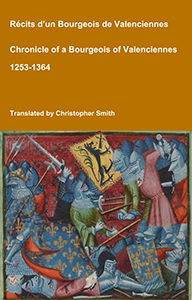
Chronicle of a Bourgeois of Valenciennes
Récits d’un bourgeois de Valenciennes aka The Chronicle of a Bourgeois of Valenciennes is a vivid 14th-century vernacular chronicle written by an anonymous urban chronicler from Valenciennes in the County of Hainaut. It survives in a manuscript that describes local and regional history from about 1253 to 1366, blending chronology, narrative episodes, and eyewitness-style accounts of political, military, and social events in medieval France, Flanders, and the Low Countries. The work begins with a chronological framework of events affecting Valenciennes and its region under rulers such as King Philip VI of France and the shifting allegiances of local nobility. It includes accounts of conflicts, sieges, diplomatic manoeuvres, and the impact of broader struggles like the Hundred Years’ War on urban life in Hainaut. Written from the perspective of a burgher (bourgeois) rather than a monastery or royal court, the chronicle offers a rare lay viewpoint on high politics and warfare, reflecting how merchants, townspeople, and civic institutions experienced the turbulence of the 13th and 14th centuries. Its narrative style combines straightforward reporting of events with moral and civic observations, making it a valuable source for readers interested in medieval urban society, regional politics, and the lived experience of war and governance in pre-modern Europe.
Available at Amazon in eBook and Paperback format.
On 18th January 1425 Edmund Mortimer 5th Earl March 7th Earl of Ulster [aged 33] died at Trim Castle. He was buried at Clare Priory, Suffolk [Map]. His nephew Richard [aged 13] succeeded 6th Earl March, 5th Earl of Ulster, 8th Baron Mortimer of Wigmore.
In 1264 Walter Burgh 1st Earl of Ulster [aged 34] was created 1st Earl of Ulster.
On 28th July 1271 Walter Burgh 1st Earl of Ulster [aged 41] died at County Galway. His son Richard [aged 12] succeeded 2nd Earl of Ulster.
In or before 1280 Richard "Red Earl" Burgh 2nd Earl of Ulster [aged 20] and Margaret Burgh Countess Ulster were married. She by marriage Countess of Ulster. He the son of Walter Burgh 1st Earl of Ulster and Aveline Fitzjohn Countess Ulster. They were third cousins.
On 29th July 1326 Richard "Red Earl" Burgh 2nd Earl of Ulster [aged 67] died at Altassel Priory. His grandson William [aged 13] succeeded 3rd Earl of Ulster.
On 6th June 1333 William Donn Burgh 3rd Earl of Ulster [aged 20] was murdered by Richard de Mandeville in revenge for the murder of Richard's wife's brother Walter Liath de Burgh the year before. Earl of Ulster and Baron Burgh extinct. There is some argument that his daughter Elizabeth Burgh Duchess of Clarence succeeded as Countess of Ulster although her husband Lionel of Antwerp 1st Duke of Clarence appears to have been Earl of Ulster of a new creation. See Annals of Ulster.