

Chronicle of Walter of Guisborough
A canon regular of the Augustinian Guisborough Priory, Yorkshire, formerly known as The Chronicle of Walter of Hemingburgh, describes the period from 1066 to 1346. Before 1274 the Chronicle is based on other works. Thereafter, the Chronicle is original, and a remarkable source for the events of the time. This book provides a translation of the Chronicle from that date. The Latin source for our translation is the 1849 work edited by Hans Claude Hamilton. Hamilton, in his preface, says: 'In the present work we behold perhaps one of the finest samples of our early chronicles, both as regards the value of the events recorded, and the correctness with which they are detailed; Nor will the pleasing style of composition be lightly passed over by those capable of seeing reflected from it the tokens of a vigorous and cultivated mind, and a favourable specimen of the learning and taste of the age in which it was framed.'
Available at Amazon in eBook and Paperback format.
Milan is in Italy.
See: Basilica di Santo Stefano Maggiore, Milan [Map], Church of San Giovanni in Conca, Milan Cathedral [Map].
In 1361 Caterina Visconti Duke Milan was born to Bernabò Visconti [aged 38] and Beatrice Regina della Scala [aged 30] in Milan. She married 2nd October 1380 her first cousin Gian Galeazzo Visconti 1st Duke Milan and had issue.
Around 1380 Lucia Visconti Countess Kent was born to Bernabò Visconti [aged 57] and Beatrice Regina della Scala [aged 49] in Milan. She married 24th January 1407 Edmund Holland 4th Earl Kent, son of Thomas Holland 2nd Earl Kent and Alice Fitzalan Countess Kent.
On 10th October 1465 Alfonso II King Naples [aged 16] and Ippolita Maria Sforza [aged 19] were married at Milan. She the daughter of Francesco Sforza I Duke Milan [aged 64] and Bianca Maria Visconti [aged 40]. He the son of Ferdinand I King Naples [aged 42] and Isabella Clermont Queen Consort Naples.
John Evelyn's Diary. 23rd March 1646. Early next day, after four miles' riding, we entered into the State of Milan, and passed by Lodi, a great city famous for cheese, little short of the best Parmeggiano. We dined at Marignano, ten miles before coming to Milan, where we met half a dozen suspicious cavaliers, who yet did us no harm. Then, passing as through a continual garden, we went on with exceeding pleasure; for it is the Paradise of Lombardy, the highways as even and straight as a line, the fields to a vast extent planted with fruit about the inclosures, vines to every tree at equal distances, and watered with frequent streams. There was likewise much corn, and olives in abundance. At approach of the city, some of our company, in dread of the Inquisition (severer here than in all Spain), thought of throwing away some Protestant books and papers. We arrived about three in the afternoon, when the officers searched us thoroughly for prohibited goods; but, finding we were only gentlemen travelers, dismissed us for a small reward, and we went quietly to our inn, the Three Kings, where, for that day, we refreshed ourselves, as we had need. The next morning, we delivered our letters of recommendation to the learned and courteous Ferrarius, a Doctor of the Ambrosian College, who conducted us to all the remarkable places of the town, the first of which was the famous Cathedral. We entered by a portico, so little inferior to that of Rome that, when it is finished, it will be hard to say which is the fairest; the materials are all of white and black marble, with columns of great height, of Egyptian granite. The outside of the church is so full of sculpture, that you may number 4,000 statues, all of white marble, among which that of St. Bartholomew is esteemed a masterpiece. The church is very spacious, almost as long as St. Peter's at Rome, but not so large. About the choir, the sacred Story is finely sculptured, in snow-white marble, nor know I where it is exceeded. About the body of the church are the miracles of St. Charles Borromeo, and in the vault beneath is his body before the high altar, grated, and inclosed, in one of the largest crystals in Europe. To this also belongs a rich treasure. The cupola is all of marble within and without, and even covered with great planks of marble, in the Gothic design. The windows are most beautifully painted. Here are two very fair and excellent organs. The fabric is erected in the midst of a fair piazza, and in the center of the city.
In 1818 Rafaelle Monti was born in Milan.
Chronicle of Edward Hall [1496-1548]. And so Charles, being furnished with men, of arms, horsemen, footmen, navy, and aid of some Italians, passed through Italy by Rome and without any great labour won the city of Naples [Map]. When he had obtained this victory: in his return being assailed with the Venetians at the town of Fornovo, he had a great dangerous victory. And so like a conqueror, with great triumph returned into his realm and country. After him Louis the 12th being Kinge, when he found opportunity and saw the gap open, invaded the Italians again, and recovered again the realm of Naples, which Frecleryck the son of King Alphonse, not long before had gotten from the French nation: and after that he subdued and conquered the whole duchy of Milan. Albeit not long after (fortune turning her wheel) he lost both the Kingdom of Naples, and the fair city and duchy of Milan both together. And so the Frenchmen warring upon the Italians had no better success in their conquests, then their parents and predecessors heretofore have been accustomed. For undoubtedly, as many places as they vexed and sacked with murder and spoiling, so many or more in conclusion they did ennoble and decorate with their blood and slaughter. Which small recompense little profited and less relieved, such as before were robbed and spoiled of all their goods, substance and riches. After this the Spaniards arrived in Italy, and their putting to flight the Frenchmen, obtained the possession of the realms of Naples and Sicily, the which they possess and enjoy at this hour. And at length a certain nation of Germany, called the Swytsers, called to be partakers of the spoil of Italy, wane certain towns there, which they possess and enjoy at this present time.
On 26th December 1476 Galeazzo Maria Sforza 5th Duke Milan [aged 32] was murdered at the Basilica di Santo Stefano Maggiore, Milan [Map]. Supported by about thirty friends, the three men waited in the church for the duke to arrive for mass. When Galeazzo Sforza arrived, Lampugnani knelt before him; after some words were exchanged, Lampugnani rose suddenly and stabbed Sforza in the groin and breast. Olgiati and Visconti soon joined in, as did a servant of Lampugnani's. Sforza was dead within a matter of seconds. All the assassins quickly escaped in the ensuing mayhem save for Lampugnani, who became entangled in some of the church's cloth and was killed by a guard. His body soon fell into the hands of a mob, which dragged the corpse through the streets, slashing and beating at it; finally, they hung the body upside-down outside Lampugnani's house. The beheaded corpse was cut down the next day and, in an act of symbolism, the "sinning" right hand was removed, burnt and put on display. His son Gian [aged 7] succeeded 6th Duke Milan.
On 2nd October 1380 Gian Galeazzo Visconti 1st Duke Milan [aged 28] and Caterina Visconti Duke Milan [aged 19] were married in the Church of San Giovanni in Conca. They were first cousins.
The Church of Santa Maria Maggiore, Milan [Map] was a church demolished and used as a stone quarry for the construction of Milan Cathedral [Map] that commenced in 1386.
The Church of Santa Maria Maggiore, Milan [Map] was a church demolished and used as a stone quarry for the construction of Milan Cathedral [Map] that commenced in 1386.
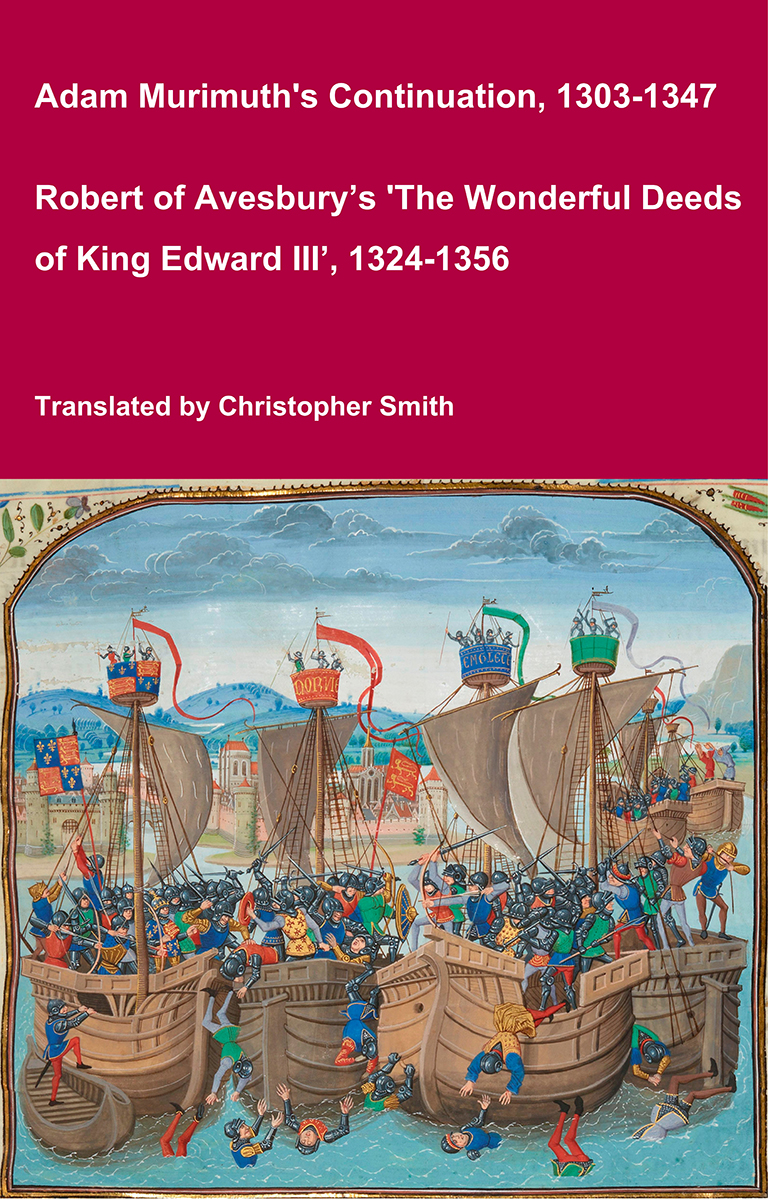
Adam Murimuth's Continuation and Robert of Avesbury’s 'The Wonderful Deeds of King Edward III'
This volume brings together two of the most important contemporary chronicles for the reign of Edward III and the opening phases of the Hundred Years’ War. Written in Latin by English clerical observers, these texts provide a vivid and authoritative window into the political, diplomatic, and military history of fourteenth-century England and its continental ambitions. Adam Murimuth Continuatio's Chronicarum continues an earlier chronicle into the mid-fourteenth century, offering concise but valuable notices on royal policy, foreign relations, and ecclesiastical affairs. Its annalistic structure makes it especially useful for establishing chronology and tracing the development of events year by year. Complementing it, Robert of Avesbury’s De gestis mirabilibus regis Edwardi tertii is a rich documentary chronicle preserving letters, treaties, and official records alongside narrative passages. It is an indispensable source for understanding Edward III’s claim to the French crown, the conduct of war, and the mechanisms of medieval diplomacy. Together, these works offer scholars, students, and enthusiasts a reliable and unembellished account of a transformative period in English and European history. Essential for anyone interested in medieval chronicles, the Hundred Years’ War, or the reign of Edward III.
Available at Amazon in eBook and Paperback format.
In June 1368 Lionel of Antwerp 1st Duke of Clarence [aged 29] and Violante Visconti [aged 14] were married in the Church of Santa Maria Maggiore, Milan [Map]. The wedding festivities were lavish and ostentatious. The banquet, held outside, included 30 courses of meat and fish presented fully gilded. Between the courses the guests were given gifts such as suits of armour, bolts of cloth, war horses, arms, and hunting dogs. Among the guests were Geoffrey Chaucer [aged 25], Petrarch, Jean Froissart and John Hawkwood [aged 48]. He the son of King Edward III of England [aged 55] and Philippa of Hainaut Queen Consort England [aged 57]. They were fourth cousin once removed.