

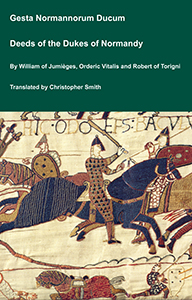
The Deeds of the Dukes of Normandy
The Gesta Normannorum Ducum [The Deeds of the Dukes of Normandy] is a landmark medieval chronicle tracing the rise and fall of the Norman dynasty from its early roots through the pivotal events surrounding the Norman Conquest of England. Originally penned in Latin by the monk William of Jumièges shortly before 1060 and later expanded at the behest of William the Conqueror, the work chronicles the deeds, politics, battles, and leadership of the Norman dukes, especially William’s own claim to the English throne. The narrative combines earlier historical sources with firsthand information and oral testimony to present an authoritative account of Normandy’s transformation from a Viking settlement into one of medieval Europe’s most powerful realms. William’s history emphasizes the legitimacy, military prowess, and governance of the Norman line, framing their expansion, including the conquest of England, as both divinely sanctioned and noble in purpose. Later chroniclers such as Orderic Vitalis and Robert of Torigni continued the history, extending the coverage into the 12th century, providing broader context on ducal rule and its impact. Today this classic work remains a foundational source for understanding Norman identity, medieval statesmanship, and the historical forces that reshaped England and Western Europe between 800AD and 1100AD.
Available at Amazon in eBook and Paperback format.
Naples is in Italy.
See: Leece, Mount Vesuvius [Map], Naples Cathedral [Map].
On 12th August 1295 Charles Martel King Hungary [aged 23] died at Naples [Map]. He was buried at Naples Cathedral [Map].
On 5th April 1336 John Capet Duke Durazzo [aged 42] died at Naples [Map].
On 4th November 1448 Alfonso II King Naples was born to Ferdinand I King Naples [aged 25] and Isabella Clermont Queen Consort Naples [aged 24] at Naples [Map]. He married 10th October 1465 Ippolita Maria Sforza, daughter of Francesco Sforza I Duke Milan and Bianca Maria Visconti, and had issue.
On 6th November 1615 Richard Musgrave 1st Baronet [aged 30] died at Naples [Map]. His son Philip [aged 8] succeeded 2nd Baronet Musgrave of Hartley Castle in Westmoreland.
In 1636 John Butler died at Naples [Map].
In February 1733 Thomas Grosvenor 5th Baronet [aged 40] died in Naples [Map]. His brother Robert [aged 37] succeeded 6th Baronet Grosvenor of Eaton in Cheshire. Jane Warre Lady Grosvenor by marriage Lady Grosvenor of Eaton in Cheshire.
On 2nd June 1738 James Fitz James 2nd Duke Berwick [aged 41] died at Naples [Map]. His son James [aged 19] succeeded 3rd Duke Berwick.
On 26th January 1762 Francis Haskins Eyles-Stiles 3rd Baronet died. at Naples [Map]. His son John [aged 20] succeeded 4th Baronet Eyles of London.
On 18th May 1763 Anne Somerset Countess Northampton [aged 22] died in Naples [Map].


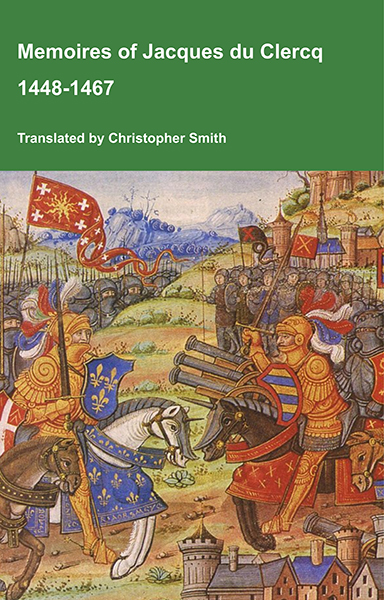
This is a translation of the 'Memoires of Jacques du Clercq', published in 1823 in two volumes, edited by Frederic, Baron de Reissenberg. In his introduction Reissenberg writes: 'Jacques du Clercq tells us that he was born in 1424, and that he was a licentiate in law and a counsellor to Philip the Good, Duke of Burgundy, in the castellany of Douai, Lille, and Orchies. It appears that he established his residence at Arras. In 1446, he married the daughter of Baldwin de la Lacherie, a gentleman who lived in Lille. We read in the fifth book of his Memoirs that his father, also named Jacques du Clercq, had married a lady of the Le Camelin family, from Compiègne. His ancestors, always attached to the counts of Flanders, had constantly served them, whether in their councils or in their armies.' The Memoires cover a period of nineteen years beginning in in 1448, ending in in 1467. It appears that the author had intended to extend the Memoirs beyond that date; no doubt illness or death prevented him from carrying out this plan. As Reissenberg writes the 'merit of this work lies in the simplicity of its narrative, in its tone of good faith, and in a certain air of frankness which naturally wins the reader’s confidence.' Du Clercq ranges from events of national and international importance, including events of the Wars of the Roses in England, to simple, everyday local events such as marriages, robberies, murders, trials and deaths, including that of his own father in Book 5; one of his last entries.
Available at Amazon in eBook and Paperback format.
After February 1764 John Tylney 2nd Earl Tylney [aged 51] settled at Naples [Map].

From 1765 Richard Worsley 7th Baronet [aged 13] spent two years in Naples [Map] with his parents.
On 4th September 1771 Frederick Calvert 6th Baron Baltimore [aged 40] died at Naples [Map]. Baron Baltimore of Longford in Leinster extinct. His body was returned to London, lying in state at the Great Room of Exeter Exchange, Strand, and was interred in his family's vault at St. Martin's "with much funeral pomp, the cavalcade extending from the church to the eastern extremity of Epsom".
On 18th September 1822 Frederick Walpole was born to Horatio Walpole 3rd Earl Orford [aged 39] and Mary Fawkener Countess Orford [aged 34] at Naples [Map]. He married before 10th July 1854 his half second cousin once removed Laura Sophia Frances Walpole and had issue.
On 3rd November 1832 Thomas Noel-Hill 2nd Baron Berwick [aged 62] died in Naples [Map] without issue. His brother William [aged 59] succeeded 3rd Baron Berwick of Attingham in Shropshire.


On 1st September 1839 Charles Edward Perugini was born in Naples [Map]. He moved to England aged six.
On 21st August 1844 William Compton 4th Marquess Northampton [aged 26] and Eliza Harriet Elliot Marchioness Northampton [aged 24] were married at Naples [Map]. He the son of Spencer Compton 2nd Marquess Northampton [aged 54] and Margaret Douglas-Maclean-Clephane Marchioness Northampton.
In 1848 Harriet Charlotte Beaujolais Campbell died at Naples [Map].
On 11th February 1853 Frederick Richard Chichester [aged 25] died at Naples [Map].
Chronicle of Edward Hall [1496-1548]. And so Charles, being furnished with men, of arms, horsemen, footmen, navy, and aid of some Italians, passed through Italy by Rome and without any great labour won the city of Naples [Map]. When he had obtained this victory: in his return being assailed with the Venetians at the town of Fornovo, he had a great dangerous victory. And so like a conqueror, with great triumph returned into his realm and country. After him Louis the 12th being Kinge, when he found opportunity and saw the gap open, invaded the Italians again, and recovered again the realm of Naples, which Frecleryck the son of King Alphonse, not long before had gotten from the French nation: and after that he subdued and conquered the whole duchy of Milan. Albeit not long after (fortune turning her wheel) he lost both the Kingdom of Naples, and the fair city and duchy of Milan both together. And so the Frenchmen warring upon the Italians had no better success in their conquests, then their parents and predecessors heretofore have been accustomed. For undoubtedly, as many places as they vexed and sacked with murder and spoiling, so many or more in conclusion they did ennoble and decorate with their blood and slaughter. Which small recompense little profited and less relieved, such as before were robbed and spoiled of all their goods, substance and riches. After this the Spaniards arrived in Italy, and their putting to flight the Frenchmen, obtained the possession of the realms of Naples and Sicily, the which they possess and enjoy at this hour. And at length a certain nation of Germany, called the Swytsers, called to be partakers of the spoil of Italy, wane certain towns there, which they possess and enjoy at this present time.

Anne Boleyn. Her Life as told by Lancelot de Carle's 1536 Letter.
In 1536, two weeks after the execution of Anne Boleyn, her brother George and four others, Lancelot du Carle, wrote an extraordinary letter that described Anne's life, and her trial and execution, to which he was a witness. This book presents a new translation of that letter, with additional material from other contemporary sources such as Letters, Hall's and Wriothesley's Chronicles, the pamphlets of Wynkyn the Worde, the Memorial of George Constantyne, the Portuguese Letter and the Baga de Secrets, all of which are provided in Appendices.
Available at Amazon in eBook and Paperback format.
Chronicle of Edward Hall [1496-1548]. When King Henry was returned into England, he first of all things elected into the Society of Sainct George, vulgarly called the Order of the Garter, Alphose duke of Calabria son, according to his desire which Alphonse was son and heir to Ferdinand King of Naples,and after King of the same realm, until he was overcome by King Charles. And after, the King sent Christopher Urswick, Ambassador with the garter, collar, mantel, and other habiliments appertaining to the companions of the said noble order. Which Ambassador arriving at Napels [Map], delivered to the duke the whole habile, with all the ceremonies and due circumstances thereunto belonging which duke very reverently received it, and with more reverence requested himself with the same in a solemn presence, thinking that by this apparel and investiture, he was made a friend and companion in order with the King of England, whose friendship obtained, he feared nothing the assaults or invasions of his enemies. And this was the cause that he desired so much to be companion of that noble order, firmly believing that the King of England sovereign of that order, should be aider and maintainer of him against the French King, whom he knew would passe the mountains and make war on him. But this custom of assistance in orders was, either never begun, or before clearly abolished: For in our time there have bene many noble men of Italy, companions as well of the Golden Fleece in Burgundy, as of the order of Saint Michael in France, that have bene banished and profligate from their natural country, and yet have not been aided by the sovereign nor companions of the same order. For surely the statutes and ordinances of all the said orders do not oblige and bind them to that case, but in certain points. After this the duke dismissed the Ambassador, rewarding him most princely.


Boniface V Pope was born at Naples [Map].
Around 1636 Antonio Verrio was born in Leece.
John Evelyn's Diary. 1st February 1645. The morrow after our arrival, in the afternoon, we hired a coach to carry us about the town. First, we went to the castle of St. Elmo, built on a very high rock, whence we had an entire prospect of the whole city, which lies in shape of a theatre upon the sea-brink, with all the circumjacent islands, as far as Capreæ, famous for the debauched recesses of Tiberius. This fort is the bridle of the whole city, and was well stored and garrisoned with native Spaniards. The strangeness of the precipice and rareness of the prospect of so many magnificent and stately palaces, churches, and monasteries, with the Arsenal, the Mole, and Mount Vesuvius [Map] in the distance, all in full command of the eye, make it one of the richest landscapes in the world.
John Evelyn's Diary. 1st February 1645. Climbing a steep hill, we came to the monastery and Church of the Carthusians, from whence is a most goodly prospect toward the sea and city, the one full of galleys and ships, the other of stately palaces, churches, monasteries, castles, gardens, delicious fields and meadows, Mount Vesuvius [Map] smoking, the promontory of Minerva and Misenum, Capreæ, Prochyta, Ischia, Pausilipum, Puteoli, and the rest, doubtless one of the most divertissant and considerable vistas in the world. The church is most elegantly built; the very pavements of the common cloister being all laid with variously polished marbles, richly figured. They showed us a massy cross of silver, much celebrated for the workmanship and carving, and said to have been fourteen years in perfecting. The choir also is of rare art; but above all to be admired, is the yet unfinished church of the Jesuits, certainly, if accomplished, not to be equalled in Europe. Hence, we passed by the Palazzo Caraffii, full of ancient and very noble statues: also the palace of the Orsini. The next day, we did little but visit some friends, English merchants, resident for their negotiation; only this morning at the Viceroy's Cavalerizza I saw the noblest horses that I had ever beheld, one of his sons riding the menage with that address and dexterity as I had never seen anything approach it.
John Evelyn's Diary. 7th February 1645. The next day, being Saturday, we went four miles out of town on mules, to see that famous volcano, Mount Vesuvius [Map]. Here we pass a fair fountain, called Labulla, which continually boils, supposed to proceed from Vesuvius, and thence over a river and bridge, where on a large upright stone, is engraven a notable inscription relative to the memorable eruption in 1630.
From 3rd July 1660 to 29th July 1660 a major eruption of Mount Vesuvius [Map] occurred. A dark eruption column is said to have risen at least 4 km high and was driven to the SE. During the final stage of the eruption, white ash was erupted - a feature common in the late stages of all final (that is, sub-cycle-closing) Vesuvian eruptions. It was in this eruption that free twinned augite phenocrysts were ejected along with the ash, the cross-shaped objects falling from the sky causing much superstition among the population. The crater was filled by a significant amount during the 1660 eruption.
John Evelyn's Diary. 8th March 1696. Divers of the conspirators tried and condemned. Vesuvius [Map] breaking out, terrified Naples. Three [Note. Robert Charnock, Edward King, and Thomas Keys] of the unhappy wretches, whereof one was a priest, were executed for intending to assassinate the King; they acknowledged their intention, but acquitted King James of inciting them to it, and died very penitent. Divers more in danger, and some very considerable persons.
On 12th August 1295 Charles Martel King Hungary [aged 23] died at Naples [Map]. He was buried at Naples Cathedral [Map].