

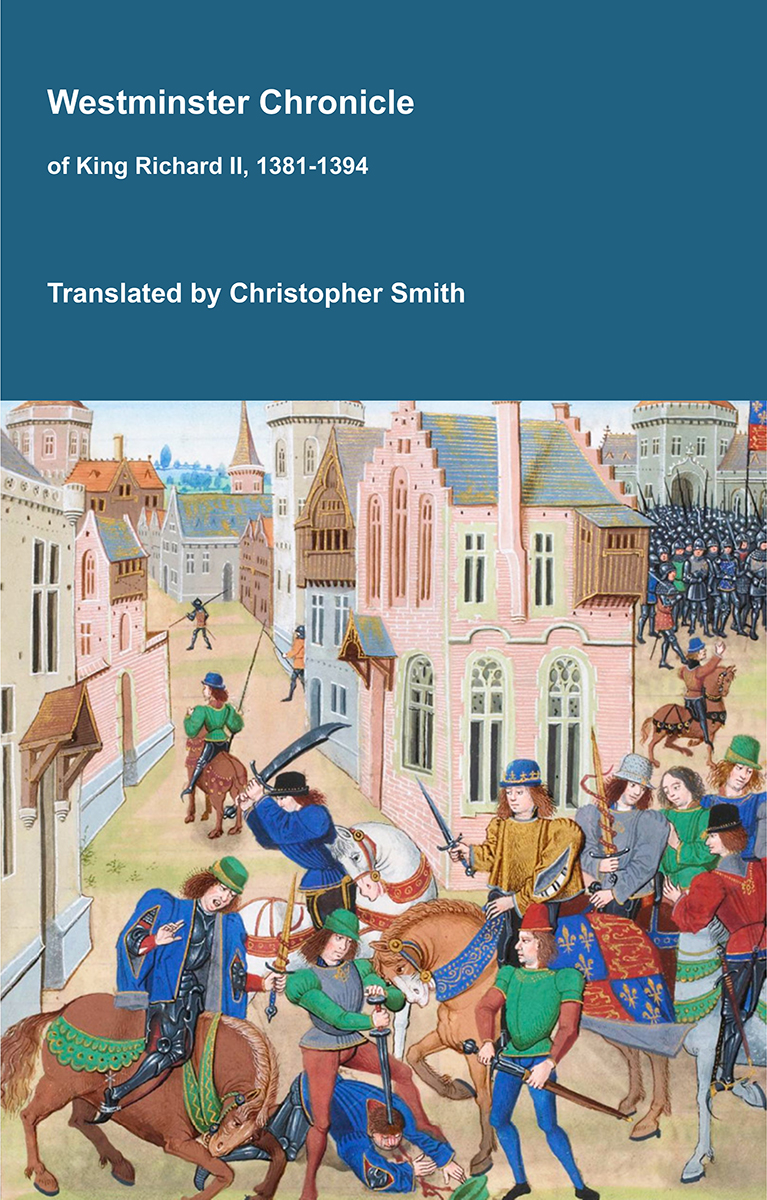
Westminster Chronicle of King Richard II, 1381-1394
The Westminster Chronicle is one of the most vivid and important narrative sources for the reign of Richard II. Written by an anonymous chronicler closely connected with Westminster Abbey, it covers the years 1381 to 1394, from the Peasants’ Revolt to the political tensions, court ceremonies, diplomatic negotiations, royal progresses, and public crises of Richard’s later reign. Rich in detail the chronicle records major events such as the conflicts between the King and Lords Appellant, King and the City of London, negotiations with France and Scotland, the death and funeral of Queen Anne of Bohemia, the illness of Charles VI of France, and the changing fortunes of leading nobles including John of Gaunt, Thomas of Gloucester, Robert de Vere, and the Earl of Arundel. The Chronicle offers readers a remarkable window into late fourteenth-century England, combining political observation, courtly spectacle, urban drama, ecclesiastical affairs, and moral judgement. It is an essential source for anyone interested in medieval monarchy, London, Westminster, and the troubled reign of Richard II.
Available at Amazon in eBook and Paperback format.
Around 1460 Meynnart Wewyck was born. The date someting of a guess. He had become established by 1502.
On 19th September 1502 Mynour, the Inglis payntour [aged 42] delivered four portraits of the English royal family to James IV of Scotland [aged 29] at Stirling Castle [Map].
In November 1503 Meynnart Wewyck [aged 43] returned to England from the Scottish Court.

Around 1510 Meynnart Wewyck [aged 50] is believed to have painted the portrait of King Henry VII of England and Ireland.

Around 1510 Meynnart Wewyck [aged 50]. Portrait of Margaret Beaufort Countess Richmond in the Masters Lodge St John's College, Oxford University. Commissioned by Bishop John Fisher [aged 40]. Note the Beaufort Arms on the wall beneath which is the Beafort Portcullis. Repeated in the window. She is wearing widow's clothes, or possibly that of a convent; Gabled Headress with Lappets. On 29th March 2019, St John's College, Cambridge, which she founded, announced the portrait was original work by Wewyck.
After 1525 Meynnart Wewyck [deceased] died.