

Henrici Quinti, Angliæ Regis, Gesta, is a first-hand account of the Agincourt Campaign, and subsequent events to his death in 1422. The author of the first part was a Chaplain in King Henry's retinue who was present from King Henry's departure at Southampton in 1415, at the siege of Harfleur, the battle of Agincourt, and the celebrations on King Henry's return to London. The second part, by another writer, relates the events that took place including the negotiations at Troye, Henry's marriage and his death in 1422.
Available at Amazon in eBook and Paperback format.
Paternal Family Tree: Norman
Before 25th October 1102 [his father] Robert Curthose III Duke Normandy [aged 51] and [his mother] Sybilla Conversano Duchess Normandy were married. She by marriage Duchess Normandy. He the son of [his grandfather] King William "Conqueror" I of England and [his grandmother] Matilda Flanders Queen Consort England.
On 25th October 1102 William Clito Count Flanders was born to Robert Curthose III Duke Normandy [aged 51] and Sybilla Conversano Duchess Normandy. He a grandson of King William "Conqueror" I of England.
History of the Dukes of Normandy by William of Jumieges. When he was returning from the journey to Jerusalem, he took [his mother] Sibylla as his wife, the sister of William, Count of Conversano, and from her he begot one son, named William. The aforesaid countess was beautiful in face, modest in her conduct, endowed with wisdom, and when the duke was sometimes absent, she herself arranged the affairs of the province, both private and public, better on her own than he would have done had he been present. She lived only a short time in Normandy, having been deceived by the envy and intrigue of certain noblewomen1. The aforesaid William, son of Duke Robert, later became Count of Flanders. How this came about we shall explain briefly.
Cum autem rediret de via Hierusalem accepit Sibyllam in uxorem, sororem Willelmi comitis Conversanæ, de qua genuit unum filium, nomine Willelmum. Fuit autem prædicta comitissa pulchra facie, honesta moribus, sapientia prædita et aliquando absente duce ipsa melius per se negotia provinciæ tam privata quam publica disponebat, quam ipse faceret si adesset. Vixit autem in Northmannia parvo tempore, invidia et factione quarumdam nobilium feminarum decepta. Prædictus vero Willelmus filius Roberti ducis procedenti tempore comes fuit Flandrensis. Quod quomodo acciderit, paucis aperiamus.
Note 1. Sybilla de Conversano died, or was murdered, on 18th March 1103.
Chronicle of William Nangis. Then Baldwin, count of Flanders, nephew of Pope Calixtus through his sister Clementia1, wishing to establish William, son of Robert, duke of Normandy, who had been held captive by Henry, king of England, in the inheritance of his father, after occupying a large part of Normandy, was struck on the head and died from the wound2. His cousin Charles, son of King Cnut3 of the Danes, succeeded him in the county. William4, however, son of Robert, duke of Normandy, married the sister of the wife of Louis, king of France, and after the death of Count Charles5 the county of Flanders was granted to him.
Note 1. Clementia, daughter of William the Great, count of Burgundy, and sister of Pope Calixtus, had by her first husband, Robert II, count of Flanders, who died in 1111, three sons, two of whom William and Philip died in childhood before their father. The third, Baldwin of the Axe, or Hapkin, took the county of Flanders in 1111.
Note 2. Baldwin, Count of Flanders was killed at the Battle of Bures-en-Bray on 17th July 1119.
Note 3. King Cnut IV of Denmark, around 1042-1096.
Note 4. William Clito, son of Robert Curthose, duke of Normandy, married in the year 1127 Joan, daughter of Rainier, marquis of Montferrat, maternal half-sister of Adelaide, wife of Louis the Fat, and, through the intervention of this monarch, was elected count of Flanders after the death of Charles the Good, which occurred on 2 March of the same year. See below under the year 1127.
Note 5. Charles, Count of Flanders, 1084-1127, was murdered whilst at church in Bruges.
On 20th August 1119 at the Battle of Bremule at Gaillardbois Cressenville [his uncle] King Henry I "Beauclerc" England [aged 51] and his son William Adelin Duke Normandy [aged 16] defeated the army of Louis VI King of the Franks [aged 37] who had invaded Normandy in support of William Clito Count Flanders [aged 16] who claimed the Duchy of Normandy.
In 1123 William Clito Count Flanders [aged 20] and Sibylla Anjou Countess Essex [aged 11] were married. She the daughter of Fulk "Young" King Jerusalem [aged 34] and Ermengarde of Maine Countess of Anjou. He the son of Robert Curthose III Duke Normandy [aged 72] and Sybilla Conversano Duchess Normandy. They were fourth cousin once removed. He a grandson of King William "Conqueror" I of England.
In 1124 William Clito Count Flanders [aged 21] and Sibylla Anjou Countess Essex [aged 12] were divorced.
Anglo-Saxon Chronicle. After 26th March 1124. After this went the [his uncle] king [aged 56], and won all the castles of the Earl Waleram [aged 20] that were in Normandy, and all the others that his enemies held against him. All this hostility was on account of the son of the [his father] Earl Robert [aged 73] of Normandy, named William [aged 21]. This same William had taken to wife the younger daughter [aged 12] of Fulke, Earl of Anjou [aged 35]: and for this reason the King of France [aged 42] and all the earls held with him, and all the rich men; and said that the king held his brother Robert wrongfully in captivity, and drove his son William unjustly out of Normandy.
In 1127 William Clito Count Flanders [aged 24] and Joanna Monferrat Countess Essex and Flanders were married. She by marriage Countess Essex. She the daughter of Rainier Aleramici Marquis of Monferrat [aged 43] and Gisela Ivrea Countess Savoy [aged 57]. He the son of Robert Curthose III Duke Normandy [aged 76] and Sybilla Conversano Duchess Normandy. They were third cousins. He a grandson of King William "Conqueror" I of England.
Anglo-Saxon Chronicle. 1127. This year held the [his uncle] King Henry [aged 59] his court at Christmas in Windsor. There was David the king of the Scots [aged 43], and all the head men that were in England, learned and lewd. And there he engaged the archbishops, and bishops, and abbots, and earls, and all the thanes that were there, to swear England and Normandy [Map] after his day into the hands of his daughter Athelicia [aged 24], who was formerly the wife of the Emperor of Saxony. Afterwards he sent her to Normandy; and with her went her brother Robert, Earl of Glocester [aged 28], and Brian, son of the Earl Alan Fergan [aged 27];154 and he let her wed the son [aged 13] of the [his former father-in-law] Earl of Anjou [aged 38], whose name was Geoffry Martel. All the French and English, however, disapproved of this; but the king did it for to have the alliance of the Earl of Anjou, and for to have help against his nephew William [aged 24].
Note 154. See an account of him in "Ord. Vit." 544. Conan, another son of this Alan, Earl of Brittany, married a daughter of Henry I.
Anglo-Saxon Chronicle. 1127. And the King of France [aged 45] brought William [aged 24], the son of the [his father] Earl of Normandy [aged 76], and gave him the earldom; and the people of that land accepted him. This same William had before taken to wife the daughter [aged 15] of the Earl of Anjou; but they were afterwards divorced on the plea of consanguinity. This was all through the King Henry [aged 59] of England. Afterwards took he to wife the sister1 of the king's wife of France; and for this reason the king gave him the earldom of Flanders.
Note. Maternal half-sister; their mother Gisela Ivrea Countess Savoy [aged 57].
On 2nd March 1127 Charles I Count Flanders [aged 43] was murdered at Church of St Donatian. His second cousin William [aged 24] succeeded Count Flanders. [his wife] Joanna Monferrat Countess Essex and Flanders by marriage Countess Flanders.
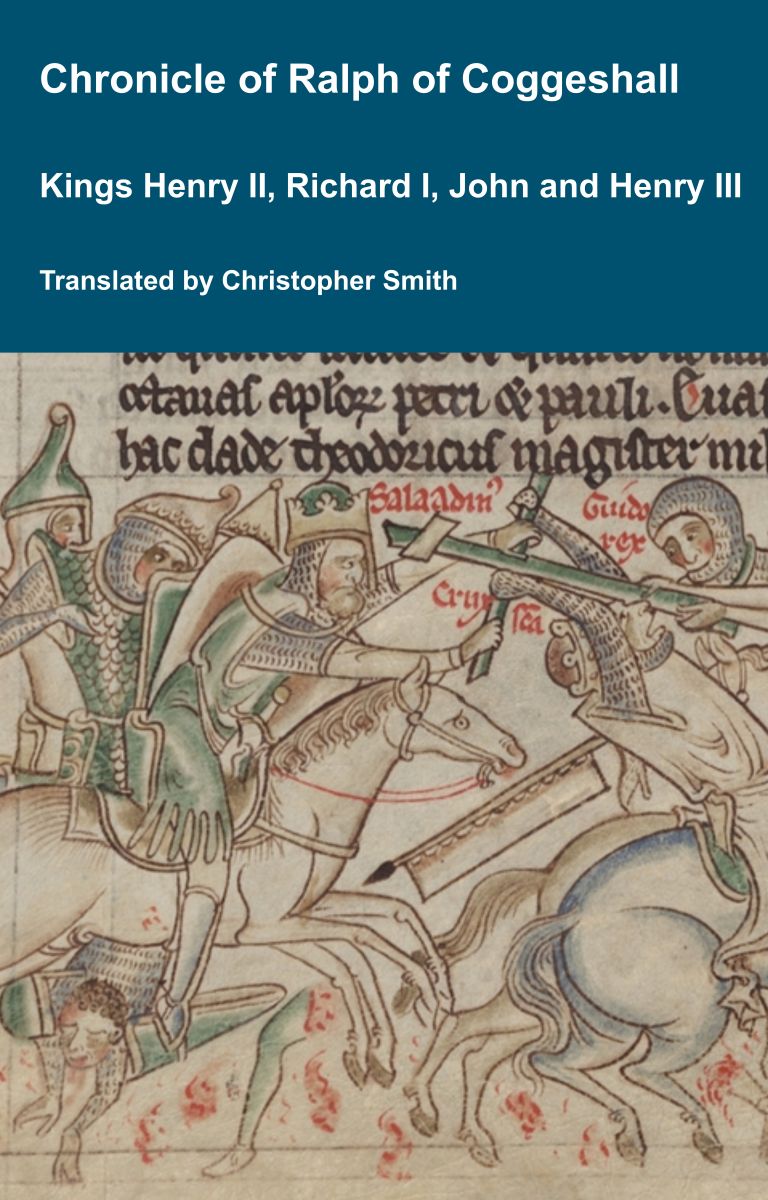
Chronicle of Abbot Ralph of Coggeshall
The Chronicle of Abbot Ralph of Coggeshall (Chronicon Anglicanum) is an indispensable medieval history that brings to life centuries of English and European affairs through the eyes of a learned Cistercian monk. Ralph of Coggeshall, abbot of the Abbey of Coggeshall in Essex in the early 13th century, continued and expanded his community’s chronicle, documenting events from the Norman Conquest of 1066 into the tumultuous reign of King Henry III. Blending eyewitness testimony, careful compilation, and the monastic commitment to record-keeping, this chronicle offers a rare narrative of political intrigue, royal power struggles, and social upheaval in England and beyond. Ralph’s work captures the reigns of pivotal figures such as Richard I and King John, providing invaluable insights into their characters, decisions, and the forces that shaped medieval rule. More than a simple annal, Chronicon Anglicanum conveys the texture of medieval life and governance, making it a rich source for scholars and readers fascinated by English history, monastic authorship, and the shaping of the medieval world.
Available at Amazon in eBook and Paperback format.
In 1128 [his wife] Joanna Monferrat Countess Essex and Flanders died.
Chronicle of William Nangis. Thierry of Alsace, arriving in Flanders and, by the persuasion of Henry, king of England, having with him certain men of Flanders, laid claim to Flanders against Count William. Count William met him with his forces drawn up and fought bravely [on 21st June 1128]; and when the enemies had almost been annihilated and the castle in which they had taken refuge ought to have been surrendered, the illustrious Count William himself, wounded in the hand, withdrew from the battle and soon afterwards died. The same Thierry then succeeded him.
[Theodericus de Alsatia in Flandrias adveniens, et suasu regis Angliæ Henrici quosdam Flandrensium secum habens, Flandrias contra Guillermum comitem calumniavit; cui Guillermus comes aciebus dispositis occurrens et viriliter decertans, dum pene adnihilatis hostibus castrum in quo latebant reddi deberet, ipse Guillermus comes inclylus sauciatus in manu a Prælio recedens satis cito mortuus est, cui successit idem Theodericus].
Anglo-Saxon Chronicle. All this year was the [his uncle] King Henry [aged 60] in Normandy, on account of the hostility that was between him and his nephew [aged 25], the Earl of Flanders [aged 29]. But the earl [William] was wounded in a fight1 by a swain; and so wounded he went to the monastery of St. Bertin; where he soon became a monk, lived five days afterwards, then died, and was there buried. God honour his soul. That was on the sixth day before the calends of August [27th July 1128].
Note 1. The Battle of Axspoele was fought on 21st June 1128.
Chronicon ex Chronicis by Florence and John of Worcester. William [aged 25], count of Flanders, surnamed The Sad, falling into an ambush, was wounded by his enemies, and, his sufferings increasing, died, amidst universal lamentations, on the sixth of the calends of August [27th July 1128], and was buried at St. Bertin.
History of the Dukes of Normandy by William of Jumieges. So then, to the aforementioned Robert, Count of Flanders, Henry, king of the Saxons and emperor of the Romans, granted the County of Cambrai, and Robert did homage to him for it. This Robert begot two sons, Robert and Philip. Robert, who was called the Jerusalemite because he was present when Jerusalem was taken by the Christians, begot Baldwin, who succeeded him. But Baldwin died from a wound that he had received in a certain battle near the castle of Auc in Normandy. After him, Charles his kinsman succeeded. And when this Charles was treacherously killed, as has already been said, William [aged 25], the son of Robert, Duke of Normandy, received the county of Flanders, as stated above. But he lived only a short time afterward, for while assaulting a certain town he was struck by a mortal wound. He died on the sixth day before the Kalends of August [27th July], in the year of the Lord 11281. He was buried in the church of Saint Bertin the Confessor, and Thierry [aged 29] of Alsace, a kinsman of the preceding counts, succeeded him. To this Thierry, Henry, king of the English, gave in marriage the sister [Sibylla2] of Geoffrey Martel, Count of Anjou.
Igitur prædicto Roberto comiti Flandriæ Henricus rex Saxonum et imperator Romanorum, dedit comiD talum Cameracensem et ipse fecit ei inde fidelitatem. Genuit autem idem Robertus duos filios, Robertum et Philippum. Robertus vero Hierosolymitanus cognominatus, quia interfuit, dum Hierusalem a Christianis caperetur, genuit Balduinum qui ei successit. Eodem vero Balduino mortuo ex vulnere, quod in conflicta quodam apud Aucum castrum quoddam Northmanniæ acceperat, Carolus cognatus ipsius ei successit Quo per traditionem occiso, sicut jam dictum est, cumdem comitatum Flandriæ, sicut superius diximus, Willelmus filius Roberti ducis Northmanniæ habuit. Sed parvo tempore supervixit, in cujusdam oppidi assultu appetitus lethali vulnere. Decessit vero 6 Kal. Aug. anno ab incarnatione Domini 1188. Sepultus est autem in ecclesia Sancti Bertini confessoris et successit ei Terricus de Avseis, congnatus præcedentium comitum. Huic Henricus rex Anglorum copulavit sororem Gaufridi Martelli comitis Andegavorum.
Note 1. The manuscript here has erroneously 1188.
Note 2. [his former wife] Sibylla [aged 16], around 1112-1165, daughter of Fulk of Anjou and Ermengarde de la Flèche. Her brother was Geoffrey, Count of Anjou, father of King Henry II of England; he is not known to have been given the nickname 'Martel' i.e. 'Hammer' although he is referred to as such in this text. Her uncle Geoffrey, Count of Anjou, who was known as 'Martel'. She married 1 in 1123 William "Clito", annulled 1124, and 2 in 1134 Thierry, Count of Flanders.
After 1132 Thierry Count Flanders [aged 33] and [his former wife] Sibylla Anjou Countess Essex [aged 20] were married. She by marriage Countess Flanders. She the daughter of [his former father-in-law] Fulk "Young" King Jerusalem [aged 43] and [his former mother-in-law] Ermengarde of Maine Countess of Anjou. He the son of Theodoric "Valiant" Metz II Duke Lorraine and Gertrude Flanders Duchess Lorraine. They were fifth cousins.
In 1165 [his former wife] Sibylla Anjou Countess Essex [aged 53] died.
Kings Wessex: Great x 7 Grand Son of King Alfred "The Great" of Wessex
Kings England: Grand Son of King William "Conqueror" I of England
Kings France: Great x 3 Grand Son of Hugh I King of the Franks
Kings Duke Aquitaine: Great x 7 Grand Son of Ranulf I Duke Aquitaine
Great x 4 Grandfather: William "Longsword" I Duke Normandy 
Great x 3 Grandfather: Richard "Fearless" Normandy I Duke Normandy
Great x 4 Grandmother: Sprota
Great x 2 Grandfather: Richard "Good" Normandy II Duke Normandy
Great x 4 Grandfather: Unknown Dane
Great x 3 Grandmother: Gunnora Countess Ponthieu
Great x 1 Grandfather: Robert "Magnificent" Normandy I Duke Normandy 8 x Great Grand Son of Charles "Charlemagne aka Great" King of the Franks King Lombardy Holy Roman Emperor
Great x 4 Grandfather: Judicael Berengar Penthièvre I Count Rennes
Great x 3 Grandfather: Conan "Crooked" Penthièvre III Duke Brittany
Great x 2 Grandmother: Judith Penthièvre Duchess Normandy 7 x Great Grand Daughter of Charles "Charlemagne aka Great" King of the Franks King Lombardy Holy Roman Emperor
Great x 4 Grandfather: Geoffrey "Greygown" Ingelger 1st Count Anjou
Great x 3 Grandmother: Ermengarde Gerberga Ingelger Duchess Brittany 6 x Great Grand Daughter of Charles "Charlemagne aka Great" King of the Franks King Lombardy Holy Roman Emperor
Great x 4 Grandmother: Adele of Meaux Countess Anjou 5 x Great Grand Daughter of Charles "Charlemagne aka Great" King of the Franks King Lombardy Holy Roman Emperor
GrandFather: King William "Conqueror" I of England -2 x Great Grand Son of King William "Conqueror" I of England
Great x 2 Grandfather: Father of Beatrix and Herleva
Great x 1 Grandmother: Herleva of Falaise
Father: Robert Curthose III Duke Normandy Son of King William "Conqueror" I of England
Great x 4 Grandfather: Baldwin III Count Flanders Great Grand Son of King Alfred "The Great" of Wessex
Great x 3 Grandfather: Arnulf II Count Flanders 2 x Great Grand Son of King Alfred "The Great" of Wessex
Great x 4 Grandmother: Matilda Billung Countess Flanders
Great x 2 Grandfather: Baldwin "Bearded" IV Count Flanders 3 x Great Grand Son of King Alfred "The Great" of Wessex
Great x 4 Grandfather: Berengar II King of Italy 
Great x 3 Grandmother: Rozala of Italy
Great x 4 Grandmother: Willa Bosonids Queen Consort Italy
Great x 1 Grandfather: Baldwin "The Good" V Count Flanders 4 x Great Grand Son of King Alfred "The Great" of Wessex
GrandMother: Matilda Flanders Queen Consort England Great Grand Daughter of Hugh I King of the Franks
Great x 4 Grandfather: Hugh "Great" Capet Count Paris  4 x Great Grand Son of Charles "Charlemagne aka Great" King of the Franks King Lombardy Holy Roman Emperor
Great x 3 Grandfather: Hugh I King of the Franks -2 x Great Grand Son of Hugh I King of the Franks
Great x 4 Grandmother: Hedwig Saxon Ottonian
Great x 2 Grandfather: Robert "Pious" II King of the Franks Son of Hugh I King of the Franks
Great x 4 Grandfather: William "Towhead" III Duke Aquitaine Great Grand Son of Ranulf I Duke Aquitaine
Great x 3 Grandmother: Adelaide Poitiers Queen Consort France 2 x Great Grand Daughter of Ranulf I Duke Aquitaine
Great x 4 Grandmother: Gerloc aka Adela Normandy Duchess Aquitaine
Great x 1 Grandmother: Adela Capet Duchess Normandy Grand Daughter of Hugh I King of the Franks
Great x 4 Grandfather: Boson II Count Arles
Great x 3 Grandfather: William "Liberator" I Count Provence I Count Arles
Great x 2 Grandmother: Constance Arles Queen Consort France
Great x 4 Grandfather: Fulk "Good" Ingelger 2nd Count Anjou
Great x 3 Grandmother: Adelaide-Blanche of Anjou Queen Consort West Francia
Great x 4 Grandmother: Gerberge Unknown Viscountess Anjou
William Clito Count Flanders Grand Son of King William "Conqueror" I of England
GrandFather: Geoffrey Count of Conversano