

Chronicle of Abbot Ralph of Coggeshall
The Chronicle of Abbot Ralph of Coggeshall (Chronicon Anglicanum) is an indispensable medieval history that brings to life centuries of English and European affairs through the eyes of a learned Cistercian monk. Ralph of Coggeshall, abbot of the Abbey of Coggeshall in Essex in the early 13th century, continued and expanded his community’s chronicle, documenting events from the Norman Conquest of 1066 into the tumultuous reign of King Henry III. Blending eyewitness testimony, careful compilation, and the monastic commitment to record-keeping, this chronicle offers a rare narrative of political intrigue, royal power struggles, and social upheaval in England and beyond. Ralph’s work captures the reigns of pivotal figures such as Richard I and King John, providing invaluable insights into their characters, decisions, and the forces that shaped medieval rule. More than a simple annal, Chronicon Anglicanum conveys the texture of medieval life and governance, making it a rich source for scholars and readers fascinated by English history, monastic authorship, and the shaping of the medieval world.
Available at Amazon in eBook and Paperback format.
Amber Bead is in Prehistoric Artefacts.
Golden Barrow aka Upton Lovell 2e [Map]. Bronze Age Barrow containing a rich collection of artefacts including:
[All information and photos sourced from Wiltshire Museum]
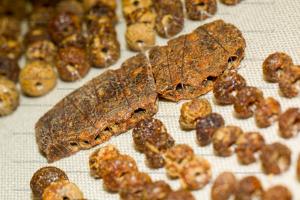
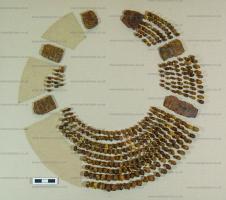
Amber spacer-plate necklace. This necklace was once made of around 1,000 amber beads, but now just over 300 survive. The flat 'spacer-plates' were drilled to hold the six strings of beads in place. Detailed examination suggests that the beads may have been from two necklaces. The necklace may have been made in Denmark or on the Baltic Coast. Necklaces with similar 'spacer-plates' have been found that are made of jet, which comes from Whitby. This suggests that this style of necklace was also made in Britain, using local materials.
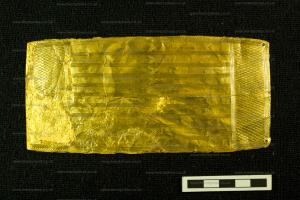
Gold plaque. Made from gold sheet less than 0.1mm thick, originally it was fixed to a backing, probably of wood. The plaque would have been sewn to an item of clothing, perhaps a cloak.
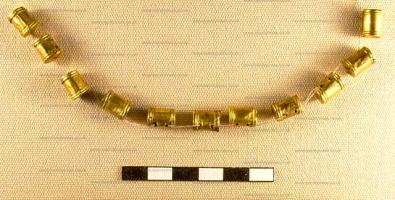
Gold drum-shaped beads. These eleven beads may have been part of a necklace or were possibly sewn onto clothing as decoration. They were made from coiled strips of gold with a gold cap at each end.
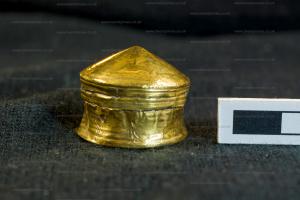
Gold caps. May have once decorated the ends of wooden staffs or sceptres.
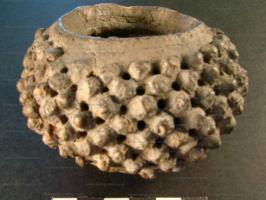
Incense 'grape cup'. These miniature pottery vessels were specially made to be used in funeral ceremonies and were placed in cremation burials, usually of women. These may have been fired on the funeral pyre and used to burn scented plants, hallucinogens or oils during a funeral ceremony. Holes in the side allowed the fragrant smoke to escape into the air.
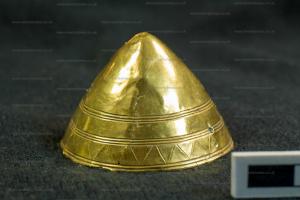
Shale pendant and gold cover. Cone-shaped shale pendant, decorated with incised lines. The cone was encased in gold sheet, decorated with the same incised lines.
Around 1700BC. Aldbourne Barrow 1013022 [Map]. Historic England: The monument includes two bowl barrows, aligned east-west, and set above the floor of a dry valley immediately south of Sugar Hill. The eastern barrow mound is 36m in diameter and stands to a maximum height of 1.5m. A ditch, originally dug to provide material for the barrow mound, is no longer visible at ground level but survives as a buried feature c.5m wide surrounding the mound. The western barrow is not visible as an earthwork but survives as a buried feature. The eastern barrow mound was partially excavated by Canon Greenwell, a prolific excavator of barrows, in the late 19th century. Finds included a cremation burial set on a wooden plank within a cairn, a bronze dagger, awls, faience and amber beads and a cup, later to become known as the "Aldbourne Cup".
Carbon Date. 1485BC. Late Bronze Age Carbon Dates
Report: human bone; from a crouched complete skeleton of a youth suffering from a tumour. The section showed that the skeleton had been inserted into the mound. It was associated with amber beads and a perforated cockle shell.
ID: 17603, C14 ID: OxA 4211 Date BP: 3485 +/- 110, Start Date BP: 3595, End BP: 3375
Abstract: Snail Down: Site XXII; 1992-93
Reference Name: Bayliss et al forthcoming 'Radiocarbon dates: from samples funded by English Heritage between 1988 and 1993', Swindon: English Heritage
Council for British Archaeology (2012) Archaeological Site Index to Radiocarbon Dates from Great Britain and Ireland [data-set]. York: Archaeology Data Service [distributor] https://doi.org/10.5284/1017767
Carbon Date. 740BC. Early Iron Age Carbon Dates
Report: human bone; site area D. Limb bone from inhumation associated with shale and amber beads.
ID: 16791, C14 ID: HAR 6122 Date BP: 2740 +/- 70, Start Date BP: 2810, End BP: 2670
Abstract: Marc 3: Easton Lane Interchange, Winchester; 1983-84
Reference Name: Bayliss, A, Hedges, R, Otlet, R, Switsur, R, and Walker, J 2012 'Radiocarbon dates: from samples funded by English Heritage between 1981 and 1988', Swindon: English Heritage
Council for British Archaeology (2012) Archaeological Site Index to Radiocarbon Dates from Great Britain and Ireland [data-set]. York: Archaeology Data Service [distributor] https://doi.org/10.5284/1017767
Carbon Date. 740BC. Early Iron Age Carbon Dates
Report: Bone, AML 833185, id as human limb, from inhumation 3058 assoc with [shale and?] amber beads at Easton Lane (Site W29, Interchange), M3 motorway site, Hampshire, England. Subm P J Fasham 1983. Comment (subm): See extended comment and CAL ranges in monograph.
ID: 2568, C14 ID: HAR-6122 Date BP: 2740 +/- 70, Start Date BP: 2670, End BP: 2810
Abstract: Multi-period settlement
Archaeologist Name: P J Fasham (Trust for Wessex Arch)
Reference Name: Fasham P J & Whinney R J B, 'Archaeology and the M3...' (= Hampshire Fld Club Archaeol Soc Monogr, 7), 1991, 143-7; Radiocarbon, 32, 1990, 170
Council for British Archaeology (2012) Archaeological Site Index to Radiocarbon Dates from Great Britain and Ireland [data-set]. York: Archaeology Data Service [distributor] https://doi.org/10.5284/1017767
Carbon Date. 130. Late Iron Age Carbon Dates
Report: Peat associated with amber beads of LBA or later type at Derrybrien North, Galway, Ireland.
ID: 74, C14 ID: Gro-650 Date BP: 1870 +/- 90, Start Date BP: 1780, End BP: 1960
OS Letter: M, OS East: 592, OS North: 21
Archaeologist Name: G F Mitchell
Reference Name: Science, 127, 1958, 133; J Roy Soc Antiq Ireland, 88, 1958, 49-56 esp 55; J Roy Soc Antiq Ireland, 90, 1960, 61-6
Council for British Archaeology (2012) Archaeological Site Index to Radiocarbon Dates from Great Britain and Ireland [data-set]. York: Archaeology Data Service [distributor] https://doi.org/10.5284/1017767

Archaeologia Volume 15 Section XI Page 128. William Cunnington, Archaeologia, Vol. 15, p.122-26
August 1st, Heytesbury 1803.
The tumulus [Golden Barrow aka Upton Lovell 2e [Map]] opened last Thursday in Upton Lovel parish, is situated a few yards north of the river Wily. It is of a pyramidical form, the base length 58 feet by 38 feet wide [g] and 22 feet in the slope, and stands from east to west. The northside of the barrow is extremely neat, the fouth side is much mutilated. On making a section lengthways on the barrow, at about two feet deep we found in a very shallow cist, human burnt bones piled in a little heap; and at the distance of a foot a considerable quantity of ashes [h] which contained small fragments of human bones; above, and at two feet distant from the bones were found the following articles of pure gold, which are neatly wrought, and highly burnished, viz. about thirteen gold beads made in the form of a drum, having two ends to screw off and perforated in the sides; [i] 2ndly, a thin plate of the same metal 2.25 inches by 5.25 inches; this is very neatly ornamented, as you will see by the annexed drawing: [k] 3dly, a beautiful Bulla (as I conjecture) of a conical form; [l] the inside of this is a solid cone of wood, the gold -which completely covered it is very thin; at the base are two holes for a thread or wire by which it was suspended; near the above were found four articles, viz. two of each, that appeared once to have covered the ends of slaves. [m] Among the gold ornaments lay several flat pieces of amber, the eighth of an inch in thickness, and about an inch wide; there were all perforated lengthways, but were sadly broken in getting out. What is very extraordinary, there were also nearly one thousand amber beads of different sizes. Close to the pile of ashes we found a very small urn, a lance-head of brass, and a pin of the same metal. The urn is of a very extraordinary form, appearing exactly as though it had been stuck all over with small black grapes. In this barrow, contrary to the usual method of interment on the Downs, which are on or in the native soil, we found the cist nearly on the top; and this deviation was probably occasioned from the wetness of the foil, being near the river, or it might have been the manner of interring their great chieftains. From the vail quantity of beads, it might be conjectured that a female had been interred here, but it is well known that our British chiefs wore pearls, beads, etc. On some of the coins of Conobeline we fee beads or pearls on the head. We find in other respects similar method of interment to what we find in many other barrows; the small urn, lance-head of brass, brass pin, etc. are common. From the profusion of valuable ornaments, for valuable they must have been at the period of their interment, we might rationally conclude this barrow to have been the sepulchre of some great chief; in all probability a chief of the Belgic Britons.
I am. Sir,
Your most humble Servant,
William Cunnington.
A. B. Lambert, Esq. Boyton House .
Note g. The length on the top 21 fe
Note h. A circumstance very common.
Note i. See fig. 5.
Note k. You see only a part of this plate: the whole length was about six inches; the pieces broken off had holes in the corners, perhaps used as a bread plate.
Note l. See fig. 1; the bafe of this is neatly ornamented
Note m. See fig. 2, 3.
Archaeologia Volume 15 Section XI Page 128. TUMULUS XX (AW 98) Copy of a letter to H.P. Wyndham Esq July 28th 1803.
William Cunnington, Manuscript Letters, Vol., p.35-6
Sir I have this day opened a barrow in Upton Lovell [Golden Barrow aka Upton Lovell 2e [Map]] it is situated in the meads a few yards north of the river Wylye. As the discoveries in this barrow are more important in their nature than any other ever yet made I hasten to inform you the particulars. This Barrow of a pyramidal form or rather like the common of houses, pointing East to West, is in the base 52 by 32 feet, the slope 22ft, the length on the top 22 feet. The North side of the barrow is extremely? the south side is much mutilated. On making a section lengthways of the barrow, at about two feet deep we found in a very shallow cist human burnt bones piled in a little heap, and at a foots distance a considerable quantity of ashes, which also contained small fragments of human bones, upon which and at two feet distant from the bones were found the following articles of pure gold, which are neatly wrought and highly polished, viz about ten gold beads made in the form of a drum? two ends to off and perforated in the sides..see Plate XI fig 5 ~.a thin plate of the same metal nearly 9 inches by 6 inches long, this is very neatly ornamented as you will see by Plate XI fig?. by a beautiful Bulla of a conical form, see fig 3 in the same plate and inside this is a solid cone of wood, the gold which completely covered it is very thin, at the base are two holes for a thread or wire by which it was suspended see fig 4. near the above were found of gold four articles viz.. two of which that appeared once I have covered the ends of staffs some of my friends say they are small boxes. see plate XI fig 1 and 2. Among the gold ornaments lay several flat pieces of amber, about the eight of an inch in thickness, and about an inch wide, -they were all perforated lengthways but were sadly broken in getting out. (see plate two fig 2 when joined they were the exact form of those found in Deverell Barrow only bigger). What is every extraordinary there were also nearly one thousand amber beads of different sizes see Plate X fig 2.- Close to the pile of ashes we found a very small urn see Plate X fig 1. Also a lance head of brass and a pin of the same metal-see the same plate. The urn is of a very extraordinary form, appearing as though it had been studded all over with small black grapes. In this barrow, contrary to the usual custom of interment on the Downs, which is generally on, or in the native soil we found the cist nearly on the top of the barrow and this deviation was probably occasioned by the wetness of the soil, the barrow being near the river. We find in other respects a similar method of interment to what we find in many other barrows, the small urn, lance head of brass, brass pin etc are common. From the profusion of valuable ornaments, for valuable they must have been at the period of their interment, we might naturally conclude this barrow to have been the sepulchre of a great chief of the Belgic+ Britons. + Mr Coxe objects to the word Belgic, suppose we say a British chief near the time of Caesars invasion.
Colt Hoare 1812. CHLORLIS'S CAMP [Map], but in Mr. Aubrey's Monumenta Britannica, as well as in Mr. Camden's Britannia, it is noticed under the title of FRIPSBURY [Map]. What, the origin of the latter name is, I am at a loss to conjecture. The former may be derived from the British General CONSTANTIUS CHLORES, to whom, perhaps, the construction of this camp may be attributed. In Kennet's Parochial Antiquities, I find this earthen work alluded to, and some history given of its supposed founder. "After the death of Carausius, in the year 297, the Emperors Dioclesian and Maximian succeeded to the government of the empire, and in order to withstand the rebellions that broke out in divers parts of it, elected Galerius Maximus and Constantius Chlorus as their generals. The latter having defeated the usurper Allectus, got a good footing in Britain, and a good governor he was, and was come forwards upon the downs as far as New Sarum2, where, upon the side of the downs he built a fortification, the rampers whereof still appear very apparently, and is called CHLOREN, after the name that the Britons gave him, by reason of his long train carried up after him; it standeth in Wiltshire, upon the north corner of CHLORENDON Park, now called CLARENDON, which taketh is name thereof; a park of that largeness and bigness that it excecdeth any park in the kingdom; it hadi a church covered over with ivy in the north pan thereof next CHLOREN, which thereupon is now called Ivy Church: and if we give credit to a late poet, the park had twenty groves in it, each of them of a mile compass, and without any sophistication, it had a house of kings within, but long since dilapidated; it cloth now belong to the Right Honourable William Earl of Pembroke, Lord Chamberlain to his Majestie, whose heart is as large and liberal as the park is wide. This CONSTANTIUS embraced the Christian faith, and married Helena, daughter to King Coyl that built ColChester, by whom he had Constantine the Great, that removed the empire to the east, and built Constantinople."
Note 1. The following minutes Were sent to me Mr. Cunnington, respecting his researches on these barrows. "August 6, 1807. Aboüt a mile and a half south of Wilbary House, in a shallow vale, immediately under the hills to the is a group of five barrows; three bowl-shaped, and two of the Druid they stand nearly in a straight line, and owing to the ground being in tillage, have been repeatedly over, therefore much reduced in height. No. 1 is a bowl shaped barrow, 74 feet in its base diameter, and 3 feet 9 inches in elevation. It contained within an oblong cist, an interment of burned bones. over which was a brass pin. In making the sections, our men found at the depth of two feet the skeleton of a dog, which had been deposited immediately over the cist. No. 2, a bowl-shaped barrow, 69 feet in diameter, and feet in elevation, produced a little pile of burned bones, unaccompanied by any arms [?] or trinkets. No. 3, a fine Druid barrow, of the second class, contained a deposit of burned bones; but Mr. Cunnington thinks he may have missed the primary interment, or it may have been disturbed by a prior opening, No. 4 and 5 had both been examined before,
"From hence we proceeded to a group of eight barrows on Idmiston Downs, two of which are shaped, four bowl-shaped, and two Druid; all situated on a piece fine maide down. One of the bell-shaped barrows produced a simple interment of burned bones; and in the other, the sepulchral deposit was not discovered.
The fine Druid barrow contained within its area, which measured 194 feet in diameter, two raised mounds, in one of which, immediately under the turf, were discovered three large urns within few inches of each other; they were inverted, and covered the burned bones of three Britons. From being placed so near the surface, two of the urns were broken, but the third is preserved entire in our Museum at Heytesbury. They were all of rude pottery, and without any ornament. Beneath these three urns, in a shallow cist, were the burned bones of another Briton, piled up in R little heap. In the other within the same barrow, was another interment of burned bones, accompanied by the following articles, viz. a small cup similar size to the very diminutive one discovered at Everley, and engraved in Tumuli Plate XXII but without ornament; a brass pin, and a considerable quantity of amber beads." In one of the bowl-shaped barrows Mr. Cunnington railed in finding the interment, and the others he did not open.
Note 1. For New, we must read Old Sarum, as the former dates its origin only from the year 1220, and this transaction must have taken place soon after the accession of Dioclesian and Maximian to the empire in the year 304.
Chronicle of Geoffrey le Baker of Swinbroke
Baker was a secular clerk from Swinbroke, now Swinbrook, an Oxfordshire village two miles east of Burford. His Chronicle describes the events of the period 1303-1356: Gaveston, Bannockburn, Boroughbridge, the murder of King Edward II, the Scottish Wars, Sluys, Crécy, the Black Death, Winchelsea and Poitiers. To quote Herbert Bruce 'it possesses a vigorous and characteristic style, and its value for particular events between 1303 and 1356 has been recognised by its editor and by subsequent writers'. The book provides remarkable detail about the events it describes. Baker's text has been augmented with hundreds of notes, including extracts from other contemporary chronicles, such as the Annales Londonienses, Annales Paulini, Murimuth, Lanercost, Avesbury, Guisborough and Froissart to enrich the reader's understanding. The translation takes as its source the 'Chronicon Galfridi le Baker de Swynebroke' published in 1889, edited by Edward Maunde Thompson.
Available at Amazon in eBook and Paperback format.
Colt Hoare 1812. No. 3 [Wilsford Barrow 3 G72 [Map]] is another barrow of the same species, which produced a similar interment by cremation, and a considerable quantity of glass, jet, and amber beads, together with a fine brass pin.
Colt Hoare 1812. No. 12 [Winterbourne Stoke West Barrow 12 G68 [Map]]. The vallum of this large Druid barrow is so much defaced, and the elevation of the mound so very trifling, that it might easily escape general notice. It contained a very large rude urn, sixteen inches and a half deep, inverted over an interment of burned bones, and within it a smaller vase. With them were found two black rings similar to those before described, but not perforated for suspension, large amber bead perforated, four pully beads, and three of a black colour. The three last mentioned barrows are situated on the outside of the bank and ditch, which, at first sight, bear an equivocal appearance from their singular shape, resembling a pentagon, which I have before, stated as being a favourite form with the Britons; but on a close investigation of them, they appear decidedly of a more modern date than the barrows. The name of the hill, Conigar, and the vulgar tradition of this spot having once been appropriated to a rabbit-warren, will corroborate this conjecture, and ascertain the origin of this earthen enclosure. On the adjoining hill, called High Down, and to the N. W. of the group of barrows, are the decided remains of a British village, in which we found coins of the Lower Empire, pottery of various sorts, with animal bones, and all the usual indicia of an ancient British and Roman population.
Colt Hoare 1812. No. 26 [Winterbourne Stoke Barrow 26 G9 [Map]] is a fine bowl-shaped barrow, 97 fret in diameter, and nine feet and a half in elevation. Mr. Cunnington attempted to open it in the year 1804, but missed the interment, when, as it turned out, he was within one foot of it. Fortune now favoured our researches, and discovered to us in an oblong cist, a skeleton lying from north to south, within a shallow case of wood, of a boat-like form. Round its neck were found a great variety of amber and jet beads, a lance head, and pin of brass, with a little urn of a very neat form, which was broken to pieces.

Colt Hoare 1812. No. 147 [Normanton Barrow 147 G16 [Map]]. One of these two barrows, enclosed within the same ditch, was opened by Thomas, Earl of Pembroke, in the year 1722, and is marked A in TAB. IX. of Stukeley; and described at page 44 of his Stonehenge. Although the noble Peer made an entire segment in it from centre to circumference, his researches proved unsuccessful as to the primary interment, but he found the deposit of a skeleton three feet under the surface, with its head placed in a northerly direction towards Stonehenge. Our experience having given us repeated proofs that the system of opening barrows was but imperfectly understood in former days, we determined to try our luck, and on reaching the floor soon found, owing to a stratum of chalk, a clue to the cist, which contained an interment of burned bones, and with it two articles of ivory in high preservation. The one resembles in shape a small lance-head, the other is like the handle of a cup. Each is engraved in Tumuli Plate XXIV. The latter is the third article of the sort we have discovered, yet can we form no idea to what use it was appropriated. In the smaller barrow Dr. Stukeley had cleared a part of the floor, but not finding any interment, he left two half-pence covered with stones; one of the reign of King WILLIAM the Third, the other of King GEORGE the First, 1718. This last is in high preservation, though the period of 86 years has elapsed since it was deposited. On meeting with these tokens, our labourers left off work, thinking that the learned Doctor bad been beforehand with us, but from the circumstance of not meeting with any fragments of bones, Mr. Cunnington desired them to continue their researches; when, on exploring the floor of the barrow, they soon perceived the well known line of chalk, which led them to a cist at the east end of the barrow, and to an interment of burned bones, with which were deposited four amber beads, two of jet with convoluted stripes, and a little broken cup.

Colt Hoare 1812. No. 156 [Normanton Barrow 156 G7 [Map]] is a fine bell-shaped barrow, 102 feet in base diameter, and 10 feet in elevation above the plain. It contained within a very shallow cist, the remains of a skeleton, whose head was placed towards the west, and a deposit of the most various elegant little trinkets; the most remarkable of which are two gold beads, engraved of their original size in Tumuli Plate XXV. No. 7, 8. The first is of an oblong form, large, and ornamented with circular rings; the other is much less, and of a globular; they appear to have been formed by first making a wooden bead, and then covering it with two thin plates of gold, which were overlapped in the centre, and made fast by indentation; for in none of these golden articles have we ever distinguished any marks of solder, or any other mode of fastening than by indentation. The large bead is perforated lengthways, the smaller one in two places on one side. Besides these beads of gold. there were several trinkets of jet, amber, &c. viz. a flat: piece of amber, No, 9; two other pieces, the one plain, the other marked with transverselines, both perforated; also two round beads of amber; a jet bead of a globular form, but much compressed, No. 10; another with convoluted stripes, No. 1; an article of jet, singular in its shape, No. 12; and some curious beads of stone, one of which, No. 13, seems to be the joint of a petrified echinus [sea urchin]. Besides the above articles, the most remarkable of which are engraved in Tumuli Plate XXV. we found another beautiful little grape cup, similar to those before described in Tumuli Plates XI. and XXIV. in high preservation. There was also a drinking cup placed at the feet of the skeleton, which was unfortunately broken, but afterwards repaired.
Colt Hoare 1812. Following the great road to Salisbury, we may observe a barrow on its side, which owing to the high ground on which it stands, becomes rather a conspicuous object. It is called Newton barrow, and must have been of much larger dimensions before it was ploughed over. We opened in July, 1805, but found that some antiquary, probably the Earl of Pembroke, or our good friend the Doctor, had been before hand with us. Our researches, however, were not totally fruitless or unproductive of novelty, as we found one amber bead, and a great many articles made of the teeth of some animal, and perforated, probably for the purpose of a rude necklace; the bones also that were dispersed about. a deep cist cut in the chalk, were strongly tinged with verditer, a proof that articles OF brass were once deposited within this barrow, whose history, we regret, was not recorded by those who investigated it. We afterwards opened two small barrows on the apex of the adjoining hill, but found that they also had been explored.
Beauties of the Boyne. During the excavations some very interesting relics and antiquities were discovered. Among the stones which form the great heap, or cairn, were found a number of globular stone shot, about the size of grape-shot, probably sling-stones, and also fragments of human heads; within the chamber, mixed with the clay and dust which had accumulated, were found a quantity of bones, consisting of heaps, as well as scattered fragments of burned bones, many of which proved to be human; also several un burned bones of horses, pigs, deer, and birds, with portions of the heads of the shorthorned variety of the ox, similar to those found at Dunshaughlin, and the head of a fox. Glass and amber beads, of unique shapes, portions of jet bracelets, a curious stone button or fibula, bone bodkins, copper pins, and iron knives and rings, the two latter similar to those found at Dunshaughlin, were also picked up. Some years ago a gentleman who then resided in the neighbourhood cleared out a portion of the passage, and found a few iron antiquities, some bones of mammals, and a small stone urn, which he lately presented to the Academy. Much might here be written upon the remains of the Fauna known to the ancient Irish, did our space permit; we can, however, merely specify some of the bones, and mention some of the articles which were discovered. In the beginning of the last century, a stone urn, somewhat similar in shape to "the upper part of a man's skull," was found in a kistvaen at Knowth; this, we believe, is now in the collection of the Academy; it is figured by Molyneux.
Archaeological Journal Volume 15 Pages 199-215. Stukeley, fresh from the Downs of Wiltshire, wondered that he observed no tumuli or barrows, the burying-places of the people about it, as in other cases, but supposed this owing to the goodness of the soil; for, as he goes on to say, "they wisely pitched upon barren ground to repose their ashes, where they could only hope to lie undisturbed: and on Mendip Hills, not far off, they are very numerous. This particularly I am told of seven that are remarkable." The group to which Stukeley alludes is most probably one of two on Priddy Hill, of which one is formed of nine [Priddy Nine Barrows], and the other of seven barrows [Ashen Hill Barrows]. Many others, however, are to be seen on the Mendip range. The Priddy barrows were examined by the late Rev. John Skinner, in 1815, and in all cases in which the interment was found, cremation appears to have prevailed. In some the ashes were found in urns, in others without urns in cists, or on flat stones without cists. The urns were rude and unbaked, with the zigzag ornament, and usually reversed. One of them was embossed with projecting knobs, like that which was dis interred by Sir R. C. Hoare from a tumulus on Beckhampton Down. The following articles were also discovered: amber beads and a small blue opaque glass bead with them, perforated; brazen (bronze) spear heads; flint and brazen (bronze) arrow-heads; and an ivory pin, upwards of 4 inches long. These barrows are of different sizes, the highest being 12 feet high, and 164 in circumference. The Men clip Mines were doubtless extensively worked by our British forefathers, and a considerable trade in metals must have been carried on by them with foreign nations.
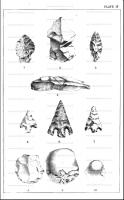
Proceedings of the Cotteswold Naturalists' Field Club Volume 5 Page 277. The "Journal of the Archseological Association" (Vol. IV., page 60) contains an account of the discovery of a number of interments in a field near Chavenage, from which were obtained iron spear-heads, bronze fibulae, silver ear-rings, stone, clay, and amber beads, all characteristic specimens of Anglo-Saxon workmanship. These interments were met with in the year 1847 by workmen employed to level down two circular tumuH, which stood 300 feet due N. and S., one from the other. This levellingdown process, though uncovering the secondary graves, did not disturb the central portions of the original grave-mounds, and these I have carefully examined during the present year. In one, charcoal, burned bones, small pieces of pottery, and worked flints were foiind on the original surface, and a few inches higher a very well worked flint javelin-point (see Plate IV., fig. 2.) What remained of the other tumulus was still protected by stones, which covered a deposit of fine soil, in which were found some pieces of iron-stone and of charcoal, but no trace of any interment; and neither bones, pottery, or flints were met with.
Rude Stone Monuments in all Countries Chapter V. At Dowth there was the usual miscellaneous assortment of things. A great quantity of globular stone-shot, probably slingstones; and in the chamber fragments of burned bones, many of wdiich proved to be human; glass and amber beads of unique shape, portions of jet bracelets, a curious stone button, a fibula, bone bodkins, copper pins, and iron knives and rings. Some years ago a gentleman residing in the neighbourhood cleared out a portion of the passage, and found a few iron antiquities, some bones of mammals, and a small stone urn, which he presented to the Irish Academy.1 In so far as negative evidence is of value, it may be remarked that no flint implements and nothing of bronze — unless the copper pins are so classed — was found in any of these tumuli.
Note 1. Sir W. Wilde, 'The Boyne and the Blackwater,' p. 209.
Annals of the six Kings of England by Nicholas Trivet
Translation of the Annals of the Six Kings of England by that traces the rise and rule of the Angevin aka Plantagenet dynasty from the mid-12th to early 14th century. Written by the Dominican scholar Nicholas Trivet, the work offers a vivid account of English history from the reign of King Stephen through to the death of King Edward I, blending political narrative with moral reflection. Covering the reigns of six monarchs—from Stephen to Edward I—the chronicle explores royal authority, rebellion, war, and the shifting balance between crown, church, and nobility. Trivet provides detailed insight into defining moments such as baronial conflicts, Anglo-French rivalry, and the consolidation of royal power under Edward I, whose reign he describes with particular immediacy. The Annals combines careful year-by-year reporting with thoughtful interpretation, presenting history not merely as a sequence of events but as a moral and political lesson. Ideal for readers interested in medieval history, kingship, and the origins of the English state, this chronicle remains a valuable and accessible window into the turbulent world of the Plantagenet kings.
Available at Amazon in eBook and Paperback format.
Archæological Handbook of Gloucestershire. Swell Barrow 2 aka Pole's Wood South [Map]
This is in the parish of Upper Swell, half a mile from the village, and one and a half miles from Stow-on‑the‑Wold. Its length was 173 feet, its greatest width 57 feet, and greatest height eight feet six inches; its direction was east by north and west by south, the highest portion lying towards the east. Like the others in this neighbourhood it is composed of oolitic rubble and slabs, and is surrounded by a wall, which at the east end reached to a height of five feet, and here it assumed the "horned" shape. Only one chamber was found in the whole of this mound; this was twenty-four feet from the west end, and on the north side of the barrow; it had a passage leading to it similar to the last. The chamber was seven feet long, four feet wide, and three feet eight inches high. At least nine skeletons were found here, together with bones of the goat or sheep, ox, pig, and two pieces of pottery. In the passage were found three other skeletons. Near the surface of the barrow three bodies were discovered, evidently Saxons, as proved by the articles found with them, viz., two bronze buckles, an iron knife, and an amber bead.
See "Jour. Anthrop. Inst.," vol. V, p120.
Also "British Barrows," p521.
Wiltshire Archaeological Magazine 1885 V22 Pages 234-238. "Barrows Opened by Mr. Cunnington near Beckhampton, 1804.
"A group of barrows near Shepherds Shore [Map]. Mr. C. opened the smallest, which contained a cist with burnt bones and a jet ornament, a bone arrow-head, a pin, &c.
"Farther to the north-west, and under Morgan's Hill, is a group of four barrows [Map], nearly in a line; but lower down the vale are several others. Opened the second from the hill — of the Druid kind — five feet in elevation — burnt bones and a piece of slate, and a neat little urn, also several long amber beads, and two ivory or bone beads. Opened a tumulus lower down — a large rude black urn with burnt bones.
Wiltshire Archaeological Magazine 1907 V35 Pages 1-20. No. 8. Five small much decayed amber beads. Not illustrated.
No. 9. Small square tanged bronze awl, length 2in.
No. 10. Small tanged bronze awl. Curiously the two points are in wonderful preservation and quite sharp, while the central part is much decayed. Length 1⅝in.
No. 11. Tanged awl of bronze, length 3¼in.
No. 12. Small bronze dagger blade. It is too much corroded to see any ornamentation if it ever had any. The two rivets are still in it. Length 1¾in.
Wiltshire Archaeological Magazine 1907 V35 Pages 1-20. Lying near each other and from 6in. to 8in. from the head were the disc of gold and amber, the spherical bead, the gold-handled lancet, a small bronze blade and amber pommel, and the jet and amber beads. The beads had certainly been threaded together, and lay in rows embedded in the clay; the rows lay over one another as though the string of beads had been deposited in a little heap and not laid out in any order. They were not round the neck. Some of the beads were stained with bronze from actual contact with the small bronze blade.
Long Barrows of the Cotswolds. The following is Witts' account:-
" Its length was 173 feet, its greatest width 57 feet and greatest height, 8 feet 6 inches; its direction was E. by N. and W. by S., the highest portion lying towards the east. Like the others in this neighbourhood it is composed of oolitic rubble and slabs, and is surrounded by a wall, which at the east end reached to a height of 5 feet, where it assumed the 'horned' shape. Only one chamber was found in the whole of this mound; this was 24 feet from the W. end, and on the N. side of the barrow; it had a passage leading to it similar to the last [IF. 29. Cow Common Barrow, No. 21 in this book]. The chamber was 7 feet long, 4 feet wide and 3 feet 8 inches high. At least nine skeletons were found here, together with bones of the goat or sheep, ox, pig, and two pieces of pottery. In the passage were found three other skeletons. Near the surface of the barrow three bodies were discovered, evidently Saxons, as proved by the articles found with them, viz., two bronze buckles, an iron knife, and an amber bead."
Wessex from the Air Plate 33a. The other disc-barrow [Normanton Barrow 160 G3 [Map]] was opened in 1804 by Sir Richard Colt Hoare and his collaborator, Mr. William Cunnington. It 'produced within a small circular cist, an interment of burned bones, and with it, a great variety of amber, jet and glass beads' (Ancient Wiltshire, i, 1812, 205). These beads consist of two long notched beads of blue glass, five-eighths of an inch long, with six segments (Stourhead Catalogue, 1896, No. 154); eleven round amber beads (ibid, No. 154 a) and six fusiform lignite beads (ibid., No. 154 b).
O.G.S.C. [aged 41]
Wessex from the Air Plate 31. Thurnam's illustration is reproduced on p. 179, by kind permission of the Society of Antiquaries of London.
No. 18 is a large circular, bowl-shaped barrow, ditched round. At the depth of seven feet and a half, and on the floor, lay a skeleton with its head to the north-east and its legs and thighs drawn up close together. The skull was pressed flat, and near it lay part of a deer's horn, perforated in the stem.' (Illustrated on Hoare's Plate XXXII.)
No. 19 is another bowl, smaller than the last. It contained, within a round cist cut in the chalk, the burned bones of one body, and two very small arrowheads
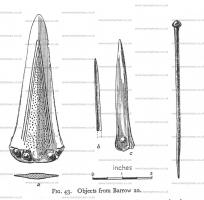
No. 20 is another, intermediate in size and position between 18 and 19. It produced a splendid sepulchral urn which was broken [and does not, therefore, seem to have been kept]. On removing the fragments we discovered an interment of burned bones, over which was a considerable quantity of decayed linen cloth, the filaments of which, at first sight, appeared like hair. This deposit was accompanied by a round pin (Fig. 43, B) and an arrowhead [sic] of bone (Fig. 43, c), and a very perfect spearhead of brass [sic, for ' bronze'] (Fig. 43, A), with a great part of the wooden handle adhering to it, by which we were enabled clearly to see the mode by which it had been fastened.' The perforated bone implement is certainly not an arrowhead, whatever its use may have been; and the bronze knife is of a kind typical of the Early Bronze Age.
No. 21 has been ploughed flat, but is still visible. It contained c a little cist full of charcoal very finely burned, and on the outside of it some fragments of coarse pottery and burned bone, which indicated a prior opening
No. 22 is a long barrow [though not a true one] very similar in form, as well as in its contents, to No. 10, for it contained three interments. That towards the north consisted of ashes and burned bones enclosed within a cist. That towards the south produced a similar deposit with a very large urn of coarse and thick pottery, together with a pair of bone tweezers. The central interment was also enclosed within a sepulchral urn of rude pottery, together with one amber bead. These diminutive long barrows differ very materially from those of the larger sort, in which we have almost invariably found the interments deposited at the east and broadest end.' It may be added that in this case, as also in that of no. lo, no side-ditches are visible.
No. 23, being a low and broad barrow, we found some difficulty in ascertaining its centre, and we failed in our first attempts upon it; bht a second trial, and a larger excavation, led us to an interment of burned bones deposited within an inverted um of very coarse unbaked pottery.' It is now heather-covered.
No. 28 'contained the deposit of a skeleton'. That is all the brief record says. I conclude that the skeleton was a secondary, perhaps Saxon, interment. Mr. Harold Peake and I found a Saxon skeleton, with an iron spearhead, as a secondary interment in the tump of a discbarrow near Botley Copse, Great Bedwyn. Below it was a burnt interment with a bronze pin or pricker. No absolutely certain instance is recorded of an inhumation in a disc-barrow. (See Thurnam, Arch. xliii. 294, note b.)
Wessex from the Air Plate 31. No. 11 is not visible on the air-photograph. It is small and flat and yielded a 'similar interment at a depth of about 12 in. from the surface '.
No. 12 is a large flat barrow in which we made two sections, but could discover no sepulchral signs whatever.' It is now distinguished by the heather which grows on it, giving it a dark appearance on the plate.
No. 13 had already been opened, but yielded a ' fine amber bead figured on Hoare's Plate XXXII, 2. It is the disc-barrow already referred to, immediately below us, with two tumps. It is one of the finest examples of its kind.
No. 14 yielded three burnt interments, one covered by an inverted urn, of which no account is given, and which is not known to have survived.
No. 15 contained a skeleton lying east and west.
No. 16, on which we are supposed to be sitting, 'is the largest barrow in the group, and has baffled our attempts, although we made a section 12 ft. square, and dug to the depth of 12 ft. 6 in. On the floor of the barrow we perceived evident marks of cremation.'
Wessex from the Air Plate 31. No. 8 is another disc-barrow, partially destroyed by the Roman road, as Stukeley also observed two hundred years ago. It has always hitherto been supposed to be circular, and is so marked on the 25-in. ordnance map; but this photograph shows that it is elliptical, the two tumps standing symmetrically at its foci. They must, therefore, be strictly contemporary, unlike those of nos. 7 and 13. Both appeared to Colt Hoare and his collaborator to have been opened before;
'... but on examining them we found ourselves repaid for our want of confidence in former explorators.... At the depth of rather more than 3 feet [in the tump farthest from the Roman road] we discovered a small cist containing the burned bones of one person, accompanied by about 100 amber beads of great variety [Fig. 40, a], and some flat pieces of amber [Fig. 40, b] There were besides, a small brass [w, for 'bronze'] pin and an arrowhead of the same metal [Fig. 40, c]. The other mound, that nearest to the Roman road, had, as well as the former, fragments of pottery intermixed with the soil; but we persevered in our researches, and at the depth of about 4 feet from the surface, discovered a cist containing burned bones, with several beads of glass, jet and amber.... This interment also had its little brass [sic, for ' bronze '] pin and a most beautiful little cup [Fig. 40, d].
Wessex from the Air Plate 31. No. 7 is a disc-barrow with two tumps, one in the centre, and the other, as may be seen, beside it. From this fact it may be concluded (as also in the case of no. 13) that the non-central tump was added later, some time after the central interment had been deposited. It was excavated by Mr. Cunnington in 1803, and it was found that one of the tumps had already been opened, and 'the other contained an interment of burned bones, with amber beads '.
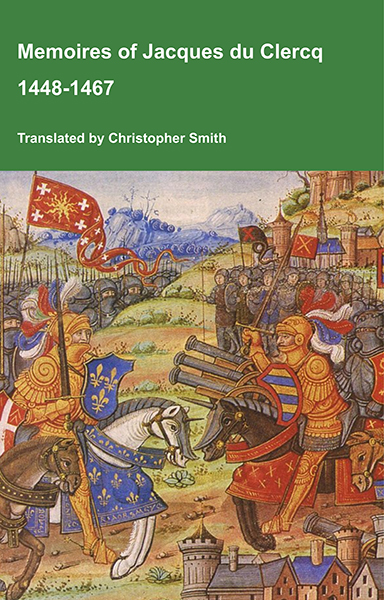
This is a translation of the 'Memoires of Jacques du Clercq', published in 1823 in two volumes, edited by Frederic, Baron de Reissenberg. In his introduction Reissenberg writes: 'Jacques du Clercq tells us that he was born in 1424, and that he was a licentiate in law and a counsellor to Philip the Good, Duke of Burgundy, in the castellany of Douai, Lille, and Orchies. It appears that he established his residence at Arras. In 1446, he married the daughter of Baldwin de la Lacherie, a gentleman who lived in Lille. We read in the fifth book of his Memoirs that his father, also named Jacques du Clercq, had married a lady of the Le Camelin family, from Compiègne. His ancestors, always attached to the counts of Flanders, had constantly served them, whether in their councils or in their armies.' The Memoires cover a period of nineteen years beginning in in 1448, ending in in 1467. It appears that the author had intended to extend the Memoirs beyond that date; no doubt illness or death prevented him from carrying out this plan. As Reissenberg writes the 'merit of this work lies in the simplicity of its narrative, in its tone of good faith, and in a certain air of frankness which naturally wins the reader’s confidence.' Du Clercq ranges from events of national and international importance, including events of the Wars of the Roses in England, to simple, everyday local events such as marriages, robberies, murders, trials and deaths, including that of his own father in Book 5; one of his last entries.
Available at Amazon in eBook and Paperback format.
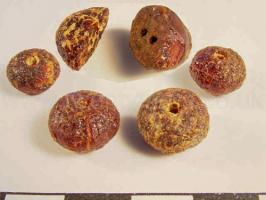
Wiltshire Museum. DZSWS:STHEAD.249a. 4 amber beads and 2 V-perforated amber buttons (like shale buttons) created by splitting a large amber bead in half, found with primary cremations in two tumps (out of three) in disc barrow Winterbourne Stoke G14 [Map] (?), excavated by William Cunnington.
Blewburton Hill, Oxfordshire [Map] is an univallate Iron Age hillfort in Oxfordshire.
From Pastscape:
An Iron Age settlement and hillfort. Excavations found the settlement to be palisaded and contained a number of pits and postholes. Finds including pottery was recovered. The hillfort was found to comprise two phases of occupation. Earlier occupation was indicated by a range of Neolithic and Bronze Age flint implements. An Anglo-Saxon cemetery was also recorded. It comprised 22 inhumation and one cremation burials . The majority of the burials were accompanied by grave goods which included brooches, buckles, knives, a spearhead, and glass and amber beads. The grave goods indicate an early Saxon date for the cemetery.
Excavation of the earthwork on Blewburton Hill by A.E.P.Collins in 1947-9, revealed an Iron Age 'A' settlement dating from circa 300 B.C., evidenced by much pottery, grain storage pits, post holes, and the trench of a timber palisade.
This was followed by the construction of typical bank and ditch hill-fort defences showing two periods of construction - 'AB' and 'B'. The bank had been fairly massive and the ditch measured 18-38 feet in width, being as little as 5 feet deep in the first period but reaching at least 15 feet in cutting J in the second period. The entrance on the southwest side was found to have a made causeway and the post-holes of double gates (cuttings H and J on plan; see AO/LP/63/61.)
Flints of Neolithic or Early Bronze Age type were found in the lower end of cutting G, and the blade of a polished stone axe in the ditch north of the entrance.
A small number of Roman sherds, (1st and 3rd-4th century) were found, but these may be considered strays the site being deserted during the Roman period.
Four Saxon burials were found in cuttings G and G1, and three more in cutting J. they may be part of a cemetery and are dated by Leeds as probably 5th century A.D. (2-3). Another Saxon burial was found just below the turf-crest of the hill-fort in July 1945. The associated grave goods: two bronze brooches (Leeds cross potent derivative group c) and nine glass beads are in the possession of Mrs.Mornington Higgs. (4-5)
Of the unusual terrace or lynchet-type features all that can be said is that they are definitely post Iron Age but that their function is still an open question. (2) (3) Scheduled (7) (2-8)
The bank and ditch of the hillfort defences do not exist as original features.
The rampart has been reduced to a negative lynchet which in the eastern half of the hillfort has been ploughed down and in part entirely destroyed. The course of the ditch is to some extent represented by a flat terrace in the western half but has been completely destroyed in the eastern half. Near the original entrance there are two short stretches of bank along the top of the upper lynchet and the lip of the terrace below but both may be the result of modern cultivation.
Finds Near Stow on the Wold. Barrow 2 [Pole's Wood South Barrow [Map]] — seen at times, by those gifted with second sight, swathed in unearthly flame. On its surface, at the horned end, with her head south, broken, and her bones displaced, lay a lady — between her knees, a small iron knife; below her breast, an amber bead, whilst two circular cabled fibulae fastened her shroud, one on each shoulder.
But, "place aux dames!" as Dr. Rolleston exclaimed, on further removal of the soil, the remains of other bodies appeared. The frame of a man, lying north-east by south-west, had been displaced to receive the lady's body. Skulls and bones of two infants were found. A Saxon family, prematurely cut ofi", would seem to have been committed to this particular spot, on the, even then, revered and ancient cairn. A singular circumstance attending this "find," was the arrival of a telegram, at a British barrow, summoning Dr. Rolleston, from the grave of the Saxon lady, to the sick bed of his sister. Progress indeed!
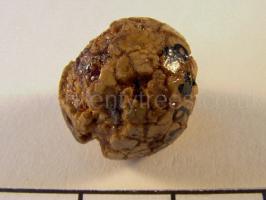
Wiltshire Museum. DZSWS:STHEAD.70c. 1 spherical amber bead found with a wrapped primary cremation under an inverted urn in disc barrow Winterbourne Stoke G67 [Map], excavated by William Cunnington.