

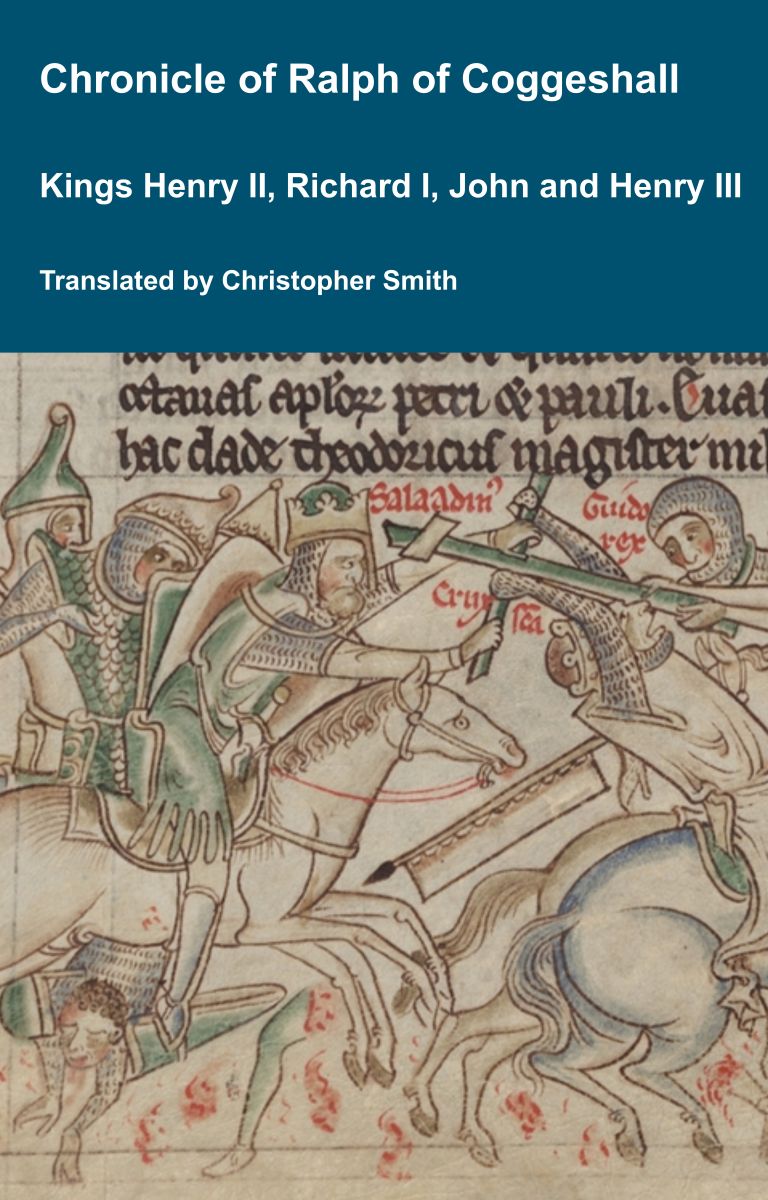
Chronicle of Abbot Ralph of Coggeshall
The Chronicle of Abbot Ralph of Coggeshall (Chronicon Anglicanum) is an indispensable medieval history that brings to life centuries of English and European affairs through the eyes of a learned Cistercian monk. Ralph of Coggeshall, abbot of the Abbey of Coggeshall in Essex in the early 13th century, continued and expanded his community’s chronicle, documenting events from the Norman Conquest of 1066 into the tumultuous reign of King Henry III. Blending eyewitness testimony, careful compilation, and the monastic commitment to record-keeping, this chronicle offers a rare narrative of political intrigue, royal power struggles, and social upheaval in England and beyond. Ralph’s work captures the reigns of pivotal figures such as Richard I and King John, providing invaluable insights into their characters, decisions, and the forces that shaped medieval rule. More than a simple annal, Chronicon Anglicanum conveys the texture of medieval life and governance, making it a rich source for scholars and readers fascinated by English history, monastic authorship, and the shaping of the medieval world.
Available at Amazon in eBook and Paperback format.
Argyllshire is in Scotland.
On 10th May 1493 Colin Campbell 1st Earl Argyll [aged 60] died. He was buried at Kilmun Church. His son Archibald [aged 44] succeeded 2nd Earl Argyll.
In 1638 Archibald Campbell 7th Earl Argyll [aged 63] died. He was buried at Kilmun Church. His son Archibald [aged 30] succeeded 8th Earl Argyll. Margaret Douglas Marchioness Argyll [aged 28] by marriage Countess Argyll.
On 27th May 1661 Archibald Campbell 1st Marquess Argyll [aged 54] was beheaded for his perceived treason on the restoration of Charles II at Edinburgh. He was buried at Kilmun Church.
Monument in the North Aisle, Edinburgh Cathedral [Map].


On 10th November 1839 George William Campbell 6th Duke Argyll [deceased] was buried at Kilmun Parish Church.
On 11th November 1836 George Murray 5th Earl Dunmore [aged 74] died at Glen Finart. His son Alexander [aged 32] succeeded 6th Earl Dunmore, 2nd Baron Dunmore of Dunmore in the Forest of Athole in Perthshire.

On 25th April 1847 John Douglas Edward Henry Campbell 7th Duke Argyll [aged 69] died at Inveraray Castle. His son George [aged 23] succeeded 8th Duke Argyll, 5th Baron Hamilton of Hameldon in Leicestershire. Elizabeth Georgiana Leveson-Gower Duchess Argyll by marriage Duchess Argyll.
On 27th August 1697 Alexander Campbell 16th Thane of Cawdor [aged 35] died on the Isle of Islay. His son John [aged 2] succeeded 18th Thane of Cawdor.

Time Team Series 2 Episode 1: Lord of the Isles was filmed between 24th June 1994 and 26th June 1994 was filmed. It was originally shown on 8th January 1995.
Location: Finlaggan, Islay [Map]
Category: Time Team Prehistory, Time Team Early Medieval.
The Time Team:
Tony Robinson [aged 48], Presenter
Mick Aston [aged 48], Bristol University Landscape Archaeologist
Carenza Lewis [aged 31], Royal Commission on Historic Monuments
Phil Harding [aged 44], Wessex Archaeological Trust Field Archaeologist
Robin Bush [aged 51], Archivist
Victor Ambrus [aged 59], Historical Illustrator
John Gator, Chris Gaffney, Geophysics
Stewart Ainsworth [aged 43], Landscape Archaeologist
David Caldwell, Director of Excavations
Kate Bonner, Excavation Team
Sally Ann Chandler, Period Clothing Expert
Donald Macfadian, Finlaggan Trust
Simon Mears, GPS System
Historical Figures: King Somerled of Argyll
Sources: Chronicle of Man and the Isles, A Description of the Western Isles of Scotland by Martin Martin, A Description of the Western Isles of Scotland by Martin Martin.
Outcomes: Partly complete Glass Bead, Replica aketon, possible mesolithic site, possibly stone rows aligned to Paps of Jura.
Description of the Western Isles. Loch-Finlagan [Map], about three miles in circumference, affords salmon, trouts, and eels: this lake lies in the centre of the isle. The isle Finlagan, from which this lake hath its name, is in it. It is famous for being once the court in which the great Macdonald, King of the Isles, had his residence; his houses, chapel, etc., are now ruinous. His guards de corps, called Lucht-taeh, kept guard on the lake side nearest to the isle; the walls of their houses are still to be seen there.
Description of the Western Isles. The Names of the Churches in this Isle are as follows:
KIL-CHOLLIM Kill, St. Columbus his church near Port Escock, Kil-Chovan in the Rins, on the west side the isle; Kil-Chiaran in Rins, on the west side Nerbols in the Rins, St. Columbus his church in Laggan, a chapel in island Nave, and Kilhan Alen, north-west of Kilrow. There is a cross standing near St. Columbus's or Port Escock side, which is ten feet high. There are two stones set up at the east side of Loch-Finlagan [Map], and they are six feet high. All the inhabitants are Protestants; some among them observe the festivals of Christmas and Good Friday. They are well proportioned and indifferently healthful. The air here is not near so good as that of Jura, from which it is but a short mile distant; but Islay is lower and more marshy, which makes it liable to several diseases that do not trouble those of Jura. They generally speak the Irish tongue; all those of the best rank speak English; they use the same habit and diet with those of Jura. This isle is annexed to the Crown of Scotland. Sir Hugh Campbell of Caddell is the King's steward there, and has one half of the island. This isle is reckoned the furthest west of all the isles in Britain. There is a village on the west coast of it called Cul, i.e., the back part; and the natives say it was so called because the ancients thought it the back of the world, as being the remotest part on that side of it. The natives of Islay, Colonsay, and Jura say that there is an island lying to the southwest of these isles, about the distance of a day's sailing, for which they have only a bare tradition. Mr. MacSwen, present minister in the isle Jura, gave me the following account of it, which he had from the master of an English vessel that happened to anchor at that little isle, and came afterwards to Jura, which is thus:
The History of William Marshal was commissioned by his son shortly after William’s death in 1219 to celebrate the Marshal’s remarkable life; it is an authentic, contemporary voice. The manuscript was discovered in 1861 by French historian Paul Meyer. Meyer published the manuscript in its original Anglo-French in 1891 in two books. This book is a line by line translation of the first of Meyer’s books; lines 1-10152. Book 1 of the History begins in 1139 and ends in 1194. It describes the events of the Anarchy, the role of William’s father John, John’s marriages, William’s childhood, his role as a hostage at the siege of Newbury, his injury and imprisonment in Poitou where he met Eleanor of Aquitaine and his life as a knight errant. It continues with the accusation against him of an improper relationship with Margaret, wife of Henry the Young King, his exile, and return, the death of Henry the Young King, the rebellion of Richard, the future King Richard I, war with France, the death of King Henry II, and the capture of King Richard, and the rebellion of John, the future King John. It ends with the release of King Richard and the death of John Marshal.
Available at Amazon in eBook and Paperback format.
On 21st April 1421 or 26th April 1421 John Stewart of Innermeath 3rd of Lorn [aged 71] died at Lorn.
