

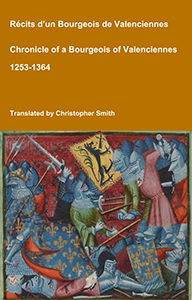
Chronicle of a Bourgeois of Valenciennes
Récits d’un bourgeois de Valenciennes aka The Chronicle of a Bourgeois of Valenciennes is a vivid 14th-century vernacular chronicle written by an anonymous urban chronicler from Valenciennes in the County of Hainaut. It survives in a manuscript that describes local and regional history from about 1253 to 1366, blending chronology, narrative episodes, and eyewitness-style accounts of political, military, and social events in medieval France, Flanders, and the Low Countries. The work begins with a chronological framework of events affecting Valenciennes and its region under rulers such as King Philip VI of France and the shifting allegiances of local nobility. It includes accounts of conflicts, sieges, diplomatic manoeuvres, and the impact of broader struggles like the Hundred Years’ War on urban life in Hainaut. Written from the perspective of a burgher (bourgeois) rather than a monastery or royal court, the chronicle offers a rare lay viewpoint on high politics and warfare, reflecting how merchants, townspeople, and civic institutions experienced the turbulence of the 13th and 14th centuries. Its narrative style combines straightforward reporting of events with moral and civic observations, making it a valuable source for readers interested in medieval urban society, regional politics, and the lived experience of war and governance in pre-modern Europe.
Available at Amazon in eBook and Paperback format.
Skaill, Deerness is in Deerness, Orkney.
Carbon Date. 1520BC. Middle Bronze Age Carbon Dates
Report: plant remains:-
ID: 5113, C14 ID: OxA-1716 Date BP: 3520 +/- 70, Start Date BP: 3450, End BP: 3590
Abstract: Skaill, Deerness [Map], England
Archaeologist Name: Limbrey
Reference Name: Archaeometry 32(2), 1990, 211-237
Council for British Archaeology (2012) Archaeological Site Index to Radiocarbon Dates from Great Britain and Ireland [data-set]. York: Archaeology Data Service [distributor] https://doi.org/10.5284/1017767
Carbon Date. 1150BC. Late Bronze Age Carbon Dates
Report: bone:-
ID: 5015, C14 ID: OxA-1437 Date BP: 3150 +/- 70, Start Date BP: 3080, End BP: 3220
Abstract: Skaill, Deerness [Map], England
Archaeologist Name: Limbrey
Reference Name: Archaeometry 32(2), 1990, 211-237
Council for British Archaeology (2012) Archaeological Site Index to Radiocarbon Dates from Great Britain and Ireland [data-set]. York: Archaeology Data Service [distributor] https://doi.org/10.5284/1017767
Carbon Date. 1010BC. Late Bronze Age Carbon Dates
Report: Sample unspecified from Site 6, no 4, under earliest occupation at Skaill, Deerness [Map], Orkney, Scotland.
ID: 771, C14 ID: Birm-594 Date BP: 3010 +/- 140, Start Date BP: 2870, End BP: 3150
OS Letter: HY, OS East: 587, OS North: 67
Archaeologist Name: P S Gelling
Reference Name: Radiocarbon, 18, 1976, 263
Council for British Archaeology (2012) Archaeological Site Index to Radiocarbon Dates from Great Britain and Ireland [data-set]. York: Archaeology Data Service [distributor] https://doi.org/10.5284/1017767
Carbon Date. 120BC. Middle Iron Age Carbon Dates
Report: Charcoal from hearth between EIA cobbling and LBA paving at Skaill, Deerness [Map], Orkney, Scotland.
ID: 3240, C14 ID: Birm-413 Date BP: 2120 +/- 120, Start Date BP: 2000, End BP: 2240
OS Letter: HY, OS East: 588, OS North: 64
Archaeologist Name: P S Gelling
Reference Name: Radiocarbon, 16, 1974, 297-8; Renfrew C (ed), 'The prehistory of Orkney' (1985) (synthesis and calibration Proc Soc Antiq Scot, 121, 1991, 206
Council for British Archaeology (2012) Archaeological Site Index to Radiocarbon Dates from Great Britain and Ireland [data-set]. York: Archaeology Data Service [distributor] https://doi.org/10.5284/1017767
Carbon Date. 100BC. Middle Iron Age Carbon Dates
Report: Charcoal from hearth between EIA cobbling and LBA paving at Skaill, Deerness [Map], Orkney, Scotland.
ID: 3241, C14 ID: Birm-397 Date BP: 2100 +/- 100, Start Date BP: 2000, End BP: 2200
OS Letter: HY, OS East: 588, OS North: 64
Archaeologist Name: P S Gelling
Reference Name: Radiocarbon, 16, 1974, 297-8; Renfrew C (ed), 'The prehistory of Orkney' (1985) (synthesis and calibration Proc Soc Antiq Scot, 121, 1991, 206
Council for British Archaeology (2012) Archaeological Site Index to Radiocarbon Dates from Great Britain and Ireland [data-set]. York: Archaeology Data Service [distributor] https://doi.org/10.5284/1017767
Carbon Date. 20BC. Middle Iron Age Carbon Dates
Report: Sample not specified from primary context on site at Skaill, Deerness [Map], Orkney, Scotland.
ID: 1256, C14 ID: Birm-764 Date BP: 2020 +/- 100, Start Date BP: 1920, End BP: 2120
Abstract: Multiphase site including Pictish
Archaeologist Name: P S Gelling
Reference Name: Renfrew C (ed), 'The prehistory of Orkney', 1985, 176-82 and 273; Proc Soc Antiq Scotl, 121, 1991, 206 (calib & comment)
Council for British Archaeology (2012) Archaeological Site Index to Radiocarbon Dates from Great Britain and Ireland [data-set]. York: Archaeology Data Service [distributor] https://doi.org/10.5284/1017767
Carbon Date. 240. Late Iron Age Carbon Dates
Report: Sample unspecified from under penultimate occ level, Site 6, no. 3 at Skaill, Deerness [Map], Orkney, Scotland.
ID: 3255, C14 ID: Birm-593 Date BP: 1760 +/- 110, Start Date BP: 1650, End BP: 1870
OS Letter: HY, OS East: 587, OS North: 67
Archaeologist Name: P S Gelling
Reference Name: Radiocarbon, 18, 1976, 263
Council for British Archaeology (2012) Archaeological Site Index to Radiocarbon Dates from Great Britain and Ireland [data-set]. York: Archaeology Data Service [distributor] https://doi.org/10.5284/1017767
Carbon Date. 500. Early Medieval
Report: Charcoal, id as mainly Betula, from hearth material under latest occ, site 6, no. 2 at Skaill, Deerness [Map], Orkney, Scotland.
ID: 3256, C14 ID: Birm-592 Date BP: 1500 +/- 120, Start Date BP: 1380, End BP: 1620
OS Letter: HY, OS East: 587, OS North: 67
Archaeologist Name: P S Gelling
Reference Name: Radiocarbon, 18, 1976, 263
Council for British Archaeology (2012) Archaeological Site Index to Radiocarbon Dates from Great Britain and Ireland [data-set]. York: Archaeology Data Service [distributor] https://doi.org/10.5284/1017767
Carbon Date. 580. Early Medieval
Report: Sample not specified from primary context in Pictish level at Skaill, Deerness [Map], Orkney, Scotland.
ID: 1257, C14 ID: Birm-763 Date BP: 1420 +/- 100, Start Date BP: 1320, End BP: 1520
Abstract: Multiphase site including Iron Age
Archaeologist Name: P S Gelling
Reference Name: Renfrew C (ed), 'The prehistory of Orkney', 1985, 176-82 and 273; Proc Soc Antiq Scotl, 121, 1991, 206 (calib & comment)
Council for British Archaeology (2012) Archaeological Site Index to Radiocarbon Dates from Great Britain and Ireland [data-set]. York: Archaeology Data Service [distributor] https://doi.org/10.5284/1017767
Carbon Date. 650. Early Medieval
Report: Sample not specified from primary context in Pictish level at Skaill, Deerness [Map], Orkney, Scotland.
ID: 1258, C14 ID: Birm-762 Date BP: 1350 +/- 100, Start Date BP: 1250, End BP: 1450
Abstract: Multiphase site
Archaeologist Name: P S Gelling
Reference Name: Renfrew C (ed), 'The prehistory of Orkney', 1985, 176-82 and 273; Proc Soc Antiq Scotl, 121, 1991, 206 (calib & comment)
Council for British Archaeology (2012) Archaeological Site Index to Radiocarbon Dates from Great Britain and Ireland [data-set]. York: Archaeology Data Service [distributor] https://doi.org/10.5284/1017767
Jean de Waurin's Chronicle of England Volume 6 Books 3-6: The Wars of the Roses
Jean de Waurin was a French Chronicler, from the Artois region, who was born around 1400, and died around 1474. Waurin’s Chronicle of England, Volume 6, covering the period 1450 to 1471, from which we have selected and translated Chapters relating to the Wars of the Roses, provides a vivid, original, contemporary description of key events some of which he witnessed first-hand, some of which he was told by the key people involved with whom Waurin had a personal relationship.
Available at Amazon in eBook and Paperback format.

Archaeologia Volume 3 Section XXX. When Mr. Banks was here, I was with, him every day, and he was pleased to make me the director of his Orkney tour. One day we went a grave-digging in the Links of Skail [Map], on the mainland, where there are great numbers of tumuli. We pitched upon one which seemed never to have been moved since its first construction; and Mr. Banks ordered the people to begin at one side, and dig to the other, that we might see the whole fabric of it. It was of a flattish conical shape, something resemblmg the figure in the plate annexed. After digging away a great quantity of sand, till we came near the centre of the hill, the people struck their spades on several large stones; upon which Mr. Banks ordered them to dig round them, and the whole conftruction appeared as I have sketched it with my pen; first, a large quantity of sand, then a large parcel of great stones, which seemed to have been taken from the neighbouring sea shore. When these were removed, the coffin or chest appeared, which was composed of four stones, covered with a very large fifth stone. In these lay the old gentleman (for so it appeared by his teeth he was) on his side, with his hands folded on his breast, his knees drawn up towards his belly, and his heels towards his hips. This was a highly-preserved skeleton, notwithstanding the length of time it must have lain. All the bones remained, only they were softish till they hardened in the air. The flesh was like a whitish earth, lying about the bones of the thicker parts of the body and on the arms, &c. was scattered a fort of blackish fibres, which Dr. Lind supposed might have been been the vascular system. What was remarkable was, a bag of some very coarfe vegetable stuff, which was laid at his feet, and contained the bones of a younger person, which seemed to have been a woman. Upon this were made many ingenious conjectures; that this might have been his wife, who died perhaps at thirty years of age, and might not have been buried till her husband died, and then her bones collected into this bag, and laid at his feet in the same grave. In examining a piece of this bag, to see whether it was made of a vegetable or animal subftance, I discovered it to be full of a species of insects called by Linnaeus Dermestes. These, together with the bag, were reduced to a blackish mass, which might be crumbled to powder between the fingers; but the warp and woof of the latter, as well as the entire shape of the insects, might easily be traced. There can be little said as to the antiquity of this, only that it was made before the introduction of Christianity.