


Anne Boleyn. Her Life as told by Lancelot de Carle's 1536 Letter.
In 1536, two weeks after the execution of Anne Boleyn, her brother George and four others, Lancelot du Carle, wrote an extraordinary letter that described Anne's life, and her trial and execution, to which he was a witness. This book presents a new translation of that letter, with additional material from other contemporary sources such as Letters, Hall's and Wriothesley's Chronicles, the pamphlets of Wynkyn the Worde, the Memorial of George Constantyne, the Portuguese Letter and the Baga de Secrets, all of which are provided in Appendices.
Available at Amazon in eBook and Paperback format.
Paternal Family Tree: Carew
In 1498 George Carew was born to [his father] Edmund Carew (age 32) and [his mother] Katherine Huddersfield.
In 1499 [his mother] Katherine Huddersfield died.
On 24th June 1513 [his father] Edmund Carew (age 47) was killed at Thérouanne [Map] at the Siege of Thérouanne. Apparently by a cannon ball whilst he sat in council.
In 1522 George Carew (age 24) graduated Bachelor of Arts at Broadgates Hall, Oxford University.
In 1534 George Carew (age 36) was appointed Archdeacon of Totnes.
In 1535 George Carew (age 37) was appointed Canon Exeter Cathedral.
On 5th November 1552 George Carew (age 54) was appointed Dean of Bristol Cathedral.
On 29th May 1555 [his son] George Carew 1st Earl Totnes was born to George Carew (age 57). He married May 1580 Joyce Clopton Countess Totnes.
Abbot John Whethamstede’s Chronicle of the Abbey of St Albans
Abbot John Whethamstede's Register aka Chronicle of his second term at the Abbey of St Albans, 1451-1461, is a remarkable text that describes his first-hand experience of the beginning of the Wars of the Roses including the First and Second Battles of St Albans, 1455 and 1461, respectively, their cause, and their consequences, not least on the Abbey itself. His text also includes Loveday, Blore Heath, Northampton, the Act of Accord, Wakefield, and Towton, and ends with the Coronation of King Edward IV. In addition to the events of the Wars of the Roses, Abbot John, or his scribes who wrote the Chronicle, include details in the life of the Abbey such as charters, letters, land exchanges, visits by legates, and disputes, which provide a rich insight into the day-to-day life of the Abbey, and the challenges faced by its Abbot.
Available at Amazon in eBook and Paperback format.
In 1556 George Carew (age 58) was appointed Archdeacon Exeter.
In 1558 George Carew (age 60) was appointed Dean of Bristol Cathedral.
In 1558 George Carew (age 60) was appointed Dean Chapel Royal.
In 1559 George Carew (age 61) was appointed Dean of Oxford.
In 1560 George Carew (age 62) was appointed Dean Chapel Royal Windsor.
In 1571 George Carew (age 73) was appointed Dean of Exeter.
In May 1580 [his son] George Carew 1st Earl Totnes (age 24) and [his daughter-in-law] Joyce Clopton Countess Totnes were married.
On 25th August 1580 the Irish forces ambushed the forces of Arthur Grey 14th Baron Grey of Wilton (age 44) at the Battle of Glenmalure fought at Glenmalure, County Wicklow. Around 800 English soldiers, including, [his son] Peter Carew were killed.
On 1st June 1583 George Carew (age 85) died. He was buried at St Giles' in the Fields Church [Map].
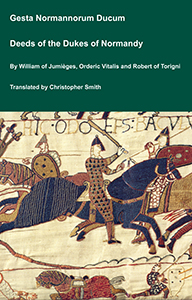
The Deeds of the Dukes of Normandy
The Gesta Normannorum Ducum [The Deeds of the Dukes of Normandy] is a landmark medieval chronicle tracing the rise and fall of the Norman dynasty from its early roots through the pivotal events surrounding the Norman Conquest of England. Originally penned in Latin by the monk William of Jumièges shortly before 1060 and later expanded at the behest of William the Conqueror, the work chronicles the deeds, politics, battles, and leadership of the Norman dukes, especially William’s own claim to the English throne. The narrative combines earlier historical sources with firsthand information and oral testimony to present an authoritative account of Normandy’s transformation from a Viking settlement into one of medieval Europe’s most powerful realms. William’s history emphasizes the legitimacy, military prowess, and governance of the Norman line, framing their expansion, including the conquest of England, as both divinely sanctioned and noble in purpose. Later chroniclers such as Orderic Vitalis and Robert of Torigni continued the history, extending the coverage into the 12th century, providing broader context on ducal rule and its impact. Today this classic work remains a foundational source for understanding Norman identity, medieval statesmanship, and the historical forces that reshaped England and Western Europe between 800AD and 1100AD.
Available at Amazon in eBook and Paperback format.
[his daughter] Mary Carew was born to George Carew.
[his son] Peter Carew was born to George Carew. He married Audrey Gardiner and had issue.
[his father] Edmund Carew and [his mother] Katherine Huddersfield were married.
Kings Wessex: Great x 15 Grand Son of King Edmund "Ironside" I of England
Kings Gwynedd: Great x 12 Grand Son of Owain "Great" King Gwynedd
Kings Seisyllwg: Great x 18 Grand Son of Hywel "Dda aka Good" King Seisyllwg King Deheubarth
Kings Powys: Great x 13 Grand Son of Maredudd ap Bleddyn King Powys
Kings England: Great x 7 Grand Son of King Edward I of England
Kings Scotland: Great x 14 Grand Son of King Duncan I of Scotland
Kings Franks: Great x 21 Grand Son of Charles "Charlemagne aka Great" King of the Franks King Lombardy Holy Roman Emperor
Kings France: Great x 16 Grand Son of Hugh I King of the Franks
Kings Duke Aquitaine: Great x 19 Grand Son of Ranulf I Duke Aquitaine
Great x 4 Grandfather: Leonard Carew  8 x Great Grand Son of King Henry I "Beauclerc" England
Great x 3 Grandfather: Thomas "Baron Hydon" Carew 4 x Great Grand Son of King Edward I of England
Great x 4 Grandmother: Elizabeth Fitzalan  3 x Great Grand Daughter of King Edward I of England
Great x 2 Grandfather: Nicholas Carew 5 x Great Grand Son of King Edward I of England
Great x 4 Grandfather: William Bonville 
Great x 3 Grandmother: Elizabeth Bonville
Great x 4 Grandmother: Margaret Aumale
Great x 1 Grandfather: Thomas Carew 4 x Great Grand Son of King Edward I of England
Great x 4 Grandfather: Edward Courtenay Great Grand Son of King Edward I of England
Great x 3 Grandfather: Hugh Courtenay 2 x Great Grand Son of King Edward I of England
Great x 2 Grandmother: Joan Courtenay 3 x Great Grand Daughter of King Edward I of England
GrandFather: Nicholas Carew 5 x Great Grand Son of King Edward I of England
Father: Edmund Carew 6 x Great Grand Son of King Edward I of England
Great x 3 Grandfather: John Dynham
Great x 2 Grandfather: John Dynham 8 x Great Grand Son of King Henry I "Beauclerc" England
Great x 4 Grandfather: Robert Courtenay 6 x Great Grand Son of King Henry I "Beauclerc" England
Great x 3 Grandmother: Muriel Courtenay 7 x Great Grand Daughter of King Henry I "Beauclerc" England
Great x 1 Grandfather: John Dynham 7 x Great Grand Son of King Henry "Curtmantle" II of England
Great x 4 Grandfather: John Lovell 5th Baron Lovel, Baron Holand  6 x Great Grand Son of King John of England
Great x 3 Grandfather: John Lovell 6th Baron Lovel 5 x Great Grand Son of King Henry "Curtmantle" II of England
Great x 4 Grandmother: Maud Holland 3rd Baroness Holand, Baroness Lovel  4 x Great Grand Daughter of King Henry "Curtmantle" II of England
Great x 2 Grandmother: Philippa Lovell 6 x Great Grand Daughter of King Henry "Curtmantle" II of England
GrandMother: Margery Dynham 8 x Great Grand Daughter of King Henry "Curtmantle" II of England
Great x 2 Grandfather: Richard Arches of Eythrop
Great x 1 Grandmother: Joan Arches
George Carew 7 x Great Grand Son of King Edward I of England
GrandFather: William Huddersfield
Mother: Katherine Huddersfield
Great x 1 Grandfather: John Bosome
GrandMother: Jennet or Elizabeth Bosome