


Anne Boleyn. Her Life as told by Lancelot de Carle's 1536 Letter.
In 1536, two weeks after the execution of Anne Boleyn, her brother George and four others, Lancelot du Carle, wrote an extraordinary letter that described Anne's life, and her trial and execution, to which he was a witness. This book presents a new translation of that letter, with additional material from other contemporary sources such as Letters, Hall's and Wriothesley's Chronicles, the pamphlets of Wynkyn the Worde, the Memorial of George Constantyne, the Portuguese Letter and the Baga de Secrets, all of which are provided in Appendices.
Available at Amazon in eBook and Paperback format.
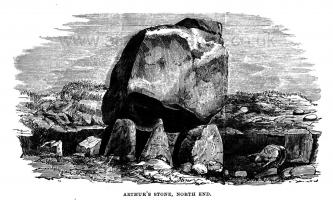
Arthur's Stone Burial Chamber is in Gower Peninsula Glamorganshire, Prehistoric Wales Neolithic Burials.
Arthur's Stone [Map] is a Neolithic Burial Chamber. Also known as Maen Ceti.
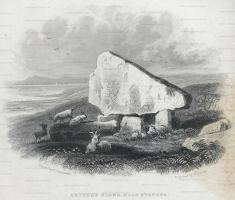
Wales Illustrated North Wales. Arthur's Stone Burial Chamber [Map].
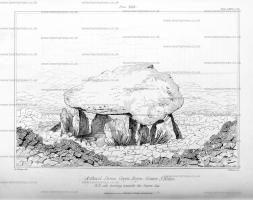
Archaeologia Volume 23 1831 Appendix. "Arthur's Stone [Map]," a Cromlech in the district of Gower. January 27, 1831. Extract of a Letter from Alfred John Kempe, Esq. F.S.A. to Henry Ellis, Esq. Secretary.
Archaeologia Cambrensis 1870 Page 23. Avenue and Carns about Arthur's Stone [Map] in Gower.
If the Greeks recorded the "wonders of the world" in their time, under the mystical number seven, four of which might be claimed as their own, the Cymry1 have also recorded the wonders and mighty labours of the Britons in one of their Triads, under their favourite, and equally mystical, number three; namely, 1, raising the Maen Cetti; 2, erecting the work of Emrys; and, 3, heaping the pile, or mound, of Cyvrangon. The first of these is the stone of Cetti, or "Arthur's Stone2;" the second, Stonehenge; and the third, apparently, the mound called Silbury Hill [Map], near Abury. But as the first is the only one connected with the inquiry I propose to make, my remarks will be confined to it, and to the avenue and the earns in its immediate vicinity.
Note 1. A question has lately been raised respecting this name by which the " Welsh" call themselves; but it is well known that Gymro "Welshman", or properly Cym-bro (from bro, "native land") signifies "of the same country", a "fellow countryman", or "compatriot"; as All-fro (a mutation of All-bro) means "of another country", or "a foreigner": hence Allobroges. And Eichard of Cirencester (b. i, c. 6, 12) says " all the Belgas are Allobroges, or foreigners", which of course they were to the Britons. All is related to aλλos, and alius, of two cognate languages; as Cym answers to cum, com, or con. Cymry and Cimbri are the same word under different forms; and we may remember how often m and mb are interchanged. The words related to Cymro, as Cymraig and others, are well known.
Note 2. Not called "Arthur's Quoit" by the people of the country, as some suppose.
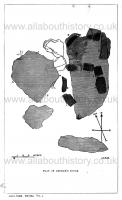
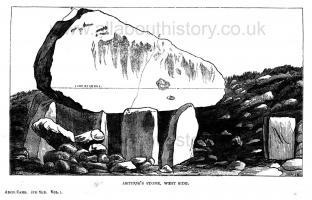
Swansea Scientific Society. CEFN BRYN
Col. Morgan and Mr. Glascodine Make A Discovery.
So much has been said and written about Arthur's Stone [Map], that stands sentinel like on the lonely top of Cefn Bryn, and so many antiquarians have speculated upon its origin and history, that one was apt to look upon the excursion, on August 29th, of the Swansea Scientific Society as a pleasure- able rather than investigative one. A happy discovery on the part of Col. Morgan and Mr. C. H. Glascodine made it both. The members of the Society left the Royal Institution of South Wales at 2 o'clock in coaches supplied by Mr. J. H. Rosser.