


The True Chronicles of Jean le Bel Volume 1 Chapters 1-60 1307-1342
The True Chronicles of Jean le Bel offer one of the most vivid and immediate accounts of 14th-century Europe, written by a knight who lived through the events he describes, and experienced some of them first hand. Covering the early decades of the Hundred Years’ War, this remarkable chronicle follows the campaigns of Edward III of England, the politics of France and the Low Countries, and the shifting alliances that shaped medieval warfare. Unlike later historians, Jean le Bel writes with a strong sense of eyewitness authenticity, drawing on personal experience and the testimony of fellow soldiers. His narrative captures not only battles and sieges, but also the realities of military life, diplomacy, and the ideals of chivalry that governed noble society. A key source for Jean Froissart, Le Bel’s chronicle stands on its own as a compelling and insightful work, at once historical record and literary achievement. This translation builds on the 1905 edition published in French by Jules Viard, adding extensive translations from other sources Rymer's Fœdera, the Chronicles of Adam Murimuth, William Nangis, Walter of Guisborough, a Bourgeois of Valenciennes, Geoffrey le Baker of Swinbroke and Richard Lescot to enrich the original text and Viard's notes.
Available at Amazon in eBook and Paperback format.
Caernarfon is in Carnarfonshire.
See: Caernarfon Castle [Map].
The Itinerary of Archbishop Baldwin through Wales: Book 2 Chapter 6. The archbishop having, by his sermon the next day, induced many persons to take the cross, we proceeded towards Banchor [Map], passing through Caernarvon [Map],147 that is, the castle of Arvon; it is called Arvon, the province opposite to Mon, because it is so situated with respect to the island of Mona. Our road leading us to a steep valley,148 with many broken ascents and descents, we dismounted from our horses, and proceeded on foot, rehearsing, as it were, by agreement, some experiments of our intended pilgrimage to Jerusalem. Having traversed the valley, and reached the opposite side with considerable fatigue, the archbishop, to rest himself and recover his breath, sat down on an oak which had been torn up by the violence of the winds; and relaxing into a pleasantry highly laudable in a person of his approved gravity, thus addressed his attendants: "Who amongst you, in this company, can now delight our wearied ears by whistling?" which is not easily done by people out of breath. He affirming that he could, if he thought fit, the sweet notes are heard, in an adjoining wood, of a bird, which some said was a woodpecker, and others, more correctly, an aureolus. The woodpecker is called in French, spec, and with its strong bill, perforates oak trees; the other bird in called aureolus, from the golden tints of its feathers, and at certain seasons utters a sweet whistling note instead of a song. Some persons having remarked, that the nightingale was never heard in this country, the archbishop, with a significant smile, replied, "The nightingale followed wise counsel, and never came into Wales; but we, unwise counsel, who have penetrated and gone through it." We remained that night at Banchor,149 the metropolitan see of North Wales, and were well entertained by the bishop of the diocese.150 On the next day, mass being celebrated by the archbishop before the high altar, the bishop of that see, at the instance of the archbishop and other persons, more importunate than persuasive, was compelled to take the cross, to the general concern of all his people of both sexes, who expressed their grief on this occasion by loud and lamentable vociferations.
Note 147. This ancient city has been recorded by a variety of names. During the time of the Romans it was called Segontium, the site of which is now called Caer Seiont, the fortress on the river Seiont, where the Setantiorum portus, and the Seteia AEstuarium of Ptolemy have also been placed. It is called, by Nennius, Caer Custent, or the city of Constantius; and Matthew of Westminster says, that about the year 1283 the body of Constantius, father of the emperor Constantine, was found there, and honourably desposited in the church by order of Edward I.
Note 148. I have searched in vain for a valley which would answer the description here given by Geraldus, and the scene of so much pleasantry to the travellers; for neither do the old or new road, from Caernarvon to Bangor, in any way correspond. But I have since been informed, that there is a valley called Nant y Garth (near the residence of Ashton Smith, Esq. at Vaenol), which terminates at about half a mile's distance from the Menai, and therefore not observable from the road; it is a serpentine ravine of more than a mile, in a direction towards the mountains, and probably that which the crusaders crossed on their journey to Bangor.
Note 149. Bangor. This cathedral church must not be confounded with the celebrated college of the same name, in Flintshire, founded by Dunod Vawr, son of Pabo, a chieftain who lived about the beginning of the sixth century, and from him called Bangor Dunod. The Bangor, i.e. the college, in Caernarvonshire, is properly called Bangor Deiniol, Bangor Vawr yn Arllechwedd, and Bangor Vawr uwch Conwy. It owes its origin to Deiniol, son of Dunod ap Pabo, a saint who lived in the early part of the sixth century, and in the year 525 founded this college at Bangor, in Caernarvonshire, over which he presided as abbot. Guy Rufus, called by our author Guianus, was at this time bishop of this see, and died in 1190.
Note 150. Guianus, or Guy Rufus, dean of Waltham, in Essex, and consecrated to this see, at Ambresbury, Wilts, in May 1177.
In 1571 John Griffith was elected MP Caernarfon.
In 1572 John Griffith was elected MP Caernarfon.
In 1604 John Griffith was elected MP Caernarfon.
In 1621 Thomas Jermyn [aged 48] was elected MP Caernarfon.
In 1659 William Glynne 1st Baronet [aged 20] was elected MP Caernarfon during the Third Protectorate Parliament.
On 25th April 1660...
Thomas Thynne [aged 50] was elected MP Hindon.
Henry Carey 4th Viscount Falkland [aged 26] was elected MP Oxfordshire.
Henry Cavendish 2nd Duke Newcastle upon Tyne [aged 29] was elected MP Derbyshire.
John Glynne [aged 58] was elected MP Caernarfonshire.
William Glynne 1st Baronet [aged 22] was elected MP Caernarfon.
Francis Godolphin [aged 54] was elected MP Heytesbury.
Richard Jennings [aged 41] was elected MP St Albans.


In 1715 Thomas Wynn 1st Baronet [aged 38] was elected MP Caernarfon.
In 1722 Thomas Wynn 1st Baronet [aged 45] was elected MP Caernarfon.
In 1747 Thomas Wynn 1st Baronet [aged 70] was elected MP Caernarfon.
After 13th April 1749 William Wynn [aged 72] was elected MP Caernarfon.
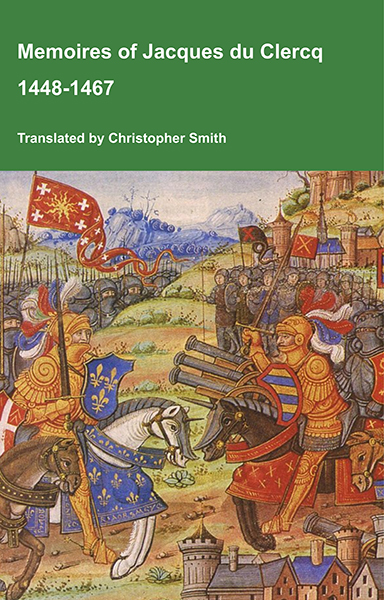
This is a translation of the 'Memoires of Jacques du Clercq', published in 1823 in two volumes, edited by Frederic, Baron de Reissenberg. In his introduction Reissenberg writes: 'Jacques du Clercq tells us that he was born in 1424, and that he was a licentiate in law and a counsellor to Philip the Good, Duke of Burgundy, in the castellany of Douai, Lille, and Orchies. It appears that he established his residence at Arras. In 1446, he married the daughter of Baldwin de la Lacherie, a gentleman who lived in Lille. We read in the fifth book of his Memoirs that his father, also named Jacques du Clercq, had married a lady of the Le Camelin family, from Compiègne. His ancestors, always attached to the counts of Flanders, had constantly served them, whether in their councils or in their armies.' The Memoires cover a period of nineteen years beginning in in 1448, ending in in 1467. It appears that the author had intended to extend the Memoirs beyond that date; no doubt illness or death prevented him from carrying out this plan. As Reissenberg writes the 'merit of this work lies in the simplicity of its narrative, in its tone of good faith, and in a certain air of frankness which naturally wins the reader’s confidence.' Du Clercq ranges from events of national and international importance, including events of the Wars of the Roses in England, to simple, everyday local events such as marriages, robberies, murders, trials and deaths, including that of his own father in Book 5; one of his last entries.
Available at Amazon in eBook and Paperback format.
Thomas Bulkeley was elected MP Caernarfon.