

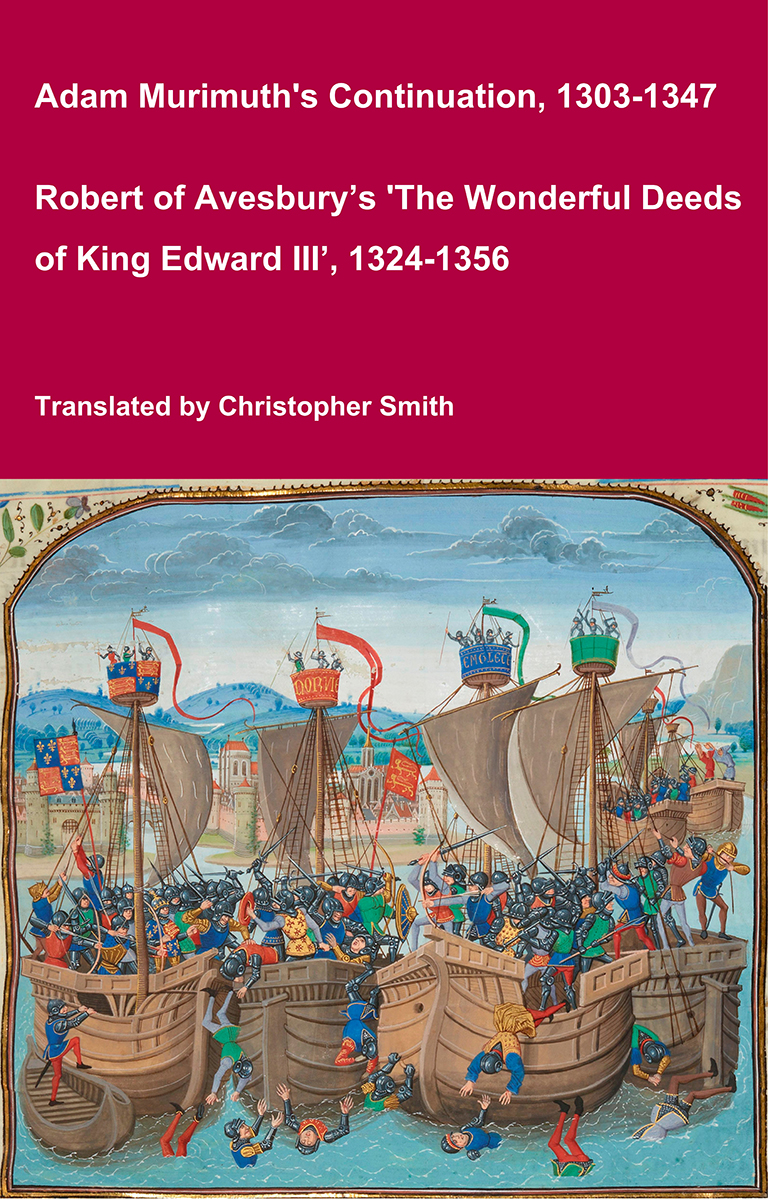
Adam Murimuth's Continuation and Robert of Avesbury’s 'The Wonderful Deeds of King Edward III'
This volume brings together two of the most important contemporary chronicles for the reign of Edward III and the opening phases of the Hundred Years’ War. Written in Latin by English clerical observers, these texts provide a vivid and authoritative window into the political, diplomatic, and military history of fourteenth-century England and its continental ambitions. Adam Murimuth Continuatio's Chronicarum continues an earlier chronicle into the mid-fourteenth century, offering concise but valuable notices on royal policy, foreign relations, and ecclesiastical affairs. Its annalistic structure makes it especially useful for establishing chronology and tracing the development of events year by year. Complementing it, Robert of Avesbury’s De gestis mirabilibus regis Edwardi tertii is a rich documentary chronicle preserving letters, treaties, and official records alongside narrative passages. It is an indispensable source for understanding Edward III’s claim to the French crown, the conduct of war, and the mechanisms of medieval diplomacy. Together, these works offer scholars, students, and enthusiasts a reliable and unembellished account of a transformative period in English and European history. Essential for anyone interested in medieval chronicles, the Hundred Years’ War, or the reign of Edward III.
Available at Amazon in eBook and Paperback format.
St David's Cathedral, Pembrokeshire is in St David's.
In 872 Bishop Lumberth was consecrated Bishop of St David's.
In 1081 Rhys ap Tewdwr King Deheubarth (age 16) sought sanctuary at St David's Cathedral, Pembrokeshire [Map].
On 18th September 1115 Bishop Bernard was appointed Bishop of St David's.
On 14th December 1148 David Fitzgerald (age 42) was elected Bishop of St David's.
On 19th December 1148 Bishop David Fitzgerald (age 42) was consecrated Bishop of St David's at Canterbury Cathedral [Map] by Archbishop Theobald of Bec (age 58).
In 1176 Bishop Peter de Leia was appointed Bishop of St David's by King Henry II (age 42) despite the cathedral chapter preferring Gerald of Wales aka Cambrensis (age 29) aka Giraldus Cambrensis.
On 7th November 1176 Bishop Peter de Leia was consecrated Bishop of St David's at Canterbury Cathedral [Map].
The Itinerary of Archbishop Baldwin through Wales: Book 1 Chapter 13. From Haverford we proceeded on our journey to Menevia, distant from thence about twelve miles, and passed through Camros [Map],109 where, in the reign of king Stephen, the relations and friends of a distinguished young man, Giraldus, son of William, revenged his death by a too severe retaliation on the men of Ros. We then passed over Niwegal sands [Map], at which place (during the winter that king Henry II. spent in Ireland), as well as in almost all the other western ports, a very remarkable circumstance occurred. The sandy shores of South Wales, being laid bare by the extraordinary violence of a storm, the surface of the earth, which had been covered for many ages, re-appeared, and discovered the trunks of trees cut off, standing in the very sea itself, the strokes of the hatchet appearing as if made only yesterday.110 The soil was very black, and the wood like ebony. By a wonderful revolution, the road for ships became impassable, and looked, not like a shore, but like a grove cut down, perhaps, at the time of the deluge, or not long after, but certainly in very remote ages, being by degrees consumed and swallowed up by the violence and encroachments of the sea. During the same tempest many sea fish were driven, by the violence of the wind and waves, upon dry land. We were well lodged at St. David's [Map] by Peter, bishop of the see, a liberal man, who had hitherto accompanied us during the whole of our journey.
Note 109. Camros [Map], a small village, containing nothing worthy of remark, excepting a large tumulus. It appears, by this route of the Crusaders, that the ancient road to Menevia, or St. David's, led through Camros, whereas the present turnpike road lies a mile and a half to the left of it. It then descends to Niwegal Sands, and passes near the picturesque little harbour of Solvach, situated in a deep and narrow cove, surrounded by high rocks.
Note 110. The remains of vast submerged forests are commonly found on many parts of the coast of Wales, especially in the north. Giraldus has elsewhere spoken of this event in the Vaticinal History, book i. chap. 35.
On 28th April 1197 Rhys ap Gruffydd "The Lord Rhys" Dinefwr (age 65) died. He was buried at St David's Cathedral, Pembrokeshire [Map].
In 1234 Rhys Gryg ap Rhys Dinefwr (age 69) died at Llandeilo. He was buried at St David's Cathedral, Pembrokeshire [Map].
The History of William Marshal was commissioned by his son shortly after William’s death in 1219 to celebrate the Marshal’s remarkable life; it is an authentic, contemporary voice. The manuscript was discovered in 1861 by French historian Paul Meyer. Meyer published the manuscript in its original Anglo-French in 1891 in two books. This book is a line by line translation of the first of Meyer’s books; lines 1-10152. Book 1 of the History begins in 1139 and ends in 1194. It describes the events of the Anarchy, the role of William’s father John, John’s marriages, William’s childhood, his role as a hostage at the siege of Newbury, his injury and imprisonment in Poitou where he met Eleanor of Aquitaine and his life as a knight errant. It continues with the accusation against him of an improper relationship with Margaret, wife of Henry the Young King, his exile, and return, the death of Henry the Young King, the rebellion of Richard, the future King Richard I, war with France, the death of King Henry II, and the capture of King Richard, and the rebellion of John, the future King John. It ends with the release of King Richard and the death of John Marshal.
Available at Amazon in eBook and Paperback format.
In 1280 Bishop Thomas Bek (age 36) was appointed Bishop of St David's.
On 21st April 1328 Bishop Henry Gower was elected Bishop of St David's.
On 12th June 1328 Bishop Henry Gower was consecrated Bishop of St David's.
On 26th December 1339 Bishop Adam de Houghton was appointed Precentor of St David's Cathedral, Pembrokeshire [Map]. He resigned around 1350.
On 23rd May 1347 Cardinal John of Thoresby was appointed Bishop of St David's. he wa consecrated on 23rd September 1347.
On 20th September 1361 Pope Innocent VI provided Bishop Adam de Houghton to be Bishop of St David's, and he was consecrated a bishop by William Evendon, bishop of Winchester, at St Mary's, Southwark [Map].
On 5th May 1389 Bishop John Gilbert was translated to Bishop of St David's.
On 11th November 1397 Bishop Guy Mone Aka Mohun was consecrated as Bishop of St David's.
On 15th December 1417 Bishop Benedict Nichols was translated to Bishop of St David's.
On 1st June 1418 Bishop Benedict Nichols received possession of the temporalities at St David's Cathedral, Pembrokeshire [Map].
Abbot John Whethamstede’s Chronicle of the Abbey of St Albans
Abbot John Whethamstede's Register aka Chronicle of his second term at the Abbey of St Albans, 1451-1461, is a remarkable text that describes his first-hand experience of the beginning of the Wars of the Roses including the First and Second Battles of St Albans, 1455 and 1461, respectively, their cause, and their consequences, not least on the Abbey itself. His text also includes Loveday, Blore Heath, Northampton, the Act of Accord, Wakefield, and Towton, and ends with the Coronation of King Edward IV. In addition to the events of the Wars of the Roses, Abbot John, or his scribes who wrote the Chronicle, include details in the life of the Abbey such as charters, letters, land exchanges, visits by legates, and disputes, which provide a rich insight into the day-to-day life of the Abbey, and the challenges faced by its Abbot.
Available at Amazon in eBook and Paperback format.
In 1433 Bishop Thomas Rodburn was elected Bishop of St David's.
Before 9th April 1483 Bishop Thomas Langton was nominated Bishop of St David's. He was consecrated around Aug/Sep 1483.
In 1508 Bishop Robert Sherbourne (age 55) was appointed Bishop of St David's.
In 1536 Bishop William Barlow (age 38) was consecrated Bishop of St David's.
On 9th September 1548 Bishop Robert Ferrar was appointed Bishop of St David's.
On 1st April 1554 the Lord Chancellor Bishop Edmund "Bloody" Bonner of London (age 54), assisted by Bishop Stephen Gardiner (age 71), Bishop Nicholas Ridley (age 54) and Bishop Cuthbert Tunstall (age 80), consecrated seven bishops at Southwark Cathedral [Map]:
Bishop George Cotes was consecrated Bishop of Chester.
Bishop Gilbert Bourne was consecrated Bishop of Bath and Wells.
Bishop James Brooks (age 41) was consecrated Bishop of Gloucester.
Bishop Maurice Griffiths (age 47) was consecrated Bishop of Rochester.
Bishop Henry Morgan was consecrated Bishop of St David's.
Bishop John White (age 44) was consecrated Bishop of Lincoln.
Bishop Robert Parfew aka Warton was consecrated Bishop of Hereford.
Henry Machyn's Diary. 1st April 1554. [The first day of April my lord chancellor (age 54) did consecrate six new bishops at St. Mary Overy's [Map], before the high altar; and a goodly mass was said. And when all] was done thay yede unto my lord ch[ancellor's,] for ther was as grett a dener as youe ha[ve seen.] Thes be the bysshopes names that wher consecrated, [doctor] Whyt (age 44), warden of Wynchastur, the bysshope of Ly[ncoln]; doctur Borne, bysshope of Bathe; doctur Morgan, bishop of sant Davys; doctur Brokes (age 41), bysshope of Gloss [ter]; doctur Cottes, bysshope of Westtchastur; bysshope of sant Asse changyd to be bysshope of Arfford; master [Griffith] (age 47) parsun of sant Magnus bysshope of Rochastur.
On 6th December 1559 Archbishop Thomas Young (age 52) was elected Bishop of St David's.
On 21st January 1560 two Bishops were consecrated...
Bishop Nicholas Bullingham (age 40) was consecrated Bishop of Lincoln.
Archbishop Thomas Young (age 53) was consecrated Bishop of St David's at Lambeth Palace [Map] by Archbishop Matthew Parker (age 55).
In 1615 Richard Milbourne was appointed Bishop of St David's.
On 18th November 1621 Archbishop William Laud (age 48) was appointed Bishop of St David's.


In 1687 Bishop Thomas Watson (age 49) was consecrated Bishop of St David's.
In 1743 Bishop Edward Willes (age 49) was appointed Bishop of St David's.
The History of William Marshal was commissioned by his son shortly after William’s death in 1219 to celebrate the Marshal’s remarkable life; it is an authentic, contemporary voice. The manuscript was discovered in 1861 by French historian Paul Meyer. Meyer published the manuscript in its original Anglo-French in 1891 in two books. This book is a line by line translation of the first of Meyer’s books; lines 1-10152. Book 1 of the History begins in 1139 and ends in 1194. It describes the events of the Anarchy, the role of William’s father John, John’s marriages, William’s childhood, his role as a hostage at the siege of Newbury, his injury and imprisonment in Poitou where he met Eleanor of Aquitaine and his life as a knight errant. It continues with the accusation against him of an improper relationship with Margaret, wife of Henry the Young King, his exile, and return, the death of Henry the Young King, the rebellion of Richard, the future King Richard I, war with France, the death of King Henry II, and the capture of King Richard, and the rebellion of John, the future King John. It ends with the release of King Richard and the death of John Marshal.
Available at Amazon in eBook and Paperback format.
In 1774 Bishop James Yorke (age 43) was appointed Bishop of St David's.
In 1801 Bishop George Murray (age 39) was appointed Bishop of St David's.
On 23rd July 1825 Bishop John Jenkinson (age 43) was elected Bishop of St David's.
In Bishop Henry Morgan was deprived of the see of the Bishop of St David's.