

Paternal Family Tree: Cann
On or before 28th March 1621, the date he was baptised at St John the Baptist Church, Bristol [Map], Robert Cann 1st Baronet was born.
On or after 17th July 1642, the date of the licence, Robert Cann 1st Baronet [aged 21] and Cecily Hooke [aged 21] were married at St Stephen's Church, Bristol [Map].
Around August 1643 [his daughter] Anne Cann was born to Robert Cann 1st Baronet [aged 22] and [his wife] Cecily Hooke [aged 22]. Her mother died a month later. She married (1) 1655 Robert Gunning (2) 1683 Dudley North, son of Dudley North 4th Baron North and Anne Montagu Baroness North, and had issue.
On or before 12th August 1643, the date she was buried at St Stephen's Church, Bristol [Map], [his wife] Cecily Hooke [aged 22] died.
In or before 1647 Robert Cann 1st Baronet [aged 25] and Ann Popley Lady Cann [aged 21] were married.
In or before 1649 [his son] William Cann 2nd Baronet was born to Robert Cann 1st Baronet [aged 27] and [his wife] Ann Popley Lady Cann [aged 23]. He married before 12th January 1694 Elizabeth Langton and had issue.
Around 1650 [his son] Thomas Cann was born to Robert Cann 1st Baronet [aged 28] and [his wife] Ann Popley Lady Cann [aged 25].
Around 1655 [his son-in-law] Robert Gunning [aged 22] and [his daughter] Anne Cann [aged 11] were married.
On 13th September 1662 Robert Cann 1st Baronet [aged 41] was created 1st Baronet Cann of Compton Green in Gloucestershire. [his wife] Ann Popley Lady Cann [aged 37] by marriage Lady Cann of Compton Green in Gloucestershire.
In February 1678 Robert Cann 1st Baronet [aged 56] was elected MP Bristol. He was re-elected in March 1679. His re-election in October 1679 was disputed and eventually declared void, leading to his expulsion from the House of Commons in 28 October 1680.
In 1683 [his son-in-law] Dudley North [aged 41] and [his daughter] Anne Cann [aged 39] were married.
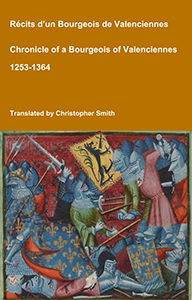
Chronicle of a Bourgeois of Valenciennes
Récits d’un bourgeois de Valenciennes aka The Chronicle of a Bourgeois of Valenciennes is a vivid 14th-century vernacular chronicle written by an anonymous urban chronicler from Valenciennes in the County of Hainaut. It survives in a manuscript that describes local and regional history from about 1253 to 1366, blending chronology, narrative episodes, and eyewitness-style accounts of political, military, and social events in medieval France, Flanders, and the Low Countries. The work begins with a chronological framework of events affecting Valenciennes and its region under rulers such as King Philip VI of France and the shifting allegiances of local nobility. It includes accounts of conflicts, sieges, diplomatic manoeuvres, and the impact of broader struggles like the Hundred Years’ War on urban life in Hainaut. Written from the perspective of a burgher (bourgeois) rather than a monastery or royal court, the chronicle offers a rare lay viewpoint on high politics and warfare, reflecting how merchants, townspeople, and civic institutions experienced the turbulence of the 13th and 14th centuries. Its narrative style combines straightforward reporting of events with moral and civic observations, making it a valuable source for readers interested in medieval urban society, regional politics, and the lived experience of war and governance in pre-modern Europe.
Available at Amazon in eBook and Paperback format.
In November 1685 Robert Cann 1st Baronet [aged 64] died. He was buried at St Werburgh's Church, Bristol [Map] in November 1685. His son William [aged 36] succeeded 2nd Baronet Cann of Compton Green in Gloucestershire.
In 1690 [his former wife] Ann Popley Lady Cann [aged 65] died.