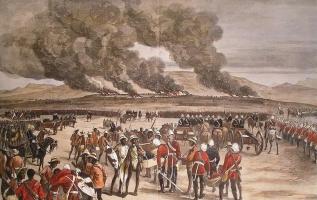
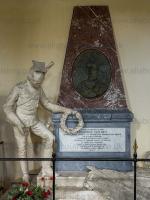
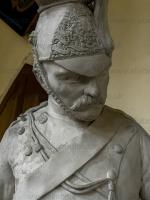
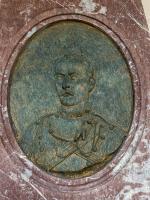
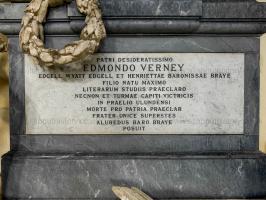
On 4th July 1879 Captain Edmund Verney Wyatt-Edgell [aged 33] was killed in action at Ulundi, KwaZulu-Natal, South Africa. His remains were returned to England and buried at St Nicholas' Church, Stanford-on-Avon [Map]. The inscription on this monument: "To a Most Beloved Father Edmund Verney, eldest son of Edgell Wyatt Edgell [aged 78] and Henrietta, Baroness Braye [aged 70], outstanding in the study of letters, and also leader of a victorious troop in the Battle of Ulundi, glorious in death for his country. His only surviving brother, Alured, Baron Braye [aged 4], set this up."
Mackinnon, J P., ed. The South African Campaign, 1879:
The Hon. Edmund Verney Wyatt Edgell Captain 17th Lancers.
Captain Edmund Verney Wyatt Edgell, who was killed in action at Ulundi on the 4th of July 1879, was the eldest son of the Rev Edgell Wyatt Edgell, by his marriage with Henrietta, fourth Baroness Braye, was grandson of Mr Wyatt Edgell formerly of Milton Place, Egham and of Great Missenden, was heir apparent to the barony of Braye and represented in his own person the ancient and political family of the Earls Verney (this earldom is extinct) and also the elder branch of the Caves of Stanford Hall, Leicestershire. He was born on the 16th of August 1845 and was educated at Eton and Christ Church, Oxford. He entered the army in 1866 being gazetted cornet in the 17th Lancers; became lieutenant by purchase in 1868 and obtained his troop in 1873. Captain Wyatt Edgell spent much of his leisure time in study, especially of the Latin classics, of which he read even the most obscure, and he was considered one of the best French as well as Latin scholars in the army. During a winter's leave he rode through the whole length of Persia and spent some time at Teheran; he completed his journey in safety, though quite unattended. On a vacancy occurring in the representation of the northern division of Northamptonshire in 1877, through the death of Mr Vard Hunt, he contested the seat in the Liberal interest, being opposed by Lord Burghley, who was returned. In February 1879 he entered the Staff College, where however he was only destined to spend a fortnight.
Captain Wyatt Edgell embarked with the 17th Lancers for Natal in the last days of the same February, shortly after the news of the disaster at Isandhlwana reached England. He landed at Durban soon after the battle of Ginghilovo and the evacuation of Etshowe, and on the return of Lord Chelmsford with the relieving column to Natal proceeded with the Lancers into the interior. With the right wing of the regiment under Colonel Drury Lowe, he joined General Newdigate's division, then in course of formation at Conference Hill on the 11th of May and subsequently served with his troop through the whole of the reconnoitring and other important duties on which it was employed during the advance of that force into the enemy's country.
On the morning of the 4th of July, the 17th Lancers covered the rear and flanks of the advancing column and on the force being attacked by the enemy, passed into the hollow square in which it was formed. When the fire of the enemy slackened Colonel Drury Lowe received orders to take out the regiment to strike the then wavering line. Passing through the rear face of the square the regiment rode towards the Nodwengo Kraal dispersing and killing those who had not time to reach its shelter, then wheeling to the right. The regiment charged through the remainder who in full flight were endeavouring to reach the lower slopes of the mountains beyond. Numbers of the enemy in this direction who had not taken part in the actual attack were now firing and momentarily strengthened by those retreating, were enabled to pour in a considerable fusillade on the advancing Lancers below them. It was at this moment that Captain Wyatt Edgell gallantly leading his troop was shot through the head.
"The country has lost a very gallant officer" — such were the words of the Secretary of State for War when he announced to the House of Commons the victory at Ulundi — and the feeling which they expressed has found an echo in the hearts of all to whom Wyatt Edgell was known. "A more gallant leader" wrote Colonel Drury Lowe in his official account of the engagement, "never rode in a charge." He will long be remembered in the 17th Lancers for his genial kindness and manly bearing, and the wide circle of friends to whom he had endeared himself will be slow to forget the pleasantness of his ways.
Captain Wyatt Edgell was by no means the first of his race who has met a soldier's death. At the battle of Edge Hill one of his ancestors Sir Edmund Verney, standard bearer to Charles I, was killed and so firmly did he grasp the staff in death that the hand had to be amputated before the flag could be released. John, second Lord Braye, fought at the battle of St Quintin and died aged thirty three, in 1557, from the wounds and exhaustion he had sustained. He was buried with much ceremony in Chelsea Church where the tomb is still shown. Captain Wyatt Edgell had he survived five months would have succeeded to the barony of Braye as fifth Lord, his mother dying on the 14th of November 1879.
Captain Edmund Verney Wyatt-Edgell:
On 16th August 1845 he was born to Reverend Edgell Wyatt-Edgell Baron Braye and Henrietta Otway 4th Baroness Braye.
Adrian Verney Verney-Cave 6th Baron Braye:
On 11th October 1874 he was born to Alfred Wyatt-Edgell 5th Baron Braye.
On 28th August 1900 he and Ethel Mary Bouverie-Pusey Baroness Braye were married.
On 1st July 1928 Alfred Wyatt-Edgell 5th Baron Braye died. His son Adrian succeeded 6th Baron Braye. Ethel Mary Bouverie-Pusey Baroness Braye by marriage Baroness Braye.
Click to read more ...