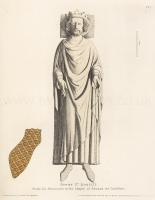
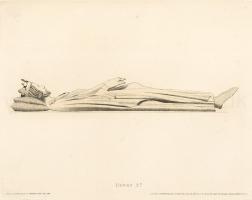
HENRY the Third was born at Winchester [Map], 1st October, A. D. 1208, and succeeded to the Crown by the death of his father John (whose eldest son he was by Isabella of Angoulesme), in 1216. William Mareschal, Earl of Pembroke, was his guardian during his minority. On the 24th of January, 1236, he was married at Canterbury to Eleanor of Provence, second daughter of the Earl of Provence, who was grandson of Alphonso the First, King of Arragon [Note. Aphonso II King of Aragon]. After an eventful reign of fifty-six years, he died at Westminster, Wednesday, 16th November, 1272, and was buried, according to the particular direction of his last will, in the Abbey Church of that place, notwithstanding his having previously appointed for himself a sepulture in the New Temple at Londona. He commits to his son and successor the finishing of the Church [Map] founded by the "blessed Edward" at Westminster, which he had rebuilt on a sumptuous scale, and which remains to this day a proud and splendid monument of our ancient Monarchy and our Christian faith, however the latter, in those remote days, was obscured by superstition. He bequeaths for completing the shrine of St. Edwardb five hundred marks of silver, to be furnished from the value of his jewels by his Queen and his executors. He leaves, moreover, certain vestments of his chapel, a silver image of the Virgin, and certain crosses of gold, to St. Edward's chapel [Map] at Westminster. His heart was buried at Fontevraud [Map], where the remains of his grandfather and grandmother, and others of his royal predecessors, reposed. His tomb is on the north side of the shrine of Edward the Confessor, and has been richly ornamented with inlaid work. On the top lies the effigy of the King, composed of copper (see the two Plates of the front and profile). On the head is a crown of a very simple and elegant form. His hands have supported the sceptre and orb, which have been removed. Over the left shoulder is thrown the royal mantle, fastened on the right by a fermail, or clasp. Beneath is the tunic. On the legs are boots, on which are represented as embroidered in fret-work golden lions passant guardant. The same ornament decorates a square and a lozenge-shaped pillow, which are placed under his head. The style in which this image is executed is of the finest cast; it is very probably Italian workmanship. The folds of the drapery are beautifully disposed, and the head has much of the simple majesty of the antique or Greek school. Sandford gives this inscription as remaining, in uncial characters, round the tomb of Henry the Third:
ICI: GIST: HENRI: IADIS: REY: DE: ENGLETERRE: SEYGNVR: DE: IRLAVNDE: DVC DE: AQVITAYNE: LE: FILZ: LE: ROY: IOHAN: IADIS: REY: DE: ENGLETERRE: A: KI: DEV: FACE: MERCY: AMEN.
Details. Plate I. The embroidered boot.
Note a. Collection of Royal Wills. Nichols, 1780, p. 15.
Note b. He caused a chest of gold to be made for laying up the reliques of Edward the Confessor. Sandford.