William of Worcester's Chronicle of England
William of Worcester, born around 1415, and died around 1482 was secretary to John Fastolf, the renowned soldier of the Hundred Years War, during which time he collected documents, letters, and wrote a record of events. Following their return to England in 1440 William was witness to major events. Twice in his chronicle he uses the first person: 1. when writing about the murder of Thomas, 7th Baron Scales, in 1460, he writes '… and I saw him lying naked in the cemetery near the porch of the church of St. Mary Overie in Southwark …' and 2. describing King Edward IV's entry into London in 1461 he writes '… proclaimed that all the people themselves were to recognize and acknowledge Edward as king. I was present and heard this, and immediately went down with them into the city'. William’s Chronicle is rich in detail. It is the source of much information about the Wars of the Roses, including the term 'Diabolical Marriage' to describe the marriage of Queen Elizabeth Woodville’s brother John’s marriage to Katherine, Dowager Duchess of Norfolk, he aged twenty, she sixty-five or more, and the story about a paper crown being placed in mockery on the severed head of Richard, 3rd Duke of York.
Available at Amazon in eBook and Paperback format.
Magna Britannia Volume 4 is in Magna Britannica.
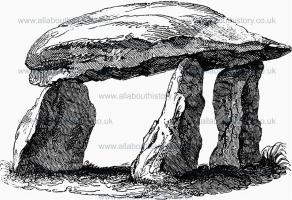
1807 The cromlech [Drewsteighton Cromlech aka Spinsters' Rock, Devon [Map]] at Drewe's Teignton, of which much has been said and written, has been supposed by some to have been the sepulchre of an arch-druid: that it was sepulchral there is little doubt; and from the rarity of such monuments, it is most probable that it was for some eminent person; but there is no more reason for supposing that it had any thing to do with druidism, than that the name of Drewe's Teignton was derived from that source.1 This cromlech is on a tenement called Shilston. It is of moor-stone, about 12 feet in length, and about nine feet wide in the widest part. The supporting stones are from six feet to six feet and a half to the under part of the covering stone.
The sketch beneath is from an accurate drawing, made by my brother, in 1807.
Note 1. See "Cornwall," General History, p. clxxxii. clxxxiv. and ccxvii., on the subject of Logan stones and rock basins, and p. 493. of this volume, as to the name of Drewe's Teignton; to which may be added, that there is no authority whatever for the place having been so called before the time of Drewe de Teignton. The natural excavations called Rock basins, occur in numerous places on the granite rocks of Dartmoor, &c. The most celebrated Logan stone in Devon is that on the banks of the Teign, in the parish of Drewe's Teignton; but I am informed that the motion is now scarcely perceptible. A natural pile of rocks in the parish of Manaton, called Bowerman's Nose, somewhat resembling the Cheesewring near Alternon, in Cornwall, has, by some enthusiasts in druidism, been supposed to have been a rock-idol.