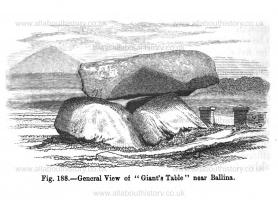
Before concluding the description of the Rude Stone Monuments of Sligo we shall make an excursion into the neighbouring county Mayo—for a distance of about two hundred yards—to where there is a remarkable cromleac1 [Dolmen of the Four Maols [Map]] supported by three stones, of which fig. 188 gives a perfect representation, taken from a photograph as well as a sketch. It is now popularly called "The Giant's Table," but by the Irish-speaking natives Clock- an-Togbhail. The cap-stone, which is nearly hexagonal in form, and now practically horizontal in position—one of the supports having slightly given way—measures about 9 feet by 7.2 This monument interests chiefly as being, according to the late John O'Donovan, the only megalith in Ireland which can be satisfactorily connected with history. The story is as follows:—
"In the life of St. Ceallach, it is related that Eoghan Bel, King of Connaught, when dying from the effects of wounds received at the Battle of Sligo (fought in the year A.D. 537), counselled the Hy Fiachrach to elect his son Ceallach to be King in his stead. This Ceallach was the great-grandson of King Daithí, whose red pillar stone at Rath Croghan, erected A.D. 428, is still pointed out. According to the King's dying injunction messengers were sent to Ceallach at Clonmacnoise, and he accepted the proffered dignity, despite the remonstrance and threats of St. Kieran, under whose tuition he was there residing. The saint thereupon solemnly cursed his pupil, and although a reconciliation afterwards took place, and Ceallach, entering the priesthood, attained Episcopal dignity, the curse was still efficacious, and could not be revoked. King Guaire Aidhne conceived a mortal hatred of the Bishop, on account of his having been elected to the sovereignty, and Ceallach in consequence resigned his See and retired to the seclusion of an island on Lough Conn, where, at the King's instigation, he was murdered by four of his pupils, or foster-brothers; and thus St. Kieran's curse was fulfilled. Cucoingilt (brother of Bishop Ceallach) succeeded in capturing the murderers, and carried them in chains to a place in the County Sligo, since called Ardnaree, where he slew them on the banks of the Moy. The hill, on the Sligo side, overlooking the river, was hence called Ard-na-riadh, i.e. "The Hill of the Executions," and this, in turn, gave name to a village (situated on the east side of the stream), which may be considered a suburb of the town of Ballina. The bodies of the four murderers were carried across the river, and interred on the summit of an eminence, (Supposedly beneath the Dolmen) on the Mayo bank, subsequently called Ard-na-Maol (the Height of the Maols), or Leac-na-Maol (The tomb of the Maols), from the four murderers of St. Ceallach having had the prefix Maol attached to their names. A more circumstantial account of the execution and interment is given in the Dinnsenchus, fol. 246."
Note 1. Close to it there is a fragment of rock, but it probably, at no period, had any connexion with the monument. It bears distinct traces of having been blasted with gunpowder, and the holes, in which it was inserted, are still visible.
Note 2. A ground plan of this cromleac is given by Fergusson in Rude Stone Monuments, p. 233.
Click to read more ...

