The True Chronicles of Jean le Bel Volume 1 Chapters 1-60 1307-1342

The True Chronicles of Jean le Bel offer one of the most vivid and immediate accounts of 14th-century Europe, written by a knight who lived through the events he describes, and experienced some of them first hand. Covering the early decades of the Hundred Years’ War, this remarkable chronicle follows the campaigns of Edward III of England, the politics of France and the Low Countries, and the shifting alliances that shaped medieval warfare. Unlike later historians, Jean le Bel writes with a strong sense of eyewitness authenticity, drawing on personal experience and the testimony of fellow soldiers. His narrative captures not only battles and sieges, but also the realities of military life, diplomacy, and the ideals of chivalry that governed noble society. A key source for Jean Froissart, Le Bel’s chronicle stands on its own as a compelling and insightful work, at once historical record and literary achievement. This translation builds on the 1905 edition published in French by Jules Viard, adding extensive translations from other sources Rymer's Fœdera, the Chronicles of Adam Murimuth, William Nangis, Walter of Guisborough, a Bourgeois of Valenciennes, Geoffrey le Baker of Swinbroke and Richard Lescot to enrich the original text and Viard's notes.

Available at Amazon in eBook and Paperback format.

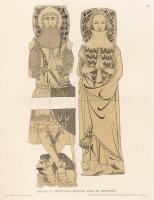
Brass in Minster Church, Sheppey

Brass in Minster Church, Sheppey is in Monumental Effigies of Great Britain.

THIS rich specimen of military and female costume in the early part of the fourteenth century, is supposed to belong to the family of Northwood, which are ranked by Dugdale among the Barons of the Realm, they having been summoned to Parliament until the forty-ninth year of Edward the Third.

Northwood Chasteners (Chataigniers) so called from its indigenous chesnut trees, was an extensive manor in the parish of Milton, in the Isle of Sheppy. Roger de Northwode, who resided at the moated house here, was with Richard I at the siege of Acon, in the Holy Land; he and his Lady Bona were buried in Minster Church [Map], and Weever took these for their effigies: but the costume contradicts hima. Roger de Northwode, his son, procured of Henry III his lands in Kent to be held by knight's service instead of in gavel-kind. His son and successor, John de Northwode, was with Edward I at the siege of Carlaverock, where he was knighted. He was four times Sheriff of Kent in the reign of Edward I and was summoned to Parliament from the sixth to the twelfth year of Edward the Second. He married Joan de Badlesmere, probably a daughter of Bartholomew Lord Badlesmere, of Leeds Castle, in Kent, who suffered death for his political conduct in the reign of Edward the Second. John de Northwode died about 1337, and himself and his wife are perhaps the personages represented by this beautiful brass. There are many remarkable peculiarities about the armour of the male figure. The female wears the hair plaited and the wimple. The pointed lappets of her mantle, drawn over the shoulders, exhibit a lining of vair; originally a decoration of dress composed of small pieces of different coloured furs, afterwards an heraldic distinction. Northwood, according to Harris, bore, Ermine, a cross engrailed Gules. The bearing on the shield appears to be a cross engrailed, between twelve chesnut leaves for North- wood Chataigniers.

Note a. The costume cannot, however, be always considered as an infallible guide. "It was no uncommon thing to erect monuments to persons from one to five hundred years after their death, representing them in the habits of the time of the erection of the monument, and not of their own." Original Letter of C. A. Stothard, Memoirs, p. 13 i.