Chronicle of Abbot Ralph of Coggeshall

The Chronicle of Abbot Ralph of Coggeshall (Chronicon Anglicanum) is an indispensable medieval history that brings to life centuries of English and European affairs through the eyes of a learned Cistercian monk. Ralph of Coggeshall, abbot of the Abbey of Coggeshall in Essex in the early 13th century, continued and expanded his community’s chronicle, documenting events from the Norman Conquest of 1066 into the tumultuous reign of King Henry III. Blending eyewitness testimony, careful compilation, and the monastic commitment to record-keeping, this chronicle offers a rare narrative of political intrigue, royal power struggles, and social upheaval in England and beyond. Ralph’s work captures the reigns of pivotal figures such as Richard I and King John, providing invaluable insights into their characters, decisions, and the forces that shaped medieval rule. More than a simple annal, Chronicon Anglicanum conveys the texture of medieval life and governance, making it a rich source for scholars and readers fascinated by English history, monastic authorship, and the shaping of the medieval world.

Available at Amazon in eBook and Paperback format.

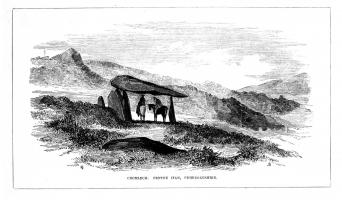
Archaeologia Cambrensis 1865 Page 284

Archaeologia Cambrensis 1865 Page 284 is in Archaeologia Cambrensis 1865.

Pentre Ifan Cromlech [Map]

The whole ridge of Carn Ingli, in the barony of Cemmaes, is worthy of careful antiquarian examination; more careful, we mean, than what it has hitherto received. It will be found, like the far larger range of Precelly, to present many striking features connected with the early history of the district; and it is to be hoped that a complete account of both ridges will ultimately be compiled for the Association.

On the north-eastern slope of this ridge, upon ground which until lately was unenclosed, stands the great cromlech of Pentre Ifan, so called from the ancient neighbouring mansion. Itisone of the largest in Wales; and its size may be judged of from the fact that, when the Association visited it in 1859, five persons on horse-back were ranged beneath the cap-stone at one and the same time. It seems to have formed one of several other sepulchral chambers, covered by a common mound; traces of these others, and of the carnedd of stones, being visible in the immediate vicinity; but the enclosures of the land have been brought close to the south side of the mound, or have cut through it; and hence the disappearance of its contents and materials is easily accounted for.

The stones are all of the same kind as the rocks towering on the ridge not far behind them and they may have been forced down by the rude mechanical appliances of early times without much difficulty. Still the cap-stone is one of unusual magnitude, and the whole monument has an appearance as grand as it is picturesque.

~~ Although the covering tumulus has disappeared, and though from the height of the cap-stone above the soil it may be supposed that the very foundations are laid bare, yet it might lead to the discovery of remains, if the soil all around were carefully probed and examined.

Here the cromlech stands some five or six miles away from the sea; and it probably served as a resting-place to a chieftain and his family dwelling in comparative security, though at what period of the history of Wales it would be vain to conjecture. The adjacent district offers a tempting field of operations for any one interested in the early antiquities of Pembrokeshire; and it would not be surprising if other remains, now not known, were brought to light by sufficient research.

H. L. J.