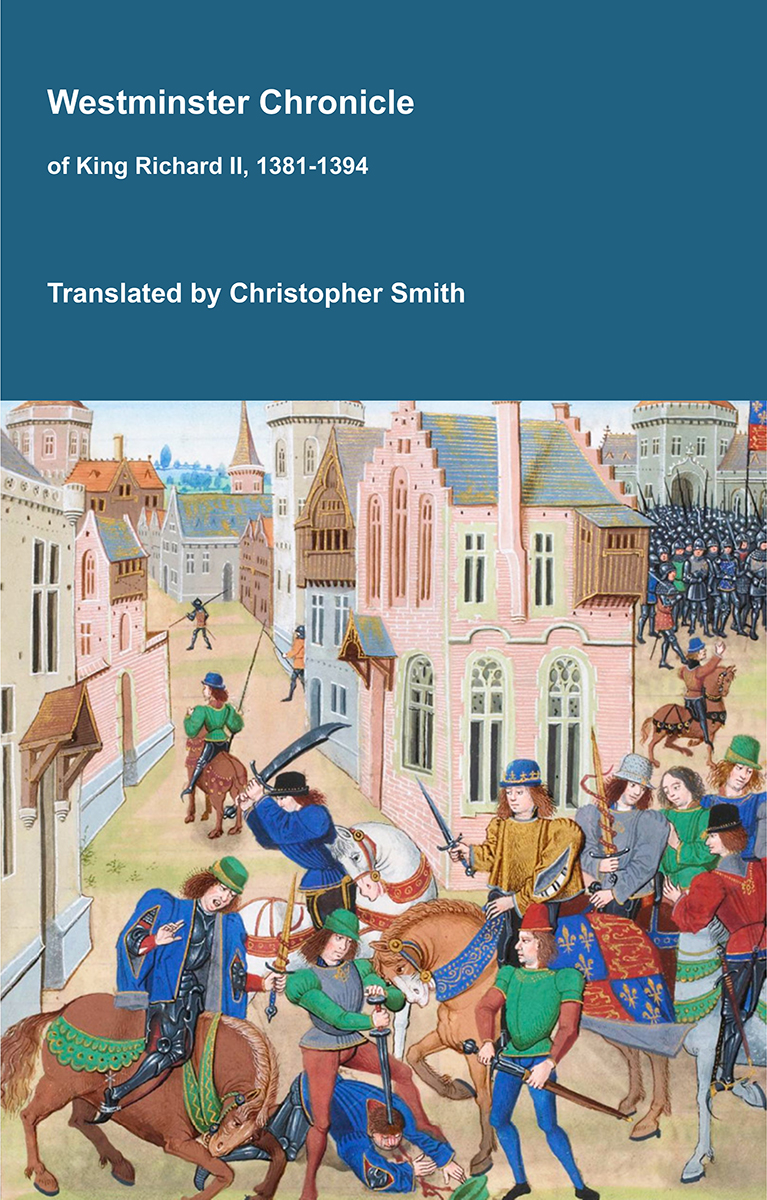
Westminster Chronicle of King Richard II, 1381-1394
The Westminster Chronicle is one of the most vivid and important narrative sources for the reign of Richard II. Written by an anonymous chronicler closely connected with Westminster Abbey, it covers the years 1381 to 1394, from the Peasants’ Revolt to the political tensions, court ceremonies, diplomatic negotiations, royal progresses, and public crises of Richard’s later reign. Rich in detail the chronicle records major events such as the conflicts between the King and Lords Appellant, King and the City of London, negotiations with France and Scotland, the death and funeral of Queen Anne of Bohemia, the illness of Charles VI of France, and the changing fortunes of leading nobles including John of Gaunt, Thomas of Gloucester, Robert de Vere, and the Earl of Arundel. The Chronicle offers readers a remarkable window into late fourteenth-century England, combining political observation, courtly spectacle, urban drama, ecclesiastical affairs, and moral judgement. It is an essential source for anyone interested in medieval monarchy, London, Westminster, and the troubled reign of Richard II.
Available at Amazon in eBook and Paperback format.
Effigy of Sir William de Staunton is in Monumental Effigies of Great Britain.
THIS singular tomb in Staunton Church, Nottinghamshire, commemorates Sir William de Staunton. This family, who took their surname from the spot where they were settled and had possessions, are said to have nourished there before the æra of the Norman Conquest. A rhyming herald of the sixteenth century, speaking of them, says,
"The first Sir Mauger Staunton, Knight,
Before Wiiiiam came in-"
They held their lands at Staunton by tenure of castle guard of the Lords of Belvoir. There was a tower in that fortress [Map] called Staunton Tower, which they, by obligation of the tenure no doubt, built and kept in repair. Sir William was the son of Sir Geoffrey de Staunton and Alice his wife. He was a knight of active reputation, favoured by Edward I and employed in his service. He made his will in 1312, and from it we may gather that he was under a vow of pilgrimage to the Holy Land, for he left a bequest of five marks each to two footmen who should go "the first passage," in his name. He died in 1326. The monumental stone of Sir William de Staunton is somewhat fanciful; it appears intended to represent him lying in his coffin, the lid of which is cut away to show the figure as far as the elbows, and the feet to the ancles. On the centre of the stone is his helmet, and his shield with two chevronsa. Round the edge of the stone runs the following inscription in the black letter character, being an early instance of its adoption.
Hic jacet Will's de Staunton miles filius galfridde eademb militis que obiit in idu maii anno d'ni......CCXXVI cui' an .. p'picietur. On that part of his surcoat visible, the upper of the two chevrons appears.
Note a. A seal of his Father Geoffrey, appendant to a charter, bears two bars and a!arge canton, charged with a mullet of six points. His son, it appears, adopted another coat: his seal, as well the tomb, exhibits the two chevrons. Legend, s . WILL . DE . STANTON . MILITIS.
Note b. Blundered for Galfridi ejusdem, as also que for qui, the second following word.