

Thisbe a character that appears in the work Metamorphoses by the Roman poet Ovid. She lived in Babylon, and was the lover of Pyramus, both living in connected houses, but being forbidden to marry by their parents, who were rivals. However, the two lovers were able to express their feelings to each other through a crack in a wall, and decided to meet near the tomb of Ninus under a mulberry tree. Thisbe arrived first, but saw a lioness that had blood all over the mouth because of hunting; Thisbe, frightened, fled losing her veil in the process. When Pyramus arrived, he saw the veil, and horrified thinking that Thisbe was dead, fell on his sword and died. His blood fell on the white mulberry fruit, staining them. Thisbe returned shortly afterwards only to find Pyramus' body on the ground. She mourned and after a bit, she took the sword and killed herself with it. In the end, the gods, touched by Thisbe's mourning, decided to permanently turn the colour of the mulberry fruit to dark, reminding the relationship of the two young lovers.
Metamorphoses Book 3. When Pyramus and Thisbe, who were known the one most handsome of all youthful men, the other loveliest of all eastern girls, lived in adjoining houses, near the walls that Queen Semiramis had built of brick around her famous city, they grew fond, and loved each other-meeting often there-and as the days went by their love increased. They wished to join in marriage, but that joy their fathers had forbidden them to hope; and yet the passion that with equal strength inflamed their minds no parents could forbid. No relatives had guessed their secret love, for all their converse was by nods and signs; and as a smoldering fire may gather heat, the more 'tis smothered, so their love increased. Now, it so happened, a partition built between their houses, many years ago, was made defective with a little chink; a small defect observed by none, although for ages there; but what is hid from love? Our lovers found the secret opening, and used its passage to convey the sounds of gentle, murmured words, whose tuneful note passed oft in safety through that hidden way. There, many a time, they stood on either side, Thisbe on one and Pyramus the other, and when their warm breath touched from lip to lip, their sighs were such as this: "Thou envious wall why art thou standing in the way of those who die for love? What harm could happen thee shouldst thou permit us to enjoy our love? But if we ask too much, let us persuade that thou wilt open while we kiss but once: for, we are not ungrateful; unto thee we own our debt; here thou hast left a way that breathed words may enter loving ears," so vainly whispered they, and when the night began to darken they exchanged farewells; made presence that they kissed a fond farewell vain kisses that to love might none avail.
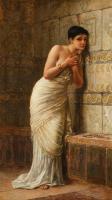
1881. Edwin Longsden Long [aged 51]. "Thisbe".
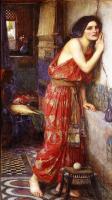
1909. John William Waterhouse [aged 59]. "Thisbe".