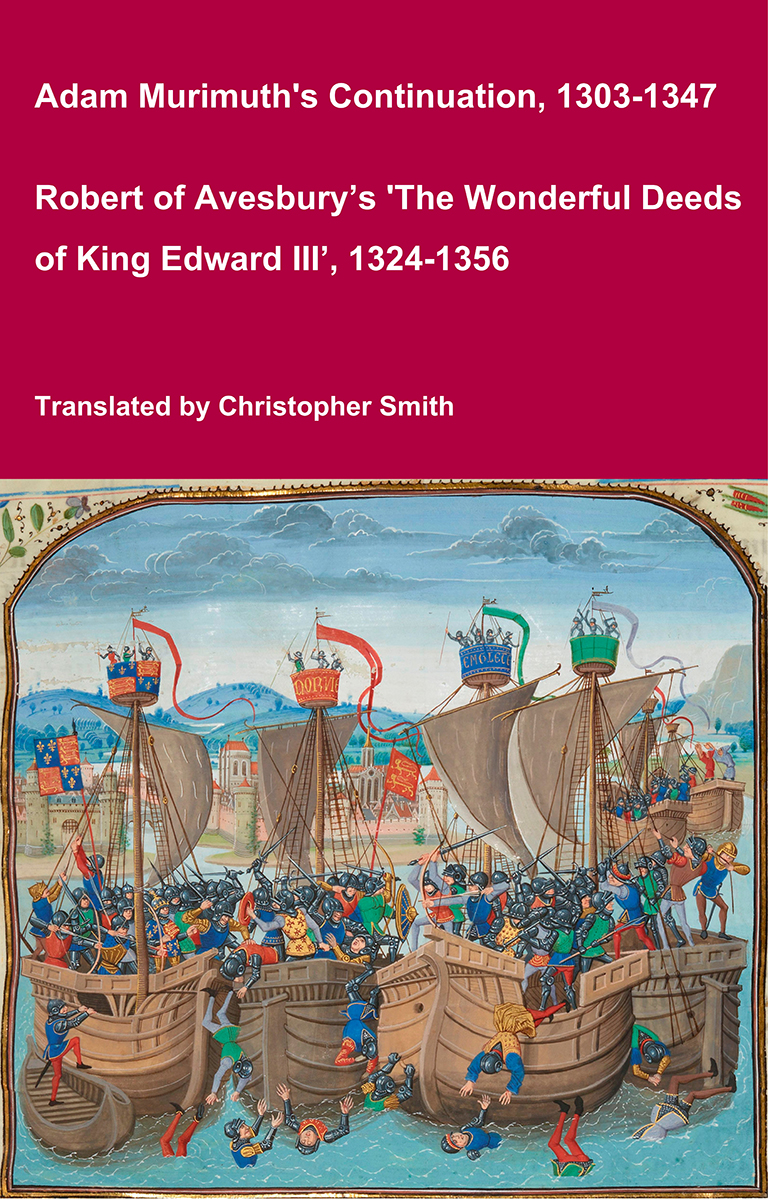
Adam Murimuth's Continuation and Robert of Avesbury’s 'The Wonderful Deeds of King Edward III'
This volume brings together two of the most important contemporary chronicles for the reign of Edward III and the opening phases of the Hundred Years’ War. Written in Latin by English clerical observers, these texts provide a vivid and authoritative window into the political, diplomatic, and military history of fourteenth-century England and its continental ambitions. Adam Murimuth Continuatio's Chronicarum continues an earlier chronicle into the mid-fourteenth century, offering concise but valuable notices on royal policy, foreign relations, and ecclesiastical affairs. Its annalistic structure makes it especially useful for establishing chronology and tracing the development of events year by year. Complementing it, Robert of Avesbury’s De gestis mirabilibus regis Edwardi tertii is a rich documentary chronicle preserving letters, treaties, and official records alongside narrative passages. It is an indispensable source for understanding Edward III’s claim to the French crown, the conduct of war, and the mechanisms of medieval diplomacy. Together, these works offer scholars, students, and enthusiasts a reliable and unembellished account of a transformative period in English and European history. Essential for anyone interested in medieval chronicles, the Hundred Years’ War, or the reign of Edward III.
Available at Amazon in eBook and Paperback format.
Diary of William Allingham is in Victorian Books.
Early in 1856 Allingham received the first number of the Oxford and Cambridge Magazine praising The Germ and writing of Rossetti's illustration to Ailingham's poem, 'The Maids of Elfin Mere,' as 'the best drawing that has ever appeared in illustration of a book.' His annual visit to London, this year, took place in May, and one of his first calls was with Arthur Hughes upon Rossetti, who, however, was not at home, but whose picture of Dante's Dream was discovered somewhere in the room. It was put on the easel, and Allingham made a little note in his diary of the 'two lovely figures' and 'rainbow of angels.'1 The visitors also came upon his picture called 'Found,' in one of the many stages of its progress, — 'The calf in cart and bit of wall,' Allingham writes — that calf which grew so many times into a cow during the thirty years in which the picture was being painted.
He made many excursions, this month, with Rossetti [aged 27] and Miss Siddal [aged 26], and he was always of the 'assemblage' which gathered so frequently at Rossetti's rooms.
Note 1. Rossetti gave Allingham a pencil study for this picture, in which Allingham stood, for a few minutes, as model for profile and hand. It is now in Mrs. Allingham's possession.
9th November 1866. On my return find a parcel by rail from Gabriel containing the portfolio of photographs from drawings by his poor Wife [Elizabeth Siddal]; they are naturally full of his influence.1 Also of two very beautiful pencil portraits of her by his hand, one a head, the other full-length.
Short, sad and strange her life ; it must have seemed to her like a troubled dream. She was sweet, gentle, and kindly, and sympathetic to art and poetry. As to art-power, it is not easy to make as much as a guess ; and this portfolio hardly helps. But it is very interesting, at least to those who knew her. Her pale face, abundant red hair, and long thin limbs were strange and affecting — never beautiful in my eyes.
Note 1. These are now in Mrs. Allingham's possession.