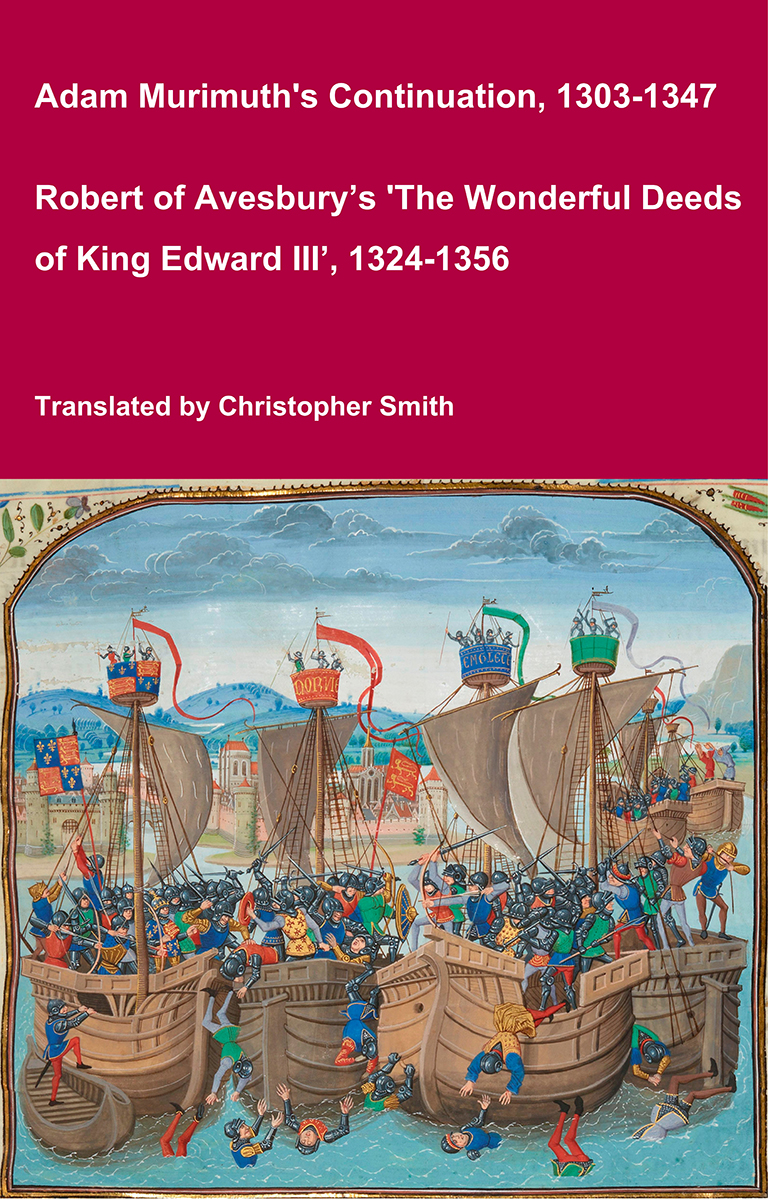
Adam Murimuth's Continuation and Robert of Avesbury’s 'The Wonderful Deeds of King Edward III'
This volume brings together two of the most important contemporary chronicles for the reign of Edward III and the opening phases of the Hundred Years’ War. Written in Latin by English clerical observers, these texts provide a vivid and authoritative window into the political, diplomatic, and military history of fourteenth-century England and its continental ambitions. Adam Murimuth Continuatio's Chronicarum continues an earlier chronicle into the mid-fourteenth century, offering concise but valuable notices on royal policy, foreign relations, and ecclesiastical affairs. Its annalistic structure makes it especially useful for establishing chronology and tracing the development of events year by year. Complementing it, Robert of Avesbury’s De gestis mirabilibus regis Edwardi tertii is a rich documentary chronicle preserving letters, treaties, and official records alongside narrative passages. It is an indispensable source for understanding Edward III’s claim to the French crown, the conduct of war, and the mechanisms of medieval diplomacy. Together, these works offer scholars, students, and enthusiasts a reliable and unembellished account of a transformative period in English and European history. Essential for anyone interested in medieval chronicles, the Hundred Years’ War, or the reign of Edward III.
Available at Amazon in eBook and Paperback format.
Geology Artefacts is in Prehistoric Artefacts.
Wiltshire Museum. DZSWS:STHEAD.70e. 3 segmented faience beads (2 four segment & 1 three segment bead) found with a wrapped primary cremation under an inverted urn in disc barrow Winterbourne Stoke G67 [Map], excavated by William Cunnington.
Wiltshire Museum. DZSWS:STHEAD.329a. 4 segmented faience beads found with a primary cremation under an inverted MBA urn in disc barrow Winterbourne Stoke G68 [Map], excavated by William Cunnington.
Diary of a Dean by Merewether. No. 13, of very trifling elevation compared with the depth at which the cist was found—3 feet. Many fragments of early pottery, teeth of red deer and ox, a bead (O) of jet or Kimmeridge coal, and nine very smooth gravel pebbles, probably for slinging. The cist, filled with burnt human bones, but without an urn, was 3 ft. 6 in. long by? ft. wide, and 2 ft. deep.
Wiltshire Museum. DZSWS:STHEAD.70. 5 rings of Kimmeridge shale (one of which was perforated for suspension) found with a wrapped primary cremation under an inverted urn in disc barrow Winterbourne Stoke G67 [Map], excavated by William Cunnington.
Wiltshire Museum. DZSWS:STHEAD.70a. 1 conical button of Kimmerage shale (v-bored on base) found with a wrapped primary cremation under an inverted urn in disc barrow Winterbourne Stoke G67 [Map], excavated by William Cunnington.
Wiltshire Museum. DZSWS:STHEAD.329. 2 rings of Kimmerage shale found with a primary cremation under an inverted MBA urn in disc barrow Winterbourne Stoke G68 [Map], excavated by William Cunnington.
Wiltshire Museum. DZSWS:STHEAD.264h. 1 fragment of stonehenge diabase (preselite) found with a primary cremation (woman?) in an upright collared urn in bowl barrow Winterbourne Stoke G28 [Map], excavated by H. Cunnington.