

The Affairs of State Volume 3 The Session of the Poets is in The Affairs of State Volume 3.
Sub-titled To the Tune of opok Lawrel.
1. Appolo concerned to see the Transgressions
Our paltry Poets do daily commit,
Gave Order once more to summon a Session
Severely to punish the Abuses of Wit,
2. Will D'Avenant wou'd fain have been Steward o'th' Court
To have fin'd and amerc'd each Man at his Will;
But Apolld it seems, had heard a Report,
That his Choice of new Plays did show h'ad no skill.
3. Befides, s Criticks had ow'd him a Spite,
And a little before had made the God fret,
By letting him know the Laureat did write
That damnable Farce, The Hoyse to be Lett.
4. Intelligence was brought, the Court being fet,
That a Play Tripartite was very near made;
Where malicious Matt Clifford, and Spiritual Spratt
Were join'd with their Duke, a Peer of the Trade.
5. Apollo rejoyc'd, and did hope for Amends,
Because he knew it was the first Case
The Duke e'er did ask the Advice of his Friends,
And so wish'd his Play as well Clapt as his Grace.
6. O yes being made, and Silence proclaimed,
Jpollo began to read the Court-Roll;
When as soon as he saw Frank Berkley was nam'd,
He scarce cou'd forbear from tearing the Scroll.
7. But Berkley, to make his Int'rest the greater,
Suspecting before what would come to pass,
Procured him his Cousin Fitzharding's Letter,
With which Apollo wiped his Arse.
8. Guy with his Pastoral next went to Pot;
At first in a doleful Study he stood
Then shew'd a Certificate which he had got
From the Maids of Honour, but it did him no good.
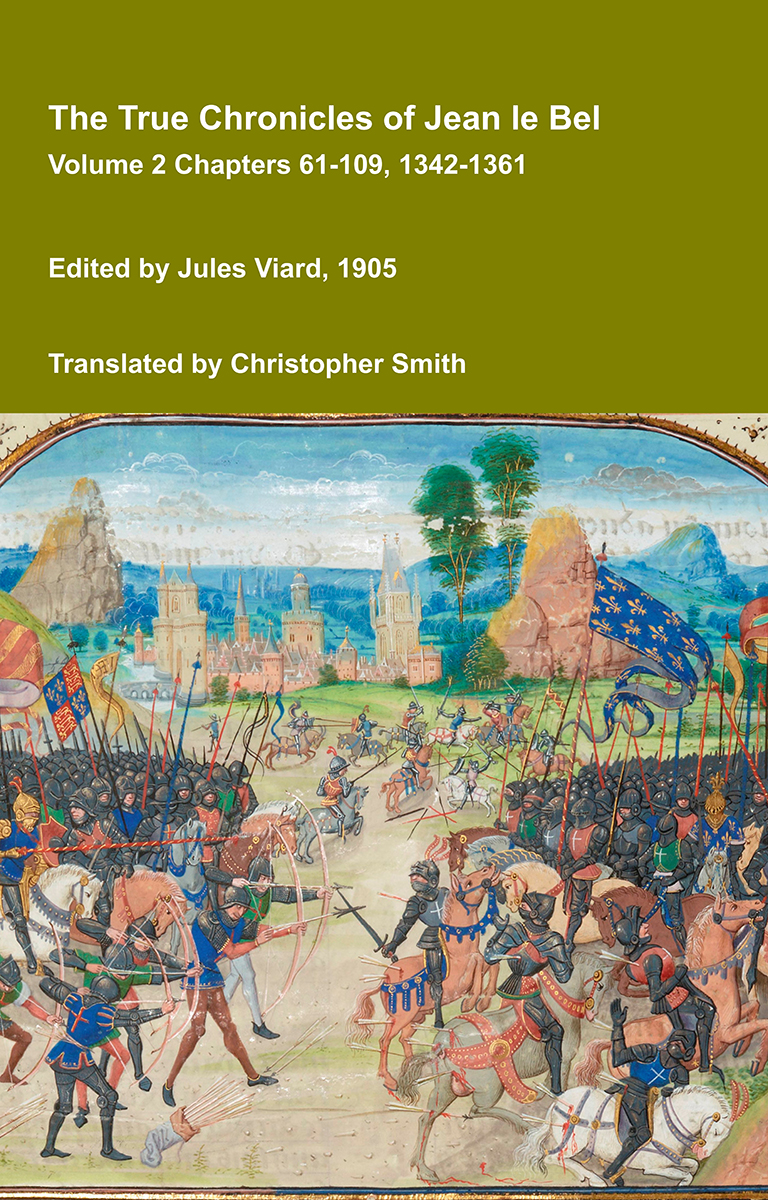
The True Chronicles of Jean le Bel Volume 2 Chapters 61-109 1342-1361
The Chronicle of Jean le Bel, Volume 2 continues one of the most important fourteenth-century accounts of the early Hundred Years’ War. Written by the Liège chronicler Jean le Bel, this vivid narrative follows the fortunes of Edward III, Jean II of France, the Black Prince, the great nobles of France and England, and the soldiers, captains and companies who shaped the conflict. This volume covers some of the most dramatic events of the period, including the battles of Crécy and Poitiers, the siege and capture of Calais, the captivity of King John, the rise of the Jacquerie, the turmoil in Paris under Étienne Marcel and Charles of Navarre, the devastation caused by the free companies, Edward III’s great campaign of 1359–1360, and the negotiations leading to the Treaty of Brétigny. Jean le Bel’s chronicle is especially valuable for its lively detail, its interest in chivalry, warfare, politics and reputation, and its influence on later chroniclers, most famously Froissart. This English translation presents the text in clear, readable British English while preserving the force and character of the original narrative. The translation includes extensive notes to help the reader better understand Jean le Bel's text. Volume 2 also includes translated appendices drawn from royal and administrative records, many from the English Record Office, which illuminate Edward III’s campaigns in Brittany, the siege and occupation of Calais, naval preparations, military finance, appointments, safe conducts and related affairs.
Available at Amazon in eBook and Paperback format.
9. Humerous Weeden came in a Pet,
And for the Laurel began to splutter;
Put Apollo chid him, and bid him first get
A Muse not so common as Mrs. Rutter.
10. A Number of other small Poets appeared,
With whom for a time Apollo made Sport
Clifford and Flechnoe were very well jeer'd,
And in Conclusion whip'd out of the Court
11. Tom Killigrew boldly came up to the Bar,
Thinking his Jibing would get him the Bays
But Apollo was angry, and bid him beware
That he caught him no more a printing his Plays.
12. With ill Luck in Battel, but worse in Wit,
George Porter began for the Laurel to bawl
But Apollo did think such Impudence fit
To be thrust out of Ceurt as he's out of Whitehall.
13. Savage missing Cowley, came into the Court,
Making Apologies for his bad Play
Every one gave him fo bad a Report,
That Apollo gave heed to all he could say:
14. Nor wou'd he have had, 'tis thought, a Rebuke,
Unless he had done fome notable Folly
Writ Verses unjustly in Praise Sam. Tuke,
Or printed his pitiful Melancholy.
15. Cotton did next to the Bays pretend;
But Apollo told him it was not fit
Tho' his Virgil was well, it made but amends
For the worst Panegyrick that ever was writ.
16. Old Shirly flood up and made an Excuse;
Because many young Men before him were got
He vow'd he had switc'd and spur-gall'd his Muse,
But still the dull Jade kept to her old Trot.
17. Sir Robert Howard, call'd for over and over,
At length sent in Teague with a Pacquet of News,
Wherein the sad Knight, to his Grief, did discover,
How Dryden had lately robb'd him of his Muse.


18. Each Man in the Court was pleas'd with the Theft,
Which made the whole Family swear and rant,
Desiring their Obin i'th lurch being left,
The Thief might be fin'd for the wild Gallant.

Anne Boleyn. Her Life as told by Lancelot de Carle's 1536 Letter.
In 1536, two weeks after the execution of Anne Boleyn, her brother George and four others, Lancelot du Carle, wrote an extraordinary letter that described Anne's life, and her trial and execution, to which he was a witness. This book presents a new translation of that letter, with additional material from other contemporary sources such as Letters, Hall's and Wriothesley's Chronicles, the pamphlets of Wynkyn the Worde, the Memorial of George Constantyne, the Portuguese Letter and the Baga de Secrets, all of which are provided in Appendices.
Available at Amazon in eBook and Paperback format.
19. Dryden, whom one wou'd have thought had more Wit
The Censure of every Man did disdain,
Pleading some pitiful Rhimes he had writ
In praise of the Countess of Castlemaine.


20. Ned Howard, in whom great Nature is found,
Tho' never took Notice of till that Day,
Impatiently sat till it came to his Round,
Then role and commended the Plot of his Play.
21. Such Arrogance made Apollo stark mad
But Shirly endeavoured to appease his Choler,
By owning the Play, and swearing the Lad
In Poetry was a very pert Scholar.
22. James Howard being call'd for out of the Throng,
Booted and spur'd to the Bar did advance,
Where singing a damn'd nonsensical Song,
The Youth and his Muse were sent into France.
23. Newcastle and's Horse for Entrance next strives,
Well stuffed was his Cloakbag, and so was his Breeches,
And unbutt'ning the Place where Nature's Posset-maker lives,
Pull'd out his Wife's Poems, Plays, Essays and Speeches.
24. Whoop, quoth Apollo what a Devil have we here,
Put up thy Wife's Trumpery, good noble Marquis,
And home again, home again, take thy Career,
To provide her fresh straw, and a Chamber that dark is.
25. Sam Tuke sat and formally smil'd at the rest
But Apollo who well did his Vanity know,
Call'd him to the Bar to put him to the Test,
But his Muse was so stiff scarcely could go.
26. She pleaded her Age, defir'd a Reward;
It feems in her Age she doated on Praise,
But Apollo resolved that such a bold Bard
Shou'd never be graced with a Per'wig of Bays.
27. Stapleton stood up, and had nothing to say,
But Apollo forbid the old Knight to despair,
Commanding him once more to write a new Play,
To be danc'd by the Poppets at Barthol'mew-Fair.
28. Sir William Killigrew doubting his Plays,
Before he was call'd? crept up to the Bench,
And whisper'd Apollo, in case he wou'd praise
Selyndra, he shou'd have a Bout with the Wench.
29. B[...]st and Sidney, with two or three more
Tranflators of Pompey, dispute in their Claim;
But Apollo made them be turn'd out of Door,
And Bid them be gone like Fools as they came.
30. Old Waller heard this, and was sneaking away,
But some Body spy'd him out of the Crow'd
Apollo tho' h' had not s him many a Day,
Knew him full well, and call'd to him aloud;
31. My old Friend Mr. Waller, what make you there,
Among those young Fellows that spoil the French Plays?
Then beck'ning to him, whisper'd in his Ear,
And g&ve him god Counsel instead of the Bays.
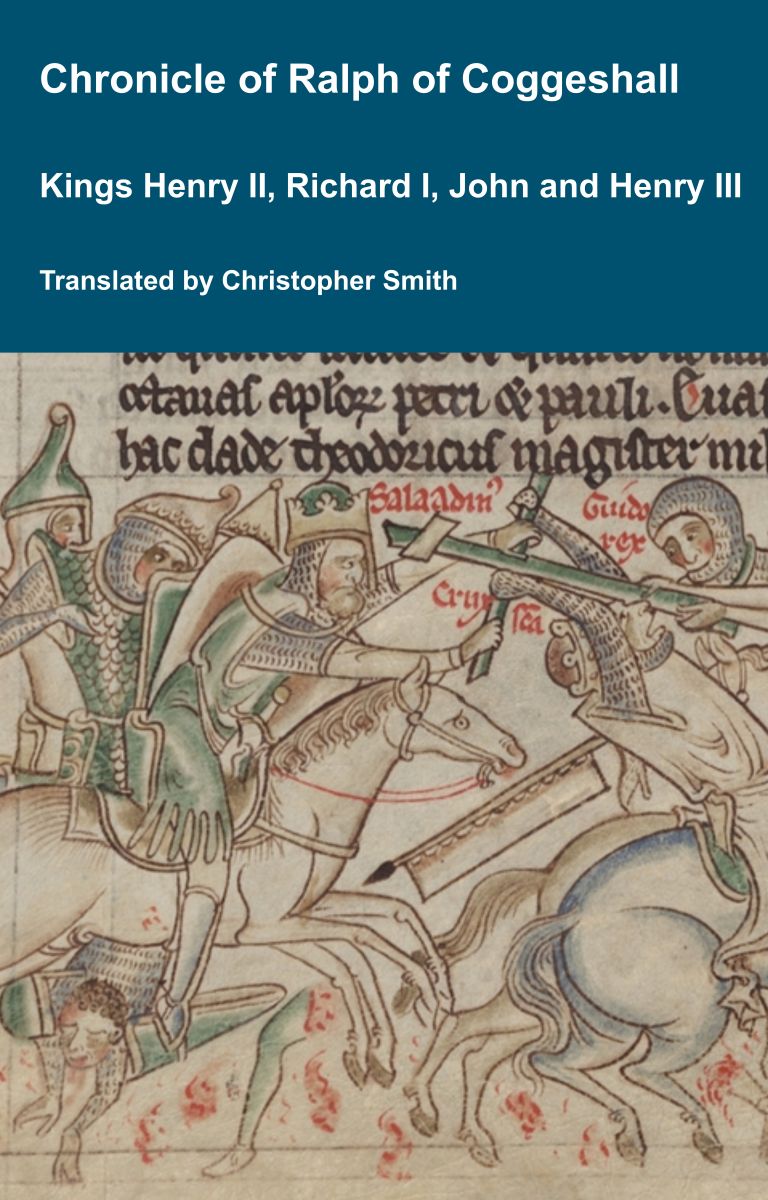
Chronicle of Abbot Ralph of Coggeshall
The Chronicle of Abbot Ralph of Coggeshall (Chronicon Anglicanum) is an indispensable medieval history that brings to life centuries of English and European affairs through the eyes of a learned Cistercian monk. Ralph of Coggeshall, abbot of the Abbey of Coggeshall in Essex in the early 13th century, continued and expanded his community’s chronicle, documenting events from the Norman Conquest of 1066 into the tumultuous reign of King Henry III. Blending eyewitness testimony, careful compilation, and the monastic commitment to record-keeping, this chronicle offers a rare narrative of political intrigue, royal power struggles, and social upheaval in England and beyond. Ralph’s work captures the reigns of pivotal figures such as Richard I and King John, providing invaluable insights into their characters, decisions, and the forces that shaped medieval rule. More than a simple annal, Chronicon Anglicanum conveys the texture of medieval life and governance, making it a rich source for scholars and readers fascinated by English history, monastic authorship, and the shaping of the medieval world.
Available at Amazon in eBook and Paperback format.
32. Then in came Denham, that limping old Bard,
Whose Fame on the Sophy and Coopers-Hill stands;
And brought many Stationers who swore very hard,
That nothing sold better except 'twere his Lands.
33. But Apollo advis'd him to write fomething more,
To clear a Suspicion which possess'd the Court,
That Coopers-Hill, so much bragg'd on before,
Was writ by a Vicar, who had forty Pound for't.
34. Then Hudlhrass boldly demanded the Bays,
Bur Apollo bad him not be so fierce;
And advis'd him to lay afide making his Plays,
Since he already began to write worse and worse.
35. Tom Porter came into the Court in a Huff,
Swearing Damn him he had writ the best Plays;
But Apollo it seems, knew his way well enough,
And would not be hectored out of his Bays.
36. Ellis in great Discontent went away,
Whilft D'Avenant against Apollo did rage
Because he declar'd the Secrets a Play,
Fitting for none but a Mountebank Stage.
37. John Wilson stood up and wildly did stare,
When on the sudden stept in a bold Scot,
And offered Apollo he freely would swear,
The said Master Wllson mought pass for a Sot.
38. But all was in vain, for Apollo, 'tis said,l
Would in no wise allow of any Scotch Wit,
Then Wilson in spite made his Plays to be read
Swearing he'd answer for all he had writ.
39. Charges stood up, and laid claim to the Bays,
But Apollo rebuk'd that arrogant Fool
Swearing if e'er he translated more Plays,
He'd Crown him Sir-Reverence with a Close-stooll.
40. Damn'd Holden with's dull Garman Princess appeared
Whom if D'Avenant he got as some do suppose,
Apollo said the Pillory should crop of his Ears,
And make them more sutable unto his Nose.
41. Rhodes stood and play'd at Bo-peep in the Door;
But Appollo instead of a Spanish Plot,
On Condition the Varlet would never write more,
Gave him three Pence to pay for a Pipe and a Pot.
Jean de Waurin's Chronicle of England Volume 6 Books 3-6: The Wars of the Roses
Jean de Waurin was a French Chronicler, from the Artois region, who was born around 1400, and died around 1474. Waurin’s Chronicle of England, Volume 6, covering the period 1450 to 1471, from which we have selected and translated Chapters relating to the Wars of the Roses, provides a vivid, original, contemporary description of key events some of which he witnessed first-hand, some of which he was told by the key people involved with whom Waurin had a personal relationship.
Available at Amazon in eBook and Paperback format.
42. Etheridge and Shadwell, and the Rabble appeal'd
To Apollo himself in a very great Rage,
Becaufe their best Friends so freely had deal'd,
As to tell 'em their Plays were not fit for the Stage.
43. Then seeing a Crowd in a Tumult resort,
Well furnish'd, with Verses, but loaded with Plays;
It forc'd poor Appollo to adjourn the new Court,
And left them together by the Ears for the Bays.