

Dean of Canterbury is in Dean, Canterbury Cathedral [Map].
Before 1020 Archbishop Æthelnoth was appointed Dean of Canterbury.
Anglo-Saxon Chronicle. 1020. This year came King Knute [aged 25] back to England; and there was at Easter a great council at Cirencester, Gloucestershire [Map], where Alderman Ethelward was outlawed, and Edwy, king of the churls. This year went the king to Assingdon; with Earl Thurkyll, and Archbishop Wulfstan, and other bishops, and also abbots, and many monks with them; and he ordered to be built there a minster of stone and lime, for the souls of the men who were there slain, and gave it to his own priest, whose name was Stigand; and they consecrated the minster at Assingdon. And Ethelnoth the monk, who had been dean at Christ's church, was the same year on the ides of November consecrated Bishop of Christ's church by Archbishop Wulfstan.
In 1615 Charles Fotherby [aged 66] was appointed Dean of Canterbury.
On 3rd January 1644 Dean Thomas Turner [aged 53] was appointed Dean of Canterbury.

In 1672 Archbishop John Tillotson [aged 41] was appointed Dean of Canterbury.
In 1689 Archbishop John Sharp [aged 43] was appointed Dean of Canterbury.
John Evelyn's Diary. 8th March 1689. Dr. Tillotson [aged 58], Dean of Canterbury, made an excellent discourse on Matt. v. 44, exhorting to charity and forgiveness of enemies; I suppose purposely, the new Parliament being furious about impeaching those who were obnoxious, and as their custom has ever been, going on violently, without reserve, or modification, while wise men were of opinion the most notorious offenders being named and excepted, an Act of Amnesty would be more seasonable, to pacify the minds of men in so general a discontent of the nation, especially of those who did not expect to see the government assumed without any regard to the absent King, or proving a spontaneous abdication, or that the birth of the Prince of Wales was an imposture; five of the Bishops also still refusing to take the new oath.
In 1734 Dean John Lynch [aged 36] was appointed Dean of Canterbury.
On 19th September 1771 Archbishop John Moore [aged 41] was appointed Dean of Canterbury.
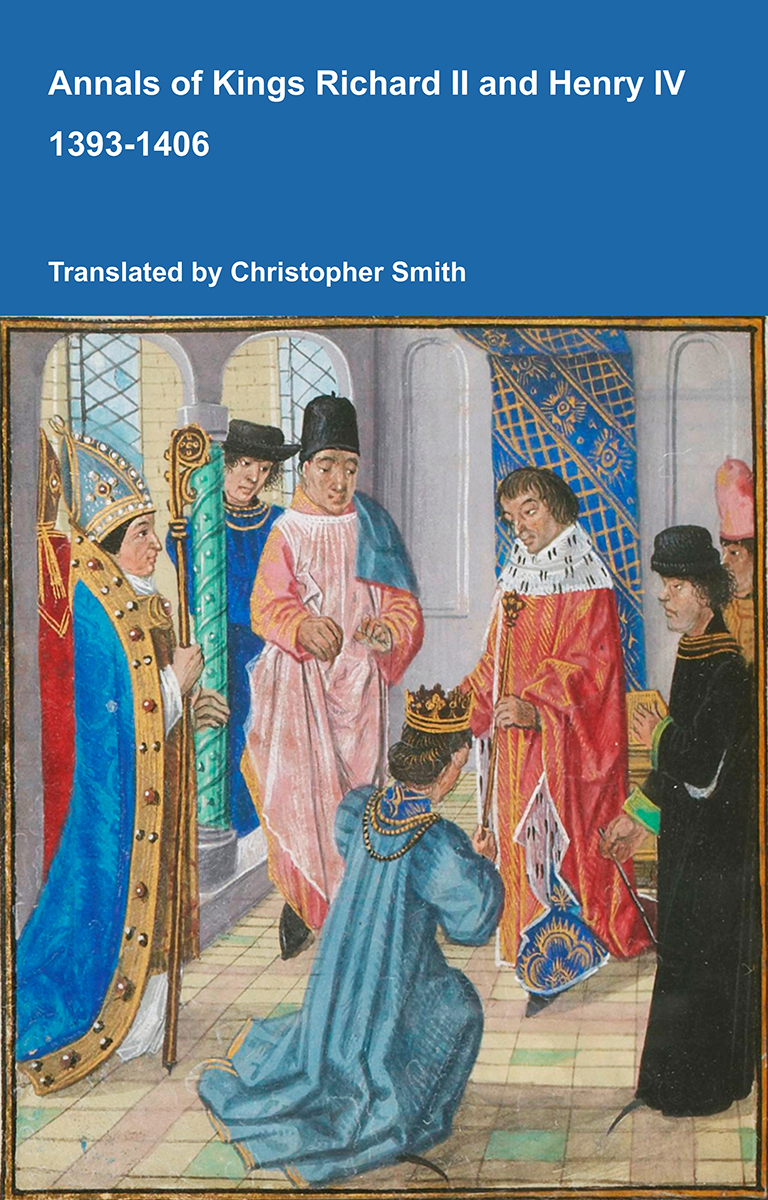
Annals of Kings Richard II and Henry IV 1393-1406
The Annals of Kings Richard II and Henry IV offers a vivid contemporary account of one of the most turbulent periods in late medieval England. Covering the reigns of Richard II and Henry IV, the chronicle records royal ceremonies, political conflict, rebellion, war, taxation, religious controversy, executions, popular unrest and remarkable portents. Its pages include a detailed description of Richard II’s coronation, the fall and deposition of the king, Henry IV’s seizure of the throne, the Percy rebellion, the execution of Archbishop Richard Scrope, the campaigns of Owain Glyndŵr, and England’s relations with Scotland, France, Portugal and Scandinavia. Alongside affairs of state, the annalist preserves reports of miracles, eclipses, prophecies, supernatural events and the experiences of ordinary townspeople, clergy, soldiers and travellers. Written from a monastic perspective, the work combines political observation with moral judgement, presenting victories and disasters as evidence of divine favour or punishment. At once a historical record and a reflection of medieval belief, the Annals provides an invaluable window into the challenges, ceremonies and conflicts of England at the turn of the fifteenth century.
Available at Amazon in eBook and Paperback format.
In 1790 Bishop William Buller [aged 55] was translated to Dean of Canterbury.