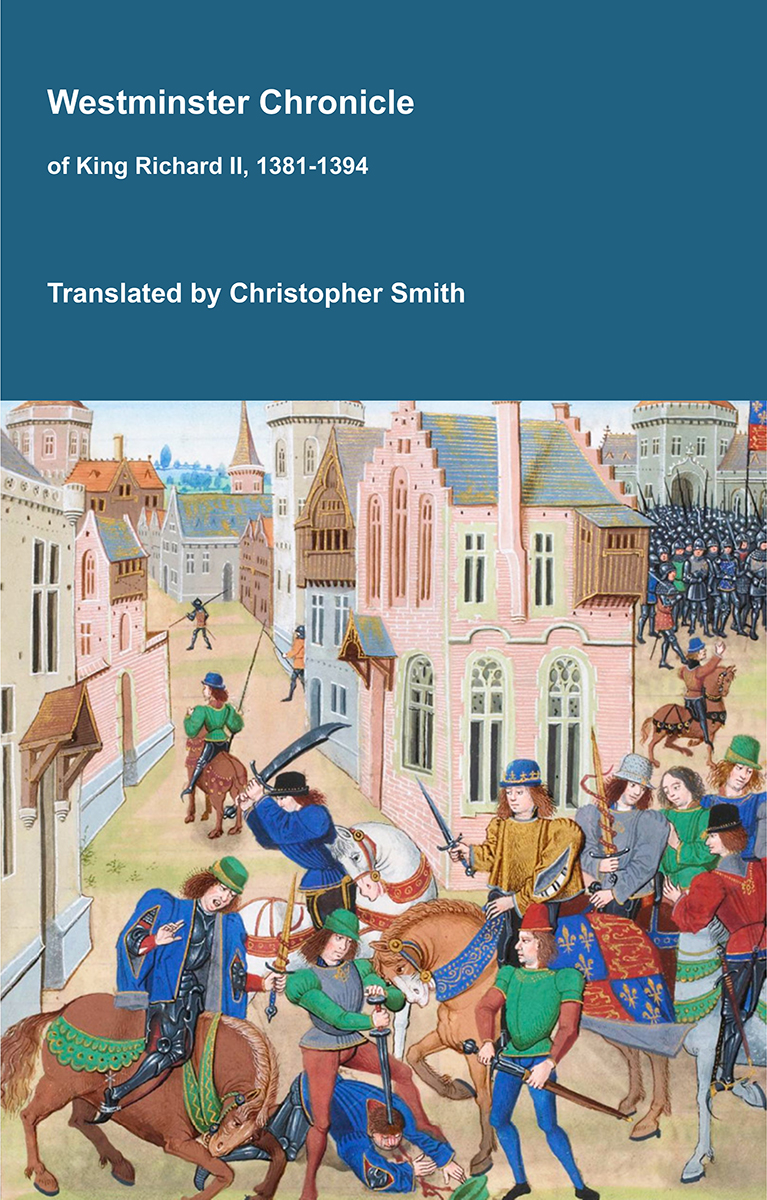
Westminster Chronicle of King Richard II, 1381-1394

The Westminster Chronicle is one of the most vivid and important narrative sources for the reign of Richard II. Written by an anonymous chronicler closely connected with Westminster Abbey, it covers the years 1381 to 1394, from the Peasants’ Revolt to the political tensions, court ceremonies, diplomatic negotiations, royal progresses, and public crises of Richard’s later reign. Rich in detail the chronicle records major events such as the conflicts between the King and Lords Appellant, King and the City of London, negotiations with France and Scotland, the death and funeral of Queen Anne of Bohemia, the illness of Charles VI of France, and the changing fortunes of leading nobles including John of Gaunt, Thomas of Gloucester, Robert de Vere, and the Earl of Arundel. The Chronicle offers readers a remarkable window into late fourteenth-century England, combining political observation, courtly spectacle, urban drama, ecclesiastical affairs, and moral judgement. It is an essential source for anyone interested in medieval monarchy, London, Westminster, and the troubled reign of Richard II.

Available at Amazon in eBook and Paperback format.

New Grange and the Bend of the Boyne

New Grange and the Bend of the Boyne is in Prehistory.

We could then see the original colonists as spreading from southern Iberia to France and the British Isles, with the Passage Grave as the tomb of their chiefs, and later variants of this form spreading at later dates; the Gallery Grave from southern Iberia would be one of these and the V Passage Grave of Iberia and Brittany another. Indeed there is a very strong case for seeing groups from Iberia settling in Brittany and in the Paris Basin and introducing among the indigenous population there (the mixture of Mesolithic and Neolithic people which, when they were building tombs, were called by Bosch-Gimpera and Serra Rafols, the Seine-Oise-Marne people) the custom of building long megalithic tombs. The art on the Paris Basin tombs and on the Breton Gallery Graves, while it has been compared with the figure of goddesses on the statues menhirs of southern France, compares even more closely with the art on idols in south Iberian tombs, with the art on pots — the symbol keramik — and the art occasionally found on Iberian tombs like that on the Dolmen de Soto. Then there have been found in south-western Iberia, and described by the Leisners, tombs at El Pozuelo which are remarkably like the so-called Transepted Gallery Graves of north-western France and the Severn-Cotswold area.

Bibby has gone further than we have done, and deliberately so because he is trying to get across to the general reader the historical implications of archaeological facts; but the general thesis is the same. As we stand outside New Grange [Map] looking at the decorated entrance stones (and, as we hope, the other decorated stones of the kerb which will be revealed to us in the next few years), or walk into the great stone tomb with its splendid roof more than four thousand years old and its great decorated stones; as we lie in the cold stone basin in the north side chamber and look up at the wonderfully decorated capstone with its goddess faces in various forms of schematization; and as we stand outside the great tomb and, on top of it, look around at the other tombs and monuments in the Bend of the Boyne, we must have a feeling of the great past of Ireland, and a sense that we are in the very middle of one of the great centres of Iberian or possibly Aegean settlement in ancient times. We do not believe that the Irish ever forgot their debt to and kinship with these Mediterreanean people. We believe that the great men buried in New Grange and elsewhere were always great figures in early historic Ireland and that that is why, for example, Christian Tara developed on the site of a pagan cemetery. New religions for old: Tara is an example of one Mediterranean religion replacing another, and we remember the other remark- able sites in Western Europe where megalithic tombs have actually been incorporated into functioning Christian churches — Gangas de Onis near Oviedo, for example, or the Chapelle des Septs-Saints in the Cotes-du-Nord of Brittany. To cite these examples is not to insist on continuity; it is to suggest that, unlike England, where there is no continuing tradition of the past from say Stonehenge and Avebury into historic times — except for the memories enshrined in Geoffrey of Monmouth — the megalithic past of Ireland might well have been a living memory, though not, pace Dr Raftery, a living practice in Roman times, and the times of St Patrick. It is also to suggest that the Passage Grave builders, the men of New Grange [Map] and the Bend of the Boyne, were and are, a very important element in the many ethnic elements that make up the Irish people of History.

Click to read more ...