

Battle of Sandwich and Eustace the Monk is in Modern Era.
The Battle of Sandwich and Eustace the Monk. By Henry Lewin Cannon, October 1912,
The battle of Sandwich, 24 August 1217, followed so closely upon the fair of Lincoln, 20 May 1217, that the careful analysis of authorities made some years ago by Professor Tout for the Lincoln contest is, in point of time, almost equally good for the other event1. His discussion of the battle of Lincoln itself likewise furnishes an excellent introduction to the battle of Sandwich. Before proceeding directly to the consideration of that topic, however, we may well trace with some care the circumstances of the career of Eustace the Monk, who as Louis's admiral had seemed endowed with diabolical ingenuity in working havoc among his former friends the English2. The points of his biography which we shall narrate go far, in our opinion, to indicate the bravery, the readiness of resource, and the other qualities requisite for success in the rough work that fell to the lot of a Channel ' master-pirate3 of those days. To such a career as this the sanguinary battle of Sandwich brought a fitting close.
Note 1. Ante, xviii, 1903, 240-4. But since the two engagements had for the most part different participants and took place in widely different localities, the evaluation of authorities for the battle of Sandwich presents some variations that require notice. The 'History of William the Marshal' is still of the highest value. The twofold account of the battle given in the poem led the editor, M. Paul Meyer, to infer that the minstrel had drawn upon two recitals which he had not been able to blend, a circumstance that gives us increased confidence in the trustworthiness of the poem as furnishing legitimate historical material (Histoire de Guillaume le Maréchal, iii. 243, n. 3). Roger of Wendover has for our purpose a smaller importance (Chronica sive Flores Historiarum, ed. H. O. Coxe). Matthew Paris, who in the case of Lincoln added little to Wendover, has for us a distinct independent value (Chronica Maiora, ed. H. R. Luard). His supposed intimate acquaintance with Hubert de Burgh (ibid. iii, preface, xiv and n. 2) would account for the chronicler's open partisanship for him, and also for what appears to be his private information about the battle of Sandwich in which the justiciar bore such a prominent part. Paris, in fact, offers two versions of the battle, one from Wendover with slight emendations, the other entirely his own and very laudatory of Hubert. We derive the impression from reading Paris's second version that he is describing that portion of the battle in which Hubert took a personal part and which he would have most liked to have remembered. The Annals of Dunstaple (Annales Monastici, ed. Luard, iii. 50) are of comparatively little importance. The brief account by the canon of Barnwell contained in the Memoriale Fratris Walter: de Coveniria (ed. Stubbs, ii. 238-9) throws light particularly upon the notorious leader of the French reinforcements, Eustace the Monk. The valuable Histoire des Ducs de Normandie et des Rois d'Angleterre, which has little upon Lincoln, is quite full upon Sandwich; as we might reasonably expect, having regard to the fact that the author was of the entourage of William, earl of Albemarle, who was at Sandwich at the time of the battle (cf. Tout, ante, xviii. 242 and n. 9). The contemporaneous account of the Annals of Waverley (Annales Monastici, ii. 287-8), while rather brief, accords in important particulars with the Histoire des Ducs de Normandie just mentioned. Ralph of Coggeshall, in Essex, has a brief but independent and suggestive account of important corroborative value (Chronicon Anglicanum, ed. J. Stevenson, pp. 185-6). The account of William le Breton, chaplain of King Philip, gives an excellent glimpse of the tactics of the fight (Guillelmus Armoricus, De Gestis Philippi Augusti, in Bouquet, Recueil, xvii. 62-116); but the Chronicle of Rouen (Ex Chronico Rotomagensi, ibid. xviii. 357-62) adds little. From the Chronica de Mailros (ed. J. Stevenson) we get details of the numbers of the captives and the names of the great lords. This information, coming by way of Warden, has a certain relationship to that of the Histoire des Ducs (see the Dictionary of National Biography, reprint of 1908, s. v. Falkes-de Breauté). Of the modern writers we should mention particularly M. Charles Petit-Dutaillis, whose valuable study of the life of Louis VIII (Etude sur la Vie et le Régne de Louis VIII, 1187-1226) appeared in 1894; and M. Paul Meyer, whose third volume of the edition of I' Histoire de Guillaume le Maréchal containing his scholarly notes appeared in 1901. Both of these authors were under a certain disadvantage owing to the fact that the Patent Rolls for 1216-25 were not published until 1901. The account of Sir James H. Ramsay (Dawn of the Constitution, 1908, pp. 12-13), though brief, is excellent; and the treat- ment by Mr. G. J. Turner of The Minority of Henry III (Transactions of the Royal Historical Society, New Series, xviii, 1904, 245-95) is of special value.
Note 2. The Histoire des Ducs de Normandie supplies a brief account of his early life and other details for the period of Louis's invasion. The Romance of Eustace (Wistasse le Moine, ed. Foerster and Trost, Halle, 1891; this is based upon Michel's edition, London, 1834), written between 1223 and 1284, though rather depreciated by M. Petit-Dutaillis (Louis VIII, pp. 168,n. 1, 98-9; cf. his biography of Eustace in La Grande Encyclopédie, xvi. 855), may be safely treated—with due allowances for poetic licence—as legitimate source material. The editors of the Romance have collected much source material for explanation of the poem (cf. the biographical note by Meyer, Guillaume le Maréchal, iii. 242, n. 3). Of further assistance is the study of this poem made by M. Malo (Revue du Nord, Conférence faite a Boulogne-sur-Mer le 12 Mars 1893; our references are to the Extrait).
Note 3. Matthew Paris, Chronica Maiora, iii. 29, 'piratarum magister'.
The birthplace of Eustace4 was not far from Boulogne, the Romance tells us at 'Cors'5; and there is a document of 1243 relating to the neighbouring abbey of Samer which mentions a 'Guillaume le Moine, seigneur de Course', thus apparently bearing out the tradition of such a family in that vicinity6. That Eustace came from near there is not open to doubt, as many subsequent events of his career will show7. The Romance points out circumstantially that his father was 'Bauduïns Buskes', a peer of Boulogne8; in the Histoire des Ducs de Normandie he is called 'i. chevaliers de Boulenois'9; William le Breton refers to him as 'miles'10. In his early life, the Romance recounts, he visited Toledo, where he studied the black art so successfully that no one in France was his equal11. We appear to have no other authority for this journey, which is announced in the first few lines of the poem as a necessary introduction to the droll adventures the poet attributes to his hero. Whether the poet is the author of this tradition or simply took it as he found it is uncertain12. Later generations believed it thoroughly, and it may have grown up, as in the instance of the Romance, to account for his incredible exploits. The author of the Histoire des Ducs de Normandie wrote in Eustace's own day: 'No one would believe the marvels he accomplished, nor those which happened to him many times13.'
Note 4. This is the accepted English form of the name. The Histoire des Ducs de Normandie gives the contemporary form 'Wistasses'; the poem uses the forms 'Wistace', 'Wistasce', 'Wistasse', 'Wistase'. The Latin chroniclers ordinarily write 'Eustachius', which in Silgrave (Chronicon, Caxton Society, 1849, p. 101) and Chronique de Douvres (Collection de Documents Inédits, Rapports au Ministre, 1839, iii, Rapport de M. Francisque Michel, p. 44, n. 2) becomes 'Stacius'. M. Michel points out (ibid.) that the form 'Buske' found in the Rot. Misae (Rot. de Liberate ac de Misis, 1844, p. 115) is another variation. M. Michel preferred 'Eustache'. 'Eustachium cognomine Matthaeum' in the Chronicle of Lanercost is evidently a mistaken emendation of the copy 'Eustachium Monachum' (cf. Michel, Roman d' Eustache, preface, xxxvi, n.; and Chronica de Mailros, p. 128).
Note 5. 1. ll. 304-5. Probably Courset, about twelve miles distant from Boulogne: cf. Malo, p. 11.
Note 6. Malo, ibid.
Note 7. The supposed counter-statement that he was a Fleming is in no sense a contradiction. It goes back to Lefebvre, who in his Histoire de Calais (Paris, 1766), i. 633, n. a (quoted by Michel, Roman, p. vi; Foerster and Trost, Wistasse, viii and n. 2), quotes Hist. Nav. d' Anglet. tom. i, p. 59, ex notis, which proves to be by Thomas Lediard (cf. Lefebvre, p. 513, n. 2). Lediardin the English original (The Naval History of England, 1066-1734, London, 1735, i. 28, n. c) plainly follows Matthew Paris, one of his references. So the whole tradition goes back to Paris, who wrote (Chronica Maiora, iii. 29): 'Erat autem ille natione Flandrensis.' In the thirteenth century the term Fleming was often applied to the Boulogne country. See Michel's note in Histoire des Ducs de Normandie, introd. ii, and compare the usage of that narrative.
Note 8. ll. 305 ff.
Note 9. p. 167.
Note 10. De Gestis Philippi Augusti, in Bouquet, Recueil, xvii. 111 B.
Note 11. 11. 6 ff.
Note 12. Cf. Malo, p. 11.
Note 13. p. 167.
We next find him as a monk in the abbey of Samer14, having for this the direct evidence of the Romance15 and such corroborative evidence as that of the Anonymous Chronicle of Laon, which speaks of Eustace 'from a black monk becoming a demoniac16'; of Ralph Coggeshall, who calls him 'Eustace, formerly a monk17'; and especially that of Matthew Paris, who states the circumstances under which Eustace had put aside his habit and renounced his order18. The Romance tells us that Eustace left the abbey to demand justice from the count of Boulogne against the murderer of his father. The appeal of battle went against the champion of Eustace19.
Note 14. Samer, eight miles south-east of Boulogne, is a shortened form of St. Vulmer. It was an old Benedictine abbey (Gallia Christiana, x, Paris, 1751, col. 1593-8).
Note 15. ll. 3-5.
Note 16. Chronicon Anonymi Laudunensis Canonici, in Bouquet, Recueil, xviii. 719 D; cf. Trivet, Annales, 201.
Note 17. Chronicon Anglicanum, p. 185.
Note 18. Paris relates that he desired to secure the inheritance which had fallen to him because of his brothers' decease without children (Chrontca Maiora, iii. 29). But we afterwards meet with mention of the brothers of Eustace (e. g. in the treaty of peace, 11 September 1217; Rymer, Fœdera, i, ed. 1727, p. 221, c. 10).
Note 19. Wistasse, ll. 319-70. Michel holds that the defeat of the innocent party substantiates the truth of the account (Roman, p. 94).
After this he went into the service of Count Renaut of Boulogne in the capacity of seneschal20. According to the Romance, Eustace's old enemy, Hainfrois de Hersinghen, who had slain the father, at length accused the son to the count of Boulogne to such good purpose that the count summoned him to deliver up his charge. Eustace appealed to a court of his peers, but at length took fright and fled. Thereupon the count seized his property and burned his fields; Eustace in return swearing that this wrong should cost the count 'ten thousand marks21'. With his subsequent exploits of revenge while living as an outlaw in the forest of the Boulonnais, interesting as they may be to the poet of the Romance22, we need not concern ourselves, except to note that his enmity against the count is too well attested to doubt. The writer of the Histoire des Ducs de Normandie relates that Eustace had warred much with the count of Boulogne; so much so that in consequence of the count going over to the king of France he went over to the king of England23.
Note 20. Wistasse, ll. 371 ff. Lambert d'Ardres, under 1203, describes Eustace acting as seneschal (Historia Comitum Ghisnensium, in Bouquet, Recueil, xviii. 587-8). This is the first date for his biography that we possess.
Note 21. Wistasse, ll. 375 ff. Cf. Malo, p. 14.
Note 22. Wistasse, ll. 399-1879.
Note 23. p. 167. We also find an oath taken by the count of Boulogne to abjure Eustace and certain others, and if possible to hand them over to King Philip (L. Delisle, Catalogue des Actes de Philippe-Auguste, Paris, 1856, no. 1245, app. pp. 516-17). This agreement is dated by the editor as 'towards 1210' (ibid. 546). If this dating is correct the agreement is to the point here only as indicating the count's hostility. As to Eustace's fear of Philip, compare Wistasse, l. 1741.
Eustace's career under John began as early as 120524. Various writs from 1205 to 120825 would indicate that during those years he was generally abroad on the king's service, possibly in the Channel Islands, to which John dispatched five galleys and three large ships in the spring of 120626. The Romance states that John sent him 'with thirty galleys' to capture the islands, and describes the raid by which Eustace executed his commission27. According to the Histoire des Ducs de Normandie Eustace had done so well that John granted him the islands28. For a number of years after this Eustace was in good standing with the English king29. During this period, and before he had to flee from England, he may have made the raid described in the Romance upon the territory guarded by Cadoc, the master of the famous castle of Gaillon on the Seine above Rouen. The Romance terms Cadoc 'le senescal de Normendie', and relates how Eustace came to Harfleur at the mouth of the Seine, and after penetrating inland as far as Pont- Audemer met Cadoc, and returned to his ships. Cadoc thought to pursue him to Boulogne, but Eustace went west to Barfleur. Finally Cadoc overtook him with a fleet, but suffered a loss of five boats and withdrew30.
Note 24. At length, thus the Romance, the Monk was taken into the service of King John and evidently gave his daughter as hostage; later on Eustace complained to Prince Louis that John had slain, burned, and disfigured her (zb4d. 11. 1880 fi, also 11. 2226-7), Cf. Rot. Litt. Pat. i, part i, 144 a.
Note 25. Rot. Litt. Claus. i. 57 a; Rot. Litt. Pat. i, parti, 65a; 8l a.
Note 26. Rot. Litt. Claus. i. 69 a.
Note 27. Wistasse, ll. 1910 fi. 3p. 167.
Note 28. p. 167.
Note 29. Rot. Misae, in Hardy, Rot. de Liberate, 113, 119, 123, 127, 165, 232; Rot. Litt. Claus. i. 126; cf. 248 b.
Note 30. 30 Wistasse, 11. 1952-2132. For Cadoc, see S. Bougenot, in La Grande Encyclopédie, viii. 702. Cf. Delisle, Recueil de Jugemenis de Echiquier de Normandie au XII1I¢ Siécle, notes to nos. 49, 137.
On his return to England after this exploit, the poet relates, Eustace secured permission of King John to build a 'palais' in London. 'Eustace finished the palace which was very rich and well built31.' However it may be with the London house, to which there seems to be no other reference, there is little doubt that his home port, when in England, was Winchelsea. For this we have first the evidence of the Romance, where 'Winchelsea' is given as his battle-cry in the Islands32. Again, the account in the Histoire des Ducs de Normandie, on the occasion of Louis's distress in Winchelsea in the early part of 1217, represents Eustace as coming to Louis and giving the following advice: 'Sire, if you would have prepared a certain very fine galley which is in this town and which I know well, for it was indeed mine, you would be able with it greatly to restrain their ships33.' Finally, in the account of the death of Eustace, as given in Guillaume le Maréchal, his executioner is named as Stephen of Winchelsea, who seemed to know him well34; who is further identified in the Histoire des Ducs de Normandie as 'Stephen Trabbe, who had long been with him35'.
Note 31. Wistasse, 11. 2134-57.
Note 32. Ibid. 1. 1931. Cf. Meyer, Guillaume le Maréchal, iii. 220, n. 2.
Note 33. p. 185.
Note 34. l, 17439.
Note 35. p. 202.
This nearly concludes the sum of what we know directly of Eustace's career under King John36. He was in England when the count of Boulogne came to John after breaking with the king of France. 'Then the Monk wished to return, when he saw Renaut de Boulogne,' but the king had the seaports guarded to prevent his departure37. A passage from the Annals of Dunstaple, under 1211 (really 1212), explains this further:
... There came... the count of Boulogne. And the king of France took all the ships of England which came to his land; and therefore the king of England took many towns of the Cinque Ports. And then Eustace the pirate, called the Monk, fled from us to the king of France with five galleys because the count of Boulogne laid snares for him38.
Note 36. Some light is thrown upon the career of Eustace under John in connexion with that of his countryman and friend, Geoffrey de Lucy. Cf. Rot. Litt. Pat. i, parti, 9, 75, 143; Rot. Litt. Claus. i. 48, 70, 126, 230, 235b, 236, 237d, 239), 241, 268d, 277 b, 280, 288 b, 295, 322 b, 326 b, 350 b, 626 b, &c.; also Annals of Dunstaple, Annales Monastict, iii. 46. Upon comparing the data for Eustace and Geoffrey, we find that the latter had evidently preceded Eustace to England, and was posted at Winchelsea in August 1205 at about the time of the arrival of Eustace, our first notice of Eustace being in November of that year. Then from May 1206 we find Eustace apparently out of England much of the time, presumably in the Islands, Geoffrey, too, after May 1206, was also in the Islands at least intermittently until November 1212, when he left for Poitou. As early as November 1214 Eustace had gone over to Louis, followed by Geoffrey between July and October 1215. We may fairly conclude that the two had been working harmoniously together for most of the time while Eustace was with King John.
Note 37. Wistasse, ll. 2158 ff.
Note 38. Annales Monastici, iii. 34. Eustace was present when the count's arrangements with John were completed, in May 1212 (Rymer, Fœdera, i. 158), ang as we have seen above (n. 29) he was in favour with the king so late as October of that year. So Eustace must have gone over to Louis sometime between that month and 4 November 1214; for under the latter date the records show that the English had taken prisoners some of Eustace's men (Rot. Litt, Claus. i. 175b, 177, 262 b; Rot. Litt. Pat. i, part i, 126, 130 b, 133 b).
The Romance gives a humorous detailed account of Eustace's escape from England in disguise and his unexpected appearance before Louis39, which in the light of the specific statement in the Annals of Dunstaple, given above, that he left England with five galleys, we are compelled to ignore. The fact that he was ostensibly in the service of Louis, however, and not of Philip, is clear. Philip was particular to explain that point to Gualo the legate when the latter applied for a safe-conduct in 1216: 'Through our land I will willingly furnish you safe-conduct; but if by chance you should fall into the hands of Eustace the Monk or of the other men of Louis who guard the sea-routes, do not impute it to me if any harm comes to you40.' Walter of Coventry attributes a degree of activity on the part of Eustace when under Louis equal to that which he displayed when in John's service41.
Note 39. Wistasse, 11. 2164 fi.
Note 40. Wendover, Flores Historiarum, iii. 367; cf. Petit-Dutaillis, Louis VIII, p. 94.
Note 41. Memoriale, ii. 238-9.
The Romance intimates that until the period or Louis's English invasion he was more particularly engaged in the Channel Islands42. The Annals of Dunstaple speak of their capture after Louis's invasion. That they were in the possession of Eustace at the time of his death we know from the terms of peace finally entered into between Henry III and Louis in 1217, for by the treaty Louis agreed to send letters to Eustace's brothers in the islands, directing them to surrender them to the English. The treaty also leads us to infer the high degree of independence Eustace had enjoyed there from the elaborate arrangements it contains for ensuring obedience to its terms.
Note 42. Waistasse, 11. 2250-1.
Abbot John Whethamstede’s Chronicle of the Abbey of St Albans
Abbot John Whethamstede's Register aka Chronicle of his second term at the Abbey of St Albans, 1451-1461, is a remarkable text that describes his first-hand experience of the beginning of the Wars of the Roses including the First and Second Battles of St Albans, 1455 and 1461, respectively, their cause, and their consequences, not least on the Abbey itself. His text also includes Loveday, Blore Heath, Northampton, the Act of Accord, Wakefield, and Towton, and ends with the Coronation of King Edward IV. In addition to the events of the Wars of the Roses, Abbot John, or his scribes who wrote the Chronicle, include details in the life of the Abbey such as charters, letters, land exchanges, visits by legates, and disputes, which provide a rich insight into the day-to-day life of the Abbey, and the challenges faced by its Abbot.
Available at Amazon in eBook and Paperback format.
The aid afforded Louis by Eustace in his English campaigns was considerable, indeed almost essential. In 1215 he had made a beginning by carrying machines of war from the French to the English barons, landing them ate Folkestone greatly to John's annoyance43. When Louis sailed from Calais in person Eustace had prepared his fleet, which amounted, according to the chroniclers, to seven or eight hundred ships44, a total which, even if reduced considerably, affords no mean indication of his ability and of his resources at the time. It was largely owing to the strenuous efforts of Eustace that Louis survived the Win- chelsea campaign at the beginning of 121745. We may assume that Eustace saw him safely home from this, and was waiting for him when Louis was prepared to recross the Channel to England once more. Finally, we come to the battle of Sandwich, on 24 August, which the biographer of the marshal gleefully called Eustace's feast-day, the day on which thereafter his death would be celebrated46.
Note 43. Coggeshall, Chronicon Anglicanum, Pp. 172; Rot. Litt. Pat. i, parti, 155b; cf. Petit-Dutaillis, Louis VIII, p. 69, and n. 3.
Note 44. Wendover, iii. 367-8; Histoire des Ducs de Normandie, p. 166-7.
Note 45. Histoire des Ducs de Normandie, p. 182-7; cf. Chronica de Mailros, p. 130.
Note 46. Guillaume le Maréchal, ii, 11. 17161-2, 17456; iii. 243, n. 1.
The disastrous Lincoln campaign, if not decisively affecting the position of the French in England47, was at least a severe blow to their prospects. Louis, who received the news on Thursday, 25 May 1217, while conducting the siege of Dover48, felt obliged to remove to London and send to France for aid. The decision to abandon the siege of Dover, the reduction of which was of the greatest importance and had been most carefully prepared for49, is in itself eloquent testimony of the straits to which the French were reduced. On the other hand, when the royalists disbanded after the Lincoln campaign, the confident appointment of Chertsey on the Thames, only twenty-two miles out of London50," as the rendezvous, is a sufficient indication of their high hopes.
Note 47. Cf. Petit-Dutaillis, Louis VIII, p. 154. For the progress of the war down to the engagement at Sandwich see Turner, Transactions of the Royal Historical Society, New Series, xviii, 1904, 258-66.:
Note 48. Histoire des Ducs de Normandie, 195. Cf. Meyer, Guillaume le Maréchal, iii, 241, n. 1.:
Note 49. See Professor Tout's remarks upon the new siege-engine, the trébuchet, ante, xviii. 263-5.
Note 50. Guillaume le Maréchal, ii, 1. 17061; iii. 240, and n. 4. Cf. the marshal'sitinerary, ibid. p. cliii.
The appeal for aid directed to Philip and to Louis's wife, the Lady Blanche of Castile, met with peculiar diplomatic difficulties. The well-known opposition of the papacy to the invasion of England had required from the beginning that it should pass as the private enterprise of Louis51. At the beginning of the year the situation had become still more delicate owing to the reconciliation of Philip and Honorius III52. The scene portrayed by the 'Ménestrel de Reims', wherein the king first refuses to aid his son and then slyly offers his daughter-in-law as much of his treasure as she cares to take, to do with what she will, explains the spirit of the compromise that Philip effected with himself53. Wendover states the case exactly when he says: 'Since the King feared to bear aid to his excommunicate son, having often been censured by the Pope for complicity with him, he imposed the whole of the work upon the wife of Louis54.' Under the energetic leadership of the Lady Blanche the preparation of the fleet went rapidly forward. Calais was the point of concentration55, where 'she toiled very hard to make his people pass over to rescue their lord56'.
Note 51. Wendover, iii. 363-7.
Note 52. Cf. M. Petit-Dutaillis, Louis VIII, p. 162. i
Note 53. Récits d'un Ménestrel de Reims (ed. N. de Wailly), 157-8; cf. pp. ix, x, Ixi.:
Note 54. Flores Historiarum, iv. 27-8.
Note 55. Cf. Guillaume le Maréchal, ii, 11. 17108-24.
Note 56. Histoire des Ducs de Normandie, pp. 198, 200; cf. M. Petit-Dutaillis, Louis VIII, p. 164, n. 1.
In the meantime affairs in England had been practically at a standstill57, but by 13 August threatening news from the Channel must have been received such as to demand the personal attention of the earl marshal. He was at Reading on 14 August, at Farnham on the 15th and 16th, at Lewes on the 17th, and at Romney on the 19th. As the marshal's biographer puts it, he was greatly perplexed upon hearing of the extensive preparations that were going forward at Calais, and promptly made his way to the coast to make the necessary counter-preparations58. The coast had not been left unguarded, however, for as early as 20 January the veteran counsellor, warrior, and seaman, Philip d'Aubigny, had been given charge of all the southern coast. His commission was addressed to all in Kent, Surrey, Sussex, and Hampshire, including the Weald, the Cinque Ports, and all maritime parts of Hampshire59. When Louis, in February, had gone on his expedition to Winchelsea and burned the town, the inhabitants, we read in the Histoire des Ducs de Normandie, entered their ships and went to Rye 'to Philip d'Aubigny, who was there with a great plenty of ships well fitted and well armed, as one whose business it was to guard the sea for the king60'. Again, we are told by the same authority that while Louis was besieging Dover in that spring, on the very day that he settled down to the siege, 12 May, forty of his ships came before Dover, but owing to a storm all but five were driven back to Calais. On Monday the 15th they set out for Dover again, but Philip d'Aubigny and Nicholas Haringos61 came from before Romney with quite four score ships, of which twenty were great ships well equipped for fighting. Louis's people seeing them, and having only small ships, did not dare attack, but attempted to retreat to Calais. Twenty-seven of the French ships, having come too far to retreat, were forced to fight, with the result that eight were captured by the English while the nineteen escaped in great confusion. The soldiers and sailors, we are told, were soon all slain, and the knights were cast into prison in the holds of the ships, where they were badly treated. The English then cast anchor before the town to prevent food and reinforcements from reaching Louis while conducting his siege62.
Note 57. The marshal remained at Lincoln until 25 May, when he returned to Oxford. June was employed in the vain endeavour to bring about a peace. When these efforts were plainly futile, the marshal, who had remained near, appears to have gone for a fortnight to the west. He was back at Oxford, 204 July; and by 7 August was again there and passed the week at that place. Cf. Rot. Litt. Claus. i. 336.
Note 58. Patent Rolls, 1216-25, 64-8.
Note 59. Patent Rolls, 25. For Aubigny, cf. Rot. Litt. Claus. i. 91, 126 b, 164, 226 b, 2305; Patent Rolls, 88, 281 b, 2825; Wendover, iv. 1, 75; Guillaume le Maréchal, ii, 1. 15336-9; iii. 214, n. 3; Histoire des Ducs de Normandie, p. 207.
Note 60. p. 183; Guillaume le Maréchal, ii, 11. 15782 ff.; and iii. 220-1.
Note 61. For Nicholas Harangod', see Rot. Litt. Claus. i. 229, 233 b, 242 b.
Note 62. Histoire des Ducs de Normandie, pp. 192-3.
On Thursday, 25 May, the news of Lincoln came to Louis at Dover; on Monday, the 29th, six score sail were seen approaching. When the English saw them,
they raised their sails and went to meet them on the high sea. Wistasses de Noeville and the others who were in the ships began to give chase: they pursued the English vigorously but could not overtake them. And when they saw they could not catch them they turned back and sailed for Dover. But when, the English saw them turn, they also came about and fell upon the rear of the fleet, capturing eight ships, the rest arriving together at Dover63.
Note 63. Ibid. p. 196. Roger of Wendover is wrong in supposing that Aubigny joined the levy that took part in the battle of Lincoln (iv. 19; cf. 28).
The feint of fleeing and returning to attack the rear is of interest as helping to explain the tactics of the subsequent battle of Sandwich.
Returning now to the preparations made by the marshal for the reception of the approaching expedition, we find that he evidently passed from Lewes on 17 August to Romney on the 19th. This supports the narrative of the Histoire de Guillaume le Maréchal, in which we are told that he summoned the mariners of the Cinque Ports. They complained vigorously of ill-treatment at the hands of King John both in regard to their losses and the serfage to which he had reduced them. The marshal, however, promised them recompense for their losses from the vessels they should capture, and also restoration of their franchises in addition to the gift of great wealth, if only they would go out and fight the French with spirit. He prevailed so well upon them that they betook themselves straightway to Sandwich and overhauled their ships for dction. The rigging was carefully seen to, as well as 'good anchors and strong cables for anchoring before the ports64'. We understand by this account that the marshal put new life into Aubigny's fleet and strengthened it in every way possible. The brave old earl was with difficulty restrained from embarking with the fleet, but the danger of leaving the realm without its chief defender was too great to permit the risk of his death or capture.
Note 64. Guillaume le Maréchal, ii, 11. 17167-233.
The Histoire des Ducs de Normandie now presents another preliminary engagement which Guillaume le Maréchal seems to corroborate. While Blanche was preparing her reinforcements at Calais, the English, so we are informed, often came before the harbour to attack them65.
One day fully three hundred came there: and when the French saw them come, they armed and entered into their ships, and went to meet the ships of the English, which were at that time rather lightly manned. So the English were discomfited and the French captured quite seven score and the others were scattered among the various havens of England.
Note 65. Histoire des Ducs de Normandie, p. 198. Is this the explanation of the anchors and cables, that the English might keep the French shut up in Calais as John had attempted to do in 1216? Cf. ibid. p. 167-8; and Petit-Dutaillis, Louis VIII, p. 100.
The first recital of Guillaume le Maréchal apparently refers to this occasion. It tells us (we translate freely) that,
when the English saw the great fleet of the French approaching, they went to meet them in combat, though since they were without leadership they greatly feared the French. In their despair they [at length?] abandoned their ships with the sails set and took to their boats66.
Note 66. Guillaume le Maréchal, ii, ll. 17234 ff.; cf. 17347-50, and Chronica de Mailros, p. 128.
On the other hand, the French had their share of misfortunes, for 'One night the French came before Dover where they were at anchor; and on the morrow when they thought to proceed to the mouth of the Thames a storm arose with a rough sea and drove them back upon Boulogne and Flanders and caused them great distress67'.
Note 67. Histoire des Ducs de Normandie, p. 198 ff. The accounts of the two French narrators may possibly, however, not refer to the same discomfiture.:
Finally, on St. Bartholomew's day, Thursday, 24 August, the French fleet was once more ready to sail: 'the day was fine and clear and they could look far out at sea68.' It was descried issuing from Calais 'sailing toward the mouth of the Thames69'. 'So dense was the fleet and in such good order that it was like a pitched battle. In advance proceeded the ship of Eustace the Monk, who was its guide and master70.' This ship was 'the great ship of Bayonne' which contained 'the treasure of the king'. The editor of Guillaume le Maréchal, M. Meyer, understands by this a reference to King Philip's treasure destined for Louis72. It also carried a trébuchet and a number of choice horses for Louis, so that with the burden of its crew and fighting men, together with their supplies, it was altogether too heavily laden. In fact it was so deep in the water that its deck was almost awash73. The ship carried the leaders of the expedition. First among them was Robert de Courtenay, the French queen's uncle74. From his order given to Eustace at the critical point of the engagement we may gather that he was in real command of the expedition; and the Histoire des Ducs de Normandie accords him a certain precedence75. Ralph de la Tourniele is then mentioned by this authority next after Eustace; so too in Guillaume le Maréchal76. Next in order is the famous William des Barres the younger, whose own brilliant reputation is usually by error merged in that of his equally famous father77. Among the others was Nevelos de Canle, son of the bailiff of Arras. In all, there were thirty-six knights in this ship78. 'In the second ship manned with knights was Mikius de Harnes,' whom we may regard as being in command79." In the third ship, presumably as leader, was the chatelain of Saint-Omer, William V80. The fourth ship was that of the mayor of Boulogne, in which there was a great number of knights81.
Note 68. Guillaume le Maréchal, ii, 11. 17281 ff,
Note 69. Histoire des Ducs de Normandie, 200 ff. Cf. Wendover, iv. 28: The fleet had been entrusted to Eustace, ' to lead it under safe-conduct to the city of London.... They had a strong wind at their backs which drove them vigorously towards England.'
Note 70. Guillaume le Maréchal, ii, 11. 17286 ff.
Note 71. Ibid. ii, 11. 17366-8.
Note 72. Ibid. iii. 245.
Note 73. Ibid. ii, 11. 17387-986.
Note 74. Histoire des Ducs de Normandie, p. 202; cf. 166, 172. Cf. also Petit-Dutaillis, Louts VIII, p. 336 and n. 3; and Appendix no. 5, 445.
Note 75. Ibid. pp. 200-1.
Note 76. Ibid. p. 201. Guillaume le Maréchal, ii, 1. 17147; iii. 242, n. 2.
Note 77. Vide Guillaume le Maréchal, iii. 32, n. 1. The father was at Bouvines, the son at Muret. These personages are confused in Oman's Art of War in the Middle Ages, p- 470, and in Tout's Political History of England, 1216-1377, p. 11. The Histoire des Ducs de Normandie, p. 201, calls him: 'Li jouenes fils Guillaume des Bares'; in the Worcester Annals, Annales Monastic, iv. 409, it is 'W. de Barre, iuvenis'.
Note 78. Histoire des Ducs de Normandie, p. 201.
Note 79. Cf. ibid. pp. 166, 169, 198, 201.
Note 80. 80 Cf, ihid. passim.
Note 81. Ibid. pp. 160, 184, 201; Guillaume le Maréchal, ii, 1. 17374; cf. iii. 246, n. 1.
It is hardly worth while to attempt to fix closely the total number of knights in these four ships. The author of the Histoire des Ducs de Normandie states the number in the leading ship as thirty-six; but this ship was apparently an unusually large one, and the leaders would have the finest company with them. 'A great mass of knights,' however, entered the fourth; so that between one hundred and one hundred and twenty-five knights would probably offer a fair approximation82. In addition to these four there were six other great ships, well fitted out and prepared for fighting, given over to the men-at-arms83. The rest of the fleet consisted of small boats, containing equipment and merchandise, which brought the total up to some fourscore84.
Note 82. Histoire des Ducs de Normandie, p. 198; but cf. Chronica de Mailros, p. 128, and Wendover, iv. 28,
Note 83. Histoire des Ducs de Normandie, pp. 200, 201. Cf. Wendover, iv. 28: 'cum multa armatorum manu.' The Chronica de Mailros, p. 128, include among the captives 146 'servientes equitum'.
Note 84. Histoire des Ducs de Normandie, p. 200. So also Wendover, iv. 28: °naves quater viginti" Paris's addition to the account of Wendover is worthless, Chronica Maiora, iii. 26: 'magnas, et plures de minoribus et galeis armatis." Coggeshall, Chronicon Anglicanum, p. 185, a strictly contemporary authority of high value for this period (cf. Pauli, Geschichte von England, iii. 880), contents himself with sixty ships. The Worcester Annals, Annales Monastic, iv. 408, give sixty. Guillaume le Maréchal, 1. 17294, states that there were bien treis cenz nez en lor estorie'.
William of Worcester's Chronicle of England
William of Worcester, born around 1415, and died around 1482 was secretary to John Fastolf, the renowned soldier of the Hundred Years War, during which time he collected documents, letters, and wrote a record of events. Following their return to England in 1440 William was witness to major events. Twice in his chronicle he uses the first person: 1. when writing about the murder of Thomas, 7th Baron Scales, in 1460, he writes '… and I saw him lying naked in the cemetery near the porch of the church of St. Mary Overie in Southwark …' and 2. describing King Edward IV's entry into London in 1461 he writes '… proclaimed that all the people themselves were to recognize and acknowledge Edward as king. I was present and heard this, and immediately went down with them into the city'. William’s Chronicle is rich in detail. It is the source of much information about the Wars of the Roses, including the term 'Diabolical Marriage' to describe the marriage of Queen Elizabeth Woodville’s brother John’s marriage to Katherine, Dowager Duchess of Norfolk, he aged twenty, she sixty-five or more, and the story about a paper crown being placed in mockery on the severed head of Richard, 3rd Duke of York.
Available at Amazon in eBook and Paperback format.
We are fortunate in having somewhat definite particulars of the English leaders. In the absence of the marshal from the fleet85, Hubert de Burgh, who had throughout the war been defending Dover, took precedence as commander, doubtless by virtue of his office' as justiciar. Paris specifically states that 'there were given to his command about sixteen ships well fitted out, besides attendant small boats to the number of twenty'; a statement which we see no reason to dispute. As to his particular ship and ship's company, the same author tells us that he took, probably from. the garrison at Dover castle, two knights in particular, Henry de Trubleville and Richard Suard, with certain others few in number; furthermore, that he entered the best ship with a few skilled seamen from the Cinque Ports86. Next in order of importance was Richard Fitz-John87, whose parentage is given by the author of the Histoire des Ducs de Normandie. He was nephew to the earl of Warren, being the son of the earl's sister and King John, 'so he was both his son and cousin88'. After the description of Hubert's embarkation in Guillaume le Maréchal we are told next about Richard89. Into another ship, as the context shows, 'there went aboard with a fine troop Sir Richard the King's son90'. We have reason to believe that this 'fine troop' was furnished by his uncle the earl of Warren, who, we are informed, 'did not embark but fitted out a ship with knights and men-at-arms where his banners were'
Note 85. Guillaume le Maréchal, 11. 17197210, 17251-61, 17295-301.
Note 86. Chronica Maiora, iii. 29. For special information as to Hubert de Burgh, see Turner, Transactions of the Royal Historical Society, New Series, xviii (1904), 246 ff, For Turberville, see the Dictionary of National Biography; also Rot. Litt. Claus. i, index. For Richard Suard, see Patent Rolls, 1216-25, 282, 283, 284, 300.
Note 87. M Petit-Dutaillis confuses him with Richard of Cornwall, the younger brother of Henry III, who would at that time have been only about eight years of age: Louis VIII, 168, n. 1.
Note 88. In Wendover, iv. 29-30, he is called 'filius regis nothus'; cf. Guillaume le Maréchal, 1. 17308, and Histoire des Ducs de Normandie, 201, and especially 200, where his parentage is given.
Note 89. Cf. Annals of Waverley, Annales Monastici, ii. 288.
Note 90. ll. 17307-8.
Note 91. Histoire des Ducs de Normandie, 201. The poet of Guillaume le Maréchal says that Richard's ship was the first to attack Eustace (Il. 17377-80), and the author of the Histoire des Ducs de Normandie states that the ship which first attacked Eustace contained the people of the earl of Warren (201). But cf. M. Petit-Dutaillis, Louis VIII, 1617.
With the exception of the ship that carried the men-at-arms of the marshal, whom we shall mention presently, 'they who had the other ships fitted them out as best they could92.' There were eighteen large ships, according to the Histoire des Ducs de Normandie93, and a number of galleys and fishing boats94. Paris, as we have seen, in his independent version gives the number of large boats as 'about sixteen'; of small, twenty. Wendover states that with galleys and other ships the number of the English did not exceed forty95. The author of Guillaume le Maréchal says simply: 'our people had only a few ships.' Earlier in the poem he states that the marshal had twenty-two ships great and small96. Of the large boats, in addition to those commanded by Hubert de Burgh and Richard Fitz-John, one especially stands out both by reason of its size and its crew. This is the 'cog', an unusually large ship for the times. It was lightly laden, and so stood high out of the water. Even the smaller ships of those days, of as low as twenty tons burden, were built with high bow and stern, fitted when need be with © castles' fore and aft. The 'cog'—a term which had come to be applied to a particularly large ship—would have these characteristics developed to a high degree; and we know that in John's day some especially large ships had been built97. Although these ships of John had beeu dissipated in the great storm of 18 May 1216, just before Louis's first crossing, we find a writ of 8 June which informs us that there were great ships of Rye and Winchelsea which the king's official was to maintain98. It was at Rye, we remember, that Philip d'Aubigny ' had a great plenty of ships well fitted and well armed'. We may feel satisfied that the great ships at Sandwich were the remainder of these which had so far survived the exigencies of the war.
Note 92. Guillaume le Maréchal, 11. 17311-12. As to the poverty of the royal treasury at this period, see Turner, ub: supra, 285-6.
Note 93. So too the Annals of Waverley, Annales Monastici, ii. 288.
Note 94. p. 201.
Note 95. Flores Histortarum, iv. 28,
Note 96. ll. 17352, 17214.
Note 97. Histoire des Ducs de Normandie, 130, 134, 135.
Note 98. Rot. Litt. Claus. a. 1216, 274 b.
The commander of these ships, including the cog, would, under ordinary circumstances, have still been Philip d'Aubigny, but on this occasion Hubert de Burgh and Richard Fitz-John seem to have had precedence; or perhaps Hubert alone outranked him, and Richard held an independent command of one ship, just as in the battle of Muret William des Barres, the younger, had held an independent command in front of the first troop of horse99. Of the troops that were on the cog sufficient information has come down to us to give grounds for supposing that it was manned by the marshal's men-at-arms, who, we are told by the marshal's own biographer, had been sent aboard the day before100.
Note 99. Oman, Art of War, 453. As to Philip's presence, see Guillaume le Maréchal, 1. 17270; and Wendover, iv. 29.
Note 100. From the presence on the cog of two men who were in the marshal's troop, namely, Ranulf Paganus and Theobald Blund, we may safely conclude that the troops aboard the cog were his: Guillaume le Maréchal, 11. 17309-10, 17405, 17406, 17425; Rot. Litt. Claus. i. 317 b, cf. 382 b, &c.; also Patent Rolls, 1216-25, 168.
A few words remain to be said concerning the composition and character of the remainder of the fleet. Some of the larger ships may, like the cog and the earl of Salisbury's great ship of a previous day, have been given or entrusted by the king to various individuals with the implied condition of war service. The rest of the ships, with perhaps here and there an exception, probably came, as we have seen, from the Cinque Ports, whose duty it was to furnish a navy when called upon101. In addition to the sailing ships there were galleys, of which the Ports were accustomed to have some, and also the king102. Wendover states that at the battle there were galleys armed with iron prows for ramming their adversaries103, and the affair of Richard I with the ship from Beirut, in June 1191, shows how deadly these galleys could be, when properly led, against even the largest ships104.
Note 102. Ibid. 87; cf. Patent Rolls, 1216-25, 71.
Note 103. Flores Historiarum, iv. 29.
Note 104. Itinerarium Regis Ricardi, in Chronicles, d:c., of Richard (ed. Stubbs), i. 208.
If we now proceed to summarize the respective advantages enjoyed by the two sides in the combat, we find the following conditions. The French had the advantage in respect to the wind, the choice of the day, the number of their ships, the number of their knights, and possibly the number of their men- at-arms. They had the redoubtable Eustace for their pilot, and apparently excellent leadership. On the other hand their ships, and especially that of Eustace, were encumbered with cargo, they were much weaker in large vessels, and were obliged to make for a certain objective—London. Furthermore, they had the defect of over-confidence, as the narrative will show, while the English were fully aware of the desperate nature of their enterprise and felt that little less than a miracle could enable them to stop the French fleet.
True to their custom followed in previous engagements, as in the fight off Dover on 29 May, the English sought to get to the windward of the French105. Hubert sailed out in advance of the others and made a feint of attacking, but so sailed outside the French line as to refuse combat. We may consider the rest of the English as advancing in column to follow his lead106. On their part the French, who were proceeding in ranks in close order toward the Thames, 'and had come much of the distance107,' 'toward the Isle of Thanet108,' upon seeing the English come out of the harbour, misapprehended them. Mindful of their recent success over the English, they clewed up their sails with the intention of capturing this little force of fishing vessels—as they supposed without the efficient leadership of knights, 'only foot '— to pay their expenses108'. That this misapprehension of the English fleet is not merely the fanciful interpretation of the poet of Guillaume le Maréchal is made clear by other accounts. William le Breton, chaplain of King Philip, tells us that 'while they were on the high sea they descried a few ships coming slowly from England; whereupon Robert de Courtenay caused the ship which he was in to be directed toward them, thinking it would be easy to capture them110'. Evidently the French had little idea of a serious engagement, and the touch of the marshal's biographer wherein he depicts the French as shouting in a spirit of bravado when they saw that Hubert apparently sought to avoid them is true to the situation111. We may notice here that Eustace, according to Paris, would have let them go; but that it was Robert de Courtenay, according to William le Breton, who gave the fatal order to attack. The result was disastrous. The ship of Eustace veering struck that ship of the English column, probably the second, which contained Richard Fitz-John112. We hear no more of Hubert de Burgh until the close of the engagement; evidently he passed beyond the French lines and fell upon the rear according to the original plan. The statement of tactics by Paris may be given at this point as applicable to Hubert's ship: 'But when the English found that they had gained the wind, tacking about with the wind now favourable to themselves, they rushed eagerly upon the enemy113.' After the battle Hubert brought in two ships which he had captured.
Note 105. The best account of the battle is perhaps that given in the Dictionary of National Biography, under Hubert de Burgh, by Dr. W. Hunt and Sir J. K. Laughton, 1886 (cf. Meyer in Guillaume le Maréchal, iii. 245, n. 1); but they used neither the Histoire des Ducs nor Guillaume le Maréchal, which was not published until 1894.
Note 106. Guillaume le Maréchal, ll. 17354 ff. Matthew Paris, Chronica Maiora, iii. 29: 'Perrexerunt igitur audacter, obliquando tamen dracenam, id est loof, acsi vellent adire Calesiam.'
Note 107. Wendover, iv. 28.
Note 108. Histoire des Ducs de Normandie, 201.
Note 109. Guillaume le Maréchal, 11, 17332-52; cf. Matthew Paris, Chronica Maiora, iii. 29.
Note 110. De Gestis Philippi Augusti, in Bouquet, Recuesl, xvii. 111 a.
Note 111. Guillaume le Maréchal, 1. 17360: 'Lors escrient: "La hart! la hart!"'
Note 112. Ibid. ll, 17376 ff.
Note 113. Chronica Maiora, iii. 29
Eustace and Richard fell upon each other fiercely, but the conflict was wholly indecisive until the next ships in the English column began to come up one after another. Three thus arrived and began to attack Eustace upon all sides115. We may well believe that the rest of the French fleet was puzzled to know what to do. Arrayed in rank in close order, with a strong wind blowing them on their coursé, it would have been extremely difficult so to manceuvre to the left flank as to attack the English column effectively. Moreover, we may doubt if they fully realized the seriousness of the predicament of their admiral's ship until too late. It seems idle to blame the rest of the French, as William le Breton does: 'But the other ships of his fellows did not follow him (Courtenay). Alone, therefore, that ship having joined combat with four English ships was in a brief time overcome and captured116.' When the cog came up, its company had the distinct advantage of the superior height which enabled them to use their missile weapons most effectively. The Histoire des Ducs de Normandie states that they cast stones117. They also had vessels of lime, which, when thrown down upon the deck of the enemy's ship, blinded the crew. This manceuvre is spoken of with emphasis not only by the writer of Guillaume le Maréchal118 and by Wendover119, but also in the Romance of Eustace. After describing the valour of the French, who defended themselves so well that the English could not board, the Romance goes on to relate that the English 'began to throw finely pulverized lime in great pots upon the deck, so that a great cloud arose. Then the French could no longer defend themselves for their eyes were full of powder; and since they were before the wind it caused them torment. Into the ship of Eustace the English leaped, and very badly did they misuse the French120. Similarly, after the lime had taken effect, the marshal's historian tells us of the boarding of the ship; but with greater detail, as we should expect from one interested, not onlyin a great battle, butespecially in the deeds of the marshal's own men. He relates, in brief, that Ranulf Paganus leaped from the cog upon the ship among the leading knights, scattering them by his fall and taking Raoul de la Tournelle prisoner. After him leaped Theobald Blund, who aided him vigorously; and then came the rest of the company, who pressed the enemy sorely, finally capturing the ship. 'Gladly would they have killed the thirty-two knights, who would not have escaped had the English knights permitted their execution; but with great difficulty they restrained them121.'
Note 114. Guillaume le Maréchal, ll. 17505-9.
Note 115. Histoire des Ducs de Normandie, 201.
Note 116. Bouquet, Recueil xvii. lll B.
Note 117. pp. 201-2
Note 118. ll. 17400-4.
Note 119. Flores Historiarum, iv. 29.
Note 120. Wistasse, ll. 2289-99.
Note 121. Guillaume le Maréchal, 11. 17405-62.
With Eustace, however, the case was different. When the ship was captured, the English instituted a search for him, and he was at length discovered down in the hold (Matthew Paris says in the bilge-water) by 'Richard Sorale and Wudecoc122'. Then Eustace offered a large sum of money for a ransom, ten thousand marks, as the writer of Guillaume le Maréchal puts it; 'but it could not be123.' His additional offer (so Wendover) to serve the king of the English faithfully thereafter, if actually made, would have been only a reminder of his previous injuries. It was Stephen Trabe (or Crave), one of the mariners, 'who had long been with him,' that executed him, so the Histoire des Ducs de Normandie tells us124; or as the poem of Guillaume le Maréchal narrates it125: 'There was one there named Stephen of Winchelsea, who recalled to him the hardships which he had caused them both upon land and sea and who gave him the choice of having his head cut off either upon the trébuchet or upon the rail of the ship. Then he cut off his head.' The head was subsequently fixed upon a lance and borne to Canterbury and about the country for a spectacle127. The Romance concludes with the sentiment: 'Nor can one live long who is intent always upon doing evil128.'
Note 122. Wendover, iv. 29; Matthew Paris, Chronica Maiora, iil. 27, 29.
Note 123. ii. 17436-7; iii. 247; Wendover, iv. 29.
Note 124. p. 202.
Note 125. We quote the brief paraphrase by Meyer, iii. 247; cf. ii, 11. 1743656.
Note 126. Stephen Crabbe (Trabe, or Crave, or Crabbe), as we have seen above, was an historic character. Cf. Rot. Litt. Claus. i. 193; ii. 44, 45D, 68, 162; Patent Rolls, 1216-25, 96; ibid. 1225-32, 10, 11, 14, 44.
Note 127. Histoire des Ducs de Normandie, 202; Chronicon Anonymi Laudunensis Canonics, in Bouquet, Recueil, xviii. 719 (cf. Trivet, Annales, 201).
Note 128. Wistasse, 11. 2304-5.
The capture of the leading ship was the turning-point of the battle, for the English then were encouraged to attack, and the French began a retreat which did not cease until the remnant of their fleet regained Calais. The English appear to have used all the methods of attack known to them. Wendover states that they rammed some of the ships129; Paris, in addition, that they grappled them and cut the rigging so that the sails fell upon the crews130. Wendover vaingloriously adds that the French were not used to naval fighting, while the English, who were very skilful at that, employed missiles, lances, and swords. As the English promptly slew the crews of all the ships they captured, with the exception of from one to three for each ship, many chose rather to leap into the sea as a preferable mode of meeting death131. In Guillaume le Maréchal the slaughter is repre- sented as so great that the writer had been told that of those slain, apart from the number of those that drowned themselves, there were four thousand, but for this number he took no responsibility. Nine of the ten large ships got safely back to Calais132. The Annals of Waverley state that only fifteen altogether escaped133. M. Petit-Dutaillis draws the conclusion that nearly all the French ships were taken or destroyed.
Note 129. Flores Historiarum, iv. 29.
Note 130. Chronica Maiora, iii. 29.
Note 131. Guillaume le Maréchal, 11. 17473 ff.; Flores Historiarum, iv. 29.
Note 132. Histoire des Ducs de Normandie, 202.
Note 133. Annales Monastici, ii. 288.
Note 134. Louis VIII, 167.
As to the number of ships captured, not to consider what were sunk, we have little knowledge save the slight indications afforded by the statement that Hubert de Burgh captured two135. As he was the first out of the harbour, and got to windward of the French, and had one of the best ships, we should suppose him to have taken the largest number. Perhaps a score or two would be a safe estimate. That there was an appreciable number of captured ships is made evident in the marshal's writ of 1 September, wherein he summoned to the Thames the whole navy of the Cinque Ports 'as well that part lately won, as the rest136'.
Note 135. Guillaume le Maréchal, 1. 17507.
Note 136. Patent Rolls, 1216-25, 89: ° Veniatis cum toto navigio vestro, tam nuper lucrato quam alio.'
From the fact that few of the common folk were spared, the number of prisoners must have been relatively small. Both Coggeshall's statement that 'many were taken with the other ships and led captive ', and the statement of the Melrose chronicler—of 145 knights, 146 horsemen, 33 balistarii, and 333 footmen—are manifestly incorrect137.' Most of the captives, or a very large percentage of them, were knights. Of these we know that all in the ship of Eustace, with the exception of Eustace himself, were spared. We do not know that any others were captured, and in Guillaume le Maréchal the same number of captive knights is given, thirty-two, as it mentions of knights taken in Eustace's ship138. Who these were the marshal's biographer does not state further than we have noticed above with reference to that ship's company. The Annals of Waverley report that 'ten magnates with many nobles of France were captured139'. In the Histoire des Ducs de Normandie four are named: Robert de Courtenay, William des Barris, Raoul de la Tourniele, and Nevelos d'Arras140; in the Melrose chronicle, besides these four, eight additional names are given141. These knights were at once taken to Sandwich and put into safekeeping, thence to be conducted to Dover and entrusted to the care of Hubert de Burgh. In a few days Robert de Courtenay was given leave to go to London to advise with Louis about the peace, which was concluded on 11 September142. The spoils taken were considerable. On the next day after the battle the marshal, in a grateful message to the barons of the Cinque Ports, appointed two of them 'to see that all your people, who lately despoiled our enemies upon the sea, shall have thence what they ought to have143'. The detailed description of the booty in Guillaume le Maréchal is very life-like144.
Note 137. Chronicon Anglicanum, 185; Chronica de Mailros, 128 (cf. Chronicon de Lanercost, 24). ll. 17458, 17572.
Note 138. ll. 17458, 17572.
Note 139. Annales Monastics, ii. 287-8.
Note 140. p, 202.
Note 141. Chronica de Mailros, 128; cf. the Annals of Worcester, Annales Monastici, iv. 409.
Note 142. Guillaume le Maréchal, 11. 17569-76; Histoire des Ducs de Normandie, 202.
Note 143. Patent Rolls, 1216-25, 88.
Note 144. We may quote in part the abbreviated paraphrase of the editor: 'After the battle our people returned to land bringing their booty which was very considerable. Sir Hubert had taken two ships. Some ships had made so great gain that the sailors distributed the cash in full porringers. The marshal ordered that the division should be made in a fashion to give entire satisfaction to the sailors. Then he decided that with the part reserved they should found a hospital in honour of Saint Bartholomew who on that day had given them the victory. The sailors carried out his orders and founded the famous establishment where are harboured and entertained God's poor:' iii. 247-8; for the text, ii, II. 1750168.
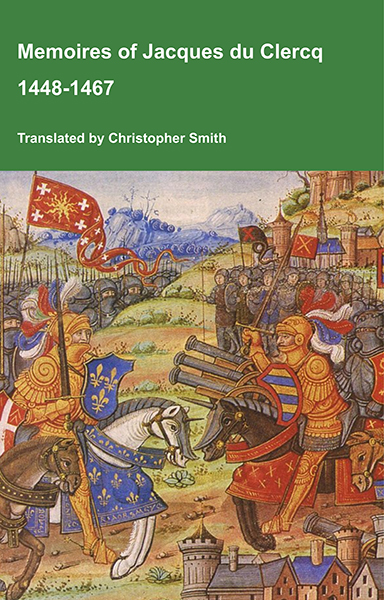
This is a translation of the 'Memoires of Jacques du Clercq', published in 1823 in two volumes, edited by Frederic, Baron de Reissenberg. In his introduction Reissenberg writes: 'Jacques du Clercq tells us that he was born in 1424, and that he was a licentiate in law and a counsellor to Philip the Good, Duke of Burgundy, in the castellany of Douai, Lille, and Orchies. It appears that he established his residence at Arras. In 1446, he married the daughter of Baldwin de la Lacherie, a gentleman who lived in Lille. We read in the fifth book of his Memoirs that his father, also named Jacques du Clercq, had married a lady of the Le Camelin family, from Compiègne. His ancestors, always attached to the counts of Flanders, had constantly served them, whether in their councils or in their armies.' The Memoires cover a period of nineteen years beginning in in 1448, ending in in 1467. It appears that the author had intended to extend the Memoirs beyond that date; no doubt illness or death prevented him from carrying out this plan. As Reissenberg writes the 'merit of this work lies in the simplicity of its narrative, in its tone of good faith, and in a certain air of frankness which naturally wins the reader’s confidence.' Du Clercq ranges from events of national and international importance, including events of the Wars of the Roses in England, to simple, everyday local events such as marriages, robberies, murders, trials and deaths, including that of his own father in Book 5; one of his last entries.
Available at Amazon in eBook and Paperback format.
The victory led to immediate peace, and completed the ruin of the cause of Louis, already disastrously affected by the battle of Lincoln. The English, both of that and later generations, how- ever, were impressed most of all with its importance as bringing to a close the career of Eustace the Monk. To them his overthrow and death was such an unlooked-for stroke of good fortune that it could be explained only as a special interposition of God. Accordingly round the historical occurrences connected with the battle of Sandwich and the life of Eustace grew up legends which vividly reflect the deep impression made by these events upon the English.
Walter of Hemingburgh, who died after 1313, followed by Knighton, who died about 1366, gives an account under 1217 of a certain tyrant of Spain, surnamed Monachus, who, after gathering much booty and subjugating many places, longed for the conquest of England, particularly upon hearing that it was ruled by a child. When he was still far off the coast, with a large fleet and an enormous equipment, the sailors of the ports learned of his approach and feared him by reason of the great evil that was reported of him. They said: 'If he lands he will devastate everything, for the country is not prepared and the king is distant. So we will take our life in our hands and meet him at sea; valour is not all, and aid will come to us from on high" A volunteer was instructed to climb the mast of the tyrant's ship and cut down the sail with an axe so as to deprive the fleet of the guidance of its leading ship. God gave the enemy into their hands, and after many were drowned and killed they returned with joy bearing great booty. So the youthful king was saved145.
Note 145. 145 Hemingburgh, Chronicon (ed. H. C. Hamilton), i. 260-1; Knighton, Chronicon (ed. J. R. Lumby), i. 205-6.
In this narrative one notices especially the entire absence of any mention of Louis: the central figure is Eustace, who is overcome only with divine assistance. A still more start- ling variation appears in another chronicle of about the same date, c. 1313, the Polistorie de Jean de Cantorbéry146 In this account we are told that in the year 1217, on the day of Saint Bartholomew the Apostle, there came toward Sandwich with a great fleet a monk named Eustace, accompanied with many great lords who hoped to possess the land, and with that idea brought their wives and even children in the cradle. They trusted, rather to their leader's knowledge of magic than to their own might. Upon their entering the harbour of Sandwich their numerous ships could all be seen except that of the leader, which was invisible. The people of Sandwich despaired of resistance except by God's help, and to that intent prayed to Him that out of love for Saint Bartholomew, whose day it was, He would save them. They also vowed a chapel with a perpetual chantry in honour of the saint if he would secure the victory for them. 'At that time there was in the town a man named Stephen Crabbe who had previously been very intimate with the monk surnamed Eustace.' Out of love for Stephen, Eustace had taught him much magic. Crabbe heard the lamentations, and said to the chiefs of the commune that he would give his life to save the city the disgrace of allowing Eustace to enter England at that port. Stephen accordingly embarked in a vessel, and leaped aboard that of Eustace. Then he cut off Eustace's head, and at once every one could see the ship clearly which heretofore had been invisible. Stephen was killed. A great tempest blew off shore, harming no one on land, but causing the hostile ships to founder. Saint Bartholomew appeared in the air to the inhabitants at the time and assured them that they had nothing to fear.
Note 146. Cf. T. Duffus Hardy, Descriptive Catalogue, iii. 350-1; Meyer, Guillaume le Maréchal, iii. 247, 1; Petit-Dutaillis, Louis VIII, 168-9. This part is quoted in Wistasse, pp. xvii—xix.
The portion of the story which describes the plan of the lords to settle in England, for which purpose they had brought their wives and even their infants, and also the foundering of their fleet from the force of a great tempest, is simply a confusion in the legend of the battle of Sandwich with the attempted arrival of Hugh de Bove's party in England in the year 1215, so graphically described, even to the cradles, by Roger of Wendover147. Hugh de Bove had, moreover, been an old partner in deeds of daring with Eustace, being included in the number of proscribed persons whom the count of Boulogne had sworn to attempt to deliver to King Philip148. The substitution of Eustace for Hugh, and the confusion of the storm and the battle, explain much of the legend.
Note 147. Flores Historiarum, iil. 332-3; cf. Chronica de Mailros, 119-20.
Note 148. See p. 652, n. 23.
The rest of the account deals with Eustace's skill in magic, his death at the hands of Stephen Crabbe, and the religious element of divine aid and the appearance of Saint Bartholomew. The belief in the magic skill of Eustace was probably existent in his own day, and undoubtedly so by the time of the composition of the Romance of Eustace. Crabbe's true share in the death of Eustace we have previously considered; and this account is a natural variation with the addition of the magical element. The emphasis upon the miraculous element is explicable by a reference to the next paragraph of the text which now remains to be considered. It is entitled 'Concerning the Hospital of St. Bartholomew Founded Near Sandwich ', and is as follows:
After the people of Sandwich had thus secured the victory over Eustace and their enemies, they bought, at the expense of the commune, a site not far from the town and had built there a chapel dedicated to St. Bartholomew. They erected houses near by for the aged of both sexes of the town who might chance to fall into poverty, and they bought some lands and rents for the hospital to support for ever the aged poor who should dwell there, and to support devoutly the chantry. Moreover they ordained among themselves, that every year on the day of St. Bartholomew the commune should meet in the city of Sandwich and make a solemn procession to the aforesaid hospital with tapers in their hands.
The reader will recall the contemporary extract given above from Guillaume le Maréchal, where is recorded the determination of the marshal to found such a hospital from the remainder of the spoils, and also the obedience of the sailors to this wish. Even the marshal believed that Saint Bartholomew had secured them the victory149. So the legend stands out not only as an evidence of the faith of after generations in the miraculous aid at the battle of Sandwich, but as a record of the belief most sincerely held by contemporaries. The Hospital of Saint Bartholomew, concerning the circumstances of whose foundation there can be no doubt, still exists in its original location, faithfully performing the functions assigned to it almost seven centuries ago. Its custumal, dating from 1301, agrees in important particulars with the account given above from the Polistorie150. The hospital itself stands a silent witness of the faith of its founders and of the deep impression made upon them by the signal victory.
Note 149. Page 667, n. 144 above; compare also especially ii, Il. 1752740, and iii. 248, n. 2.
Note 150. The custumal is to be found in William Boys, Collections for an History of Sandwich in Kent (Canterbury, 1792); the date is discussed on p. v. The seal of the hospital, attached to a deed of 1225, mentioned in Boys, 114, can no longer be found 'in the archives of the cathedral church of Canterbury', but the seal of 1317 is extant.