

Psalm 55 is in Book of Psalms.
1 Listen to my prayer, O God, do not ignore my plea;
2 hear me and answer me. My thoughts trouble me and I am distraught
3 because of what my enemy is saying, because of the threats of the wicked; for they bring down suffering on me and assail me in their anger.
4 My heart is in anguish within me; the terrors of death have fallen on me.
5 Fear and trembling have beset me; horror has overwhelmed me.
6 I said, "Oh, that I had the wings of a dove! I would fly away and be at rest.
7 I would flee far away and stay in the desert;
8 I would hurry to my place of shelter, far from the tempest and storm."
9 Lord, confuse the wicked, confound their words, for I see violence and strife in the city.
10 Day and night they prowl about on its walls; malice and abuse are within it.
11 Destructive forces are at work in the city; threats and lies never leave its streets.
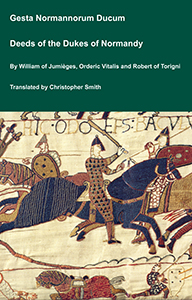
The Deeds of the Dukes of Normandy
The Gesta Normannorum Ducum [The Deeds of the Dukes of Normandy] is a landmark medieval chronicle tracing the rise and fall of the Norman dynasty from its early roots through the pivotal events surrounding the Norman Conquest of England. Originally penned in Latin by the monk William of Jumièges shortly before 1060 and later expanded at the behest of William the Conqueror, the work chronicles the deeds, politics, battles, and leadership of the Norman dukes, especially William’s own claim to the English throne. The narrative combines earlier historical sources with firsthand information and oral testimony to present an authoritative account of Normandy’s transformation from a Viking settlement into one of medieval Europe’s most powerful realms. William’s history emphasizes the legitimacy, military prowess, and governance of the Norman line, framing their expansion, including the conquest of England, as both divinely sanctioned and noble in purpose. Later chroniclers such as Orderic Vitalis and Robert of Torigni continued the history, extending the coverage into the 12th century, providing broader context on ducal rule and its impact. Today this classic work remains a foundational source for understanding Norman identity, medieval statesmanship, and the historical forces that reshaped England and Western Europe between 800AD and 1100AD.
Available at Amazon in eBook and Paperback format.
12 If an enemy were insulting me, I could endure it; if a foe were rising against me, I could hide.
13 But it is you, a man like myself, my companion, my close friend,
14 with whom I once enjoyed sweet fellowship at the house of God, as we walked about among the worshipers.
15 Let death take my enemies by surprise; let them go down alive to the realm of the dead, for evil finds lodging among them.
16 As for me, I call to God, and the Lord saves me.
17 Evening, morning and noon I cry out in distress, and he hears my voice.
18 He rescues me unharmed from the battle waged against me, even though many oppose me.
19 God, who is enthroned from of old, who does not change-he will hear them and humble them, because they have no fear of God.
20 My companion attacks his friends; he violates his covenant.
21 His talk is smooth as butter, yet war is in his heart; his words are more soothing than oil, yet they are drawn swords.
22 Cast your cares on the Lord and he will sustain you; he will never let the righteous be shaken.
23 But you, God, will bring down the wicked into the pit of decay; the bloodthirsty and deceitful will not live out half their days. But as for me, I trust in you.